
We read your photo as:
A substance dissociates through a first-order reaction with a half-life of 32 ext min. If the initial concentration of the substance is 2.7 imes 1010 ext molecules/L, what will be the concentration 2.
ScanSolve AI Answer
Step-by-step solution
7 stepsHere are the solutions for the questions in the image.
2ai) A substance dissociates through a first-order reaction with a half-life of . If the initial concentration of the substance is , what will be the concentration later?
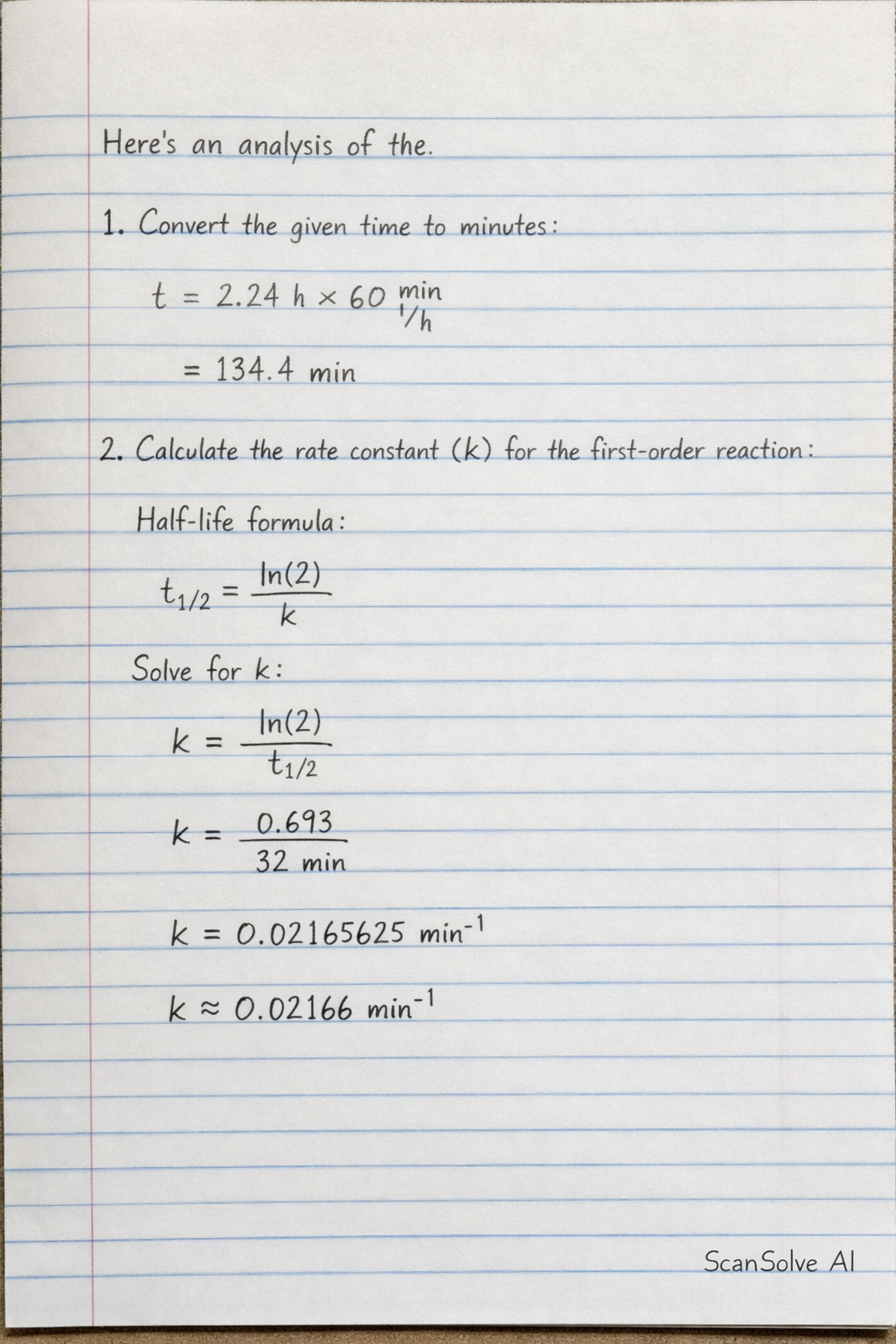
Convert the given time to minutes.
The half-life is in minutes, so we convert the total time from hours to minutes for consistency.
Calculate the rate constant () for the first-order reaction.
For a first-order reaction, the half-life () is related to the rate constant () by the formula:
Rearranging to solve for :
Use the integrated rate law for a first-order reaction to find the concentration at time .
The integrated rate law is:
Where is the concentration at time , and is the initial concentration. This can also be written as:
Substitute the known values into the integrated rate law.
Round the final answer to two significant figures, consistent with the given data.
ii) Express the rate of the following reaction in terms of the formation of ammonia: .
Write the general rate expression for the reaction.
The rate of reaction is expressed as the change in concentration of a reactant or product over time, divided by its stoichiometric coefficient. Reactants have a negative sign because their concentration decreases.
Express the rate specifically in terms of the formation of ammonia.
The formation of ammonia is represented by the term . To express the overall rate of reaction in terms of this, we use the coefficient.
Still stuck on this one?
Ask a follow-up, and the answer starts from this question.
More Chemistry Questions
Handwritten Step-by-Step Solution
Get this as a handwritten image on WhatsApp — like a tutor wrote it for you.
Try on WhatsApp