

This chemistry question involves key chemical concepts and calculations. The detailed solution below walks through each step, from identifying the reaction type to computing the final answer.
ScanSolve AI Answer
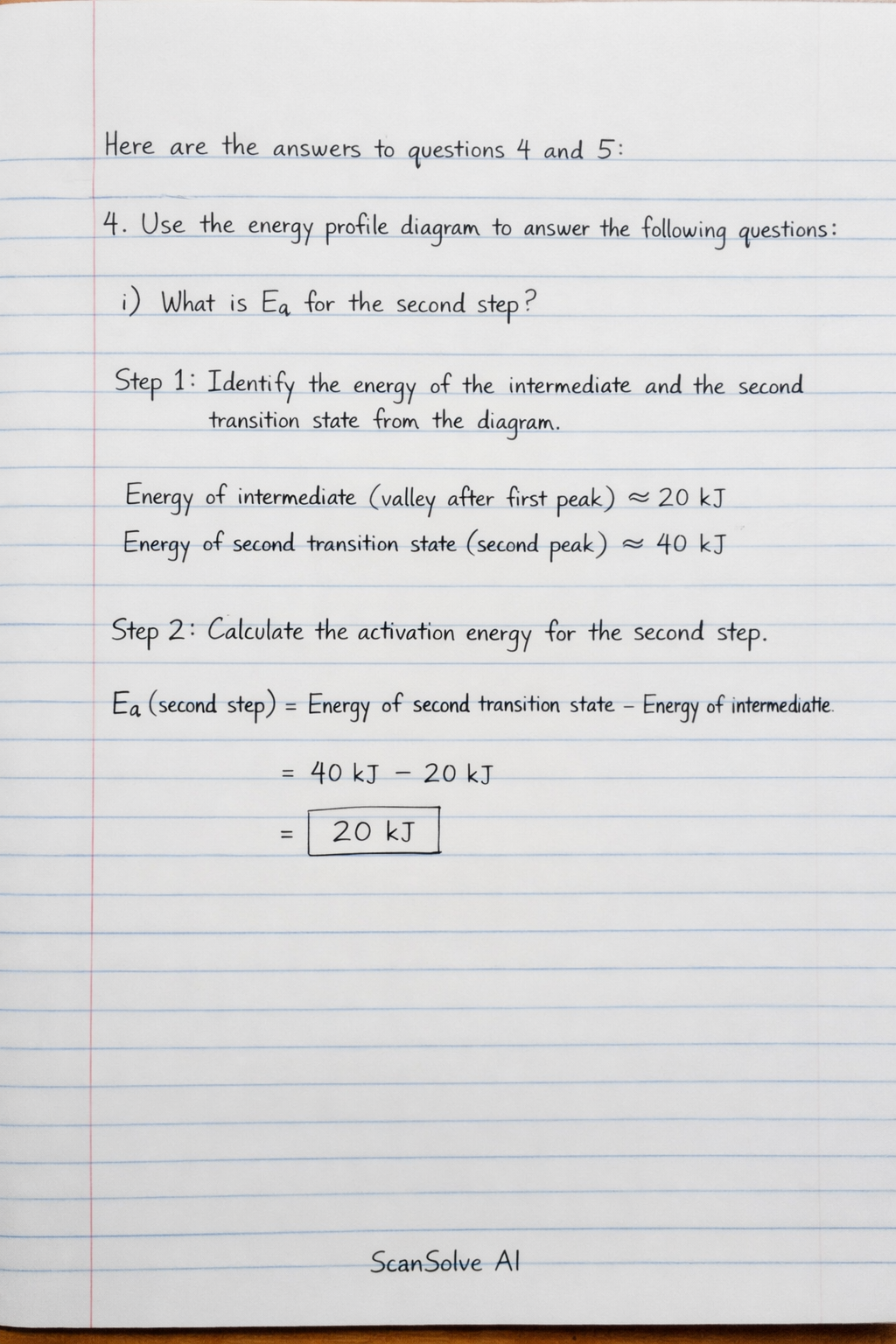
Here are the answers to questions 4 and 5: 4. Use the energy profile diagram to answer the following questions: i) What is E_a for the second step? Step 1: Identify the energy of the intermediate and the second transition state from the diagram. Energy of intermediate (valley after first peak) ≈ 20 kJ Energy of second transition state (second peak) ≈ 40 kJ Step 2: Calculate the activation energy for the second step. E_a(second step) = Energy of second transition state - Energy of intermediate E_a(second step) = 40 kJ - 20 kJ = 20 kJ ii) Which is the rate-determining step? How do you know? Step 1: Calculate the activation energy for the first step. Energy of reactants ≈ 10 kJ Energy of first transition state (first peak) ≈ 50 kJ E_a(first step) = Energy of first transition state - Energy of reactants E_a(first step) = 50 kJ - 10 kJ = 40 kJ Step 2: Compare the activation energies. The first step has an activation energy of 40 kJ, and the second step has an activation energy of 20 kJ. The first step is the rate-determining step because it has the highest activation energy. iii) Is the overall reaction endothermic or exothermic? Step 1: Determine the overall change in enthalpy ( H_overall). Energy of products ≈ 0 kJ Energy of reactants ≈ 10 kJ H_overall = Energy of products - Energy of reactants H_overall = 0 kJ - 10 kJ = -10 kJ Since the overall change in enthalpy is negative, the overall reaction is exothermic. iv) What is H for the first step of the reaction mechanism? Step 1: Determine the enthalpy change for the first step. Energy of intermediate ≈ 20 kJ Energy of reactants ≈ 10 kJ H_first step = Energy of intermediate - Energy of reactants H_first step = 20 kJ - 10 kJ = 10 kJ v) What is H for the overall reaction? Step 1: Determine the overall change in enthalpy ( H_overall). Energy of products ≈ 0 kJ Energy of reactants ≈ 10 kJ H_overall = Energy of products - Energy of reactants H_overall = 0 kJ - 10 kJ = -10 kJ 5b) Obtain units of rate constant 'k' for: The general unit for the rate constant k is M^1-ns^-1, where n is the order of the reaction and M represents molarity (mol/L). i) second order reaction For a second-order reaction, n=2. Units of k = M^1-2s^-1 = M^-1s^-1 = L mol^-1s^-1 ii) third order reaction For a third-order reaction, n=3. Units of k = M^1-3s^-1 = M^-2s^-1 = L^2mol^-2s^-1 iii) half-order reaction when concentration is express in mol/L. For a half-order reaction, n=0.5. Units of k = M^1-0.5s^-1 = M^0.5s^-1 = mol^0.5L^-0.5s^-1 That's all for this one! What's next?