
We read your photo as:
The reaction: 2A(g) + B(g) → 2C(g) was studied at 80 °C and the following results were obtained. What is the order of reaction with respect to: (α) A? (β) B? What is the overall order of reaction?
ScanSolve AI Answer
Step-by-step solution
5 stepsHere are the solutions to the questions:
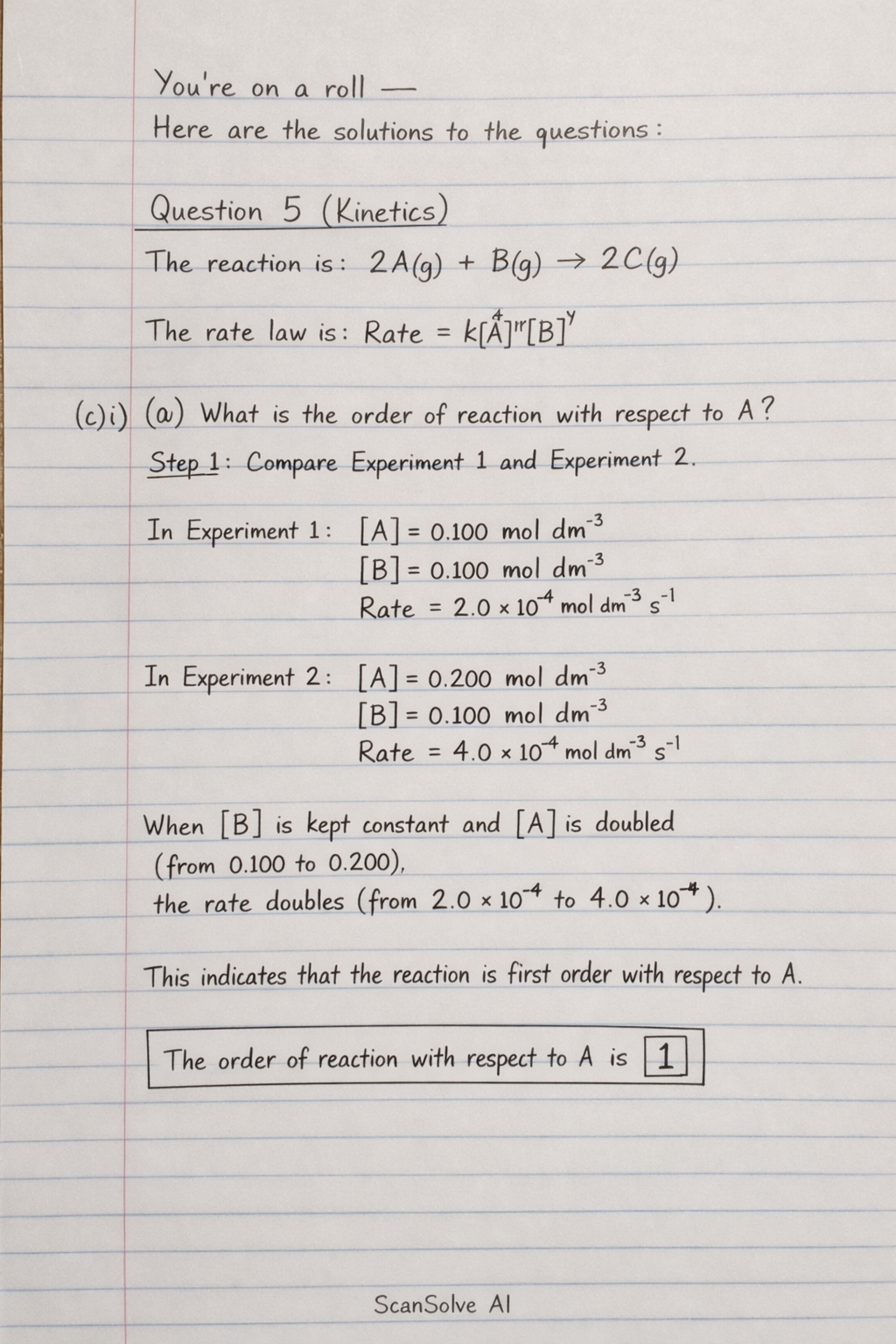
Question 5 (Kinetics)
The reaction is . The rate law can be expressed as .
(c)(i)
- (α) What is the order of reaction with respect to A?
Compare Experiment 1 and Experiment 2.
In Experiment 1, $[\text{A}] = 0.100 \text{ mol dm}^{-3}$, $[\text{B}] = 0.100 \text{ mol dm}^{-3}$, Rate $= 2.0 \times 10^{-4} \text{ mol dm}^{-3}\text{s}^{-1}$. In Experiment 2, $[\text{A}] = 0.200 \text{ mol dm}^{-3}$, $[\text{B}] = 0.100 \text{ mol dm}^{-3}$, Rate $= 4.0 \times 10^{-4} \text{ mol dm}^{-3}\text{s}^{-1}$. When $[\text{B}]$ is kept constant and $[\text{A}]$ is doubled (from 0.100 to 0.200), the rate doubles (from $2.0 \times 10^{-4}$ to $4.0 \times 10^{-4}$). This indicates that the reaction is first order with respect to A. The order of reaction with respect to A is $\boxed{\text{1}}$.- (β) What is the order of reaction with respect to B?
Compare Experiment 2 and Experiment 3.
In Experiment 2, $[\text{A}] = 0.200 \text{ mol dm}^{-3}$, $[\text{B}] = 0.100 \text{ mol dm}^{-3}$, Rate $= 4.0 \times 10^{-4} \text{ mol dm}^{-3}\text{s}^{-1}$. In Experiment 3, $[\text{A}] = 0.200 \text{ mol dm}^{-3}$, $[\text{B}] = 0.200 \text{ mol dm}^{-3}$, Rate $= 1.6 \times 10^{-3} \text{ mol dm}^{-3}\text{s}^{-1}$. When $[\text{A}]$ is kept constant and $[\text{B}]$ is doubled (from 0.100 to 0.200), the rate increases by a factor of $\frac{1.6 \times 10^{-3}}{4.0 \times 10^{-4}} = 4$. Since doubling $[\text{B}]$ quadruples the rate, the reaction is second order with respect to B. The order of reaction with respect to B is $\boxed{\text{2}}$.(c)(ii)
- What is the overall order of reaction? The overall order of reaction is the sum of the individual orders with respect to each reactant. Overall order . The overall order of reaction is .
Question 5 (Thermodynamics & Hybridization)
(a)
Hess's law of constant heat summation states that the total enthalpy change for a chemical reaction is independent of the pathway taken, as long as the initial and final conditions are the same. It means that if a reaction can be expressed as a sum of several steps, the enthalpy change for the overall reaction is the sum of the enthalpy changes for each step.(b)
The thermochemical equations for the given statements are:- (i) Standard enthalpy of formation of LiF is -617 kJ mol.
- (ii) Atomization energy of Li is +161 kJ mol.
- (iii) Ionisation energy of Li is +520 kJ mol.
- (iv) Dissociation energy of F is +79 kJ mol.
- (v) Electron affinity of F is -328 kJ mol.
(c)(i)
- Use the thermochemical equations in (b) to draw an energy cycle. The Born-Haber cycle for the formation of LiF is shown below: (Note: The arrows for and should point downwards, indicating exothermic processes for formation and lattice energy, respectively, as drawn in the cycle above. The cycle starts from elements in standard states, goes through gaseous ions, and then forms the ionic solid.)
(c)(ii)
- Using Hess's law, write an equation relating all the energy terms in (b). According to Hess's Law, the enthalpy of formation of LiF is equal to the sum of the enthalpy changes in the Born-Haber cycle:
(c)(iii)
- Using the equation in (ii) calculate the lattice energy of LiF.
Substitute the given values into the equation from (ii).
$$ -617 \text{ kJ mol}^{-1} = (+161 \text{ kJ mol}^{-1}) + (+520 \text{ kJ mol}^{-1}) + (+39.5 \text{ kJ mol}^{-1}) + (-328 \text{ kJ mol}^{-1}) + \Delta H_{lattice} $$Sum the known enthalpy changes.
$$ -617 = 161 + 520 + 39.5 - 328 + \Delta H_{lattice} $$ $$ -617 = 392.5 + \Delta H_{lattice} $$Solve for .
$$ \Delta H_{lattice} = -617 - 392.5 $$ $$ \Delta H_{lattice} = -1009.5 \text{ kJ mol}^{-1} $$ The lattice energy of LiF$_{(s)}$ is $\boxed{\text{-1009.5 kJ mol}^{-1}\text{}}$.(d)(i)
- Give the type of hybridization shown by the central atoms in each of the following compounds:
- BCl: The central atom is Boron (B). Boron has 3 valence electrons and forms 3 single bonds with chlorine atoms. There are no lone pairs on boron. The steric number is 3 (3 bonding pairs + 0 lone pairs), which corresponds to hybridization.
- NH: The central atom is Nitrogen (N). Nitrogen has 5 valence electrons and forms 3 single bonds with hydrogen atoms, leaving 1 lone pair. The steric number is 4 (3 bonding pairs + 1 lone pair), which corresponds to hybridization.
- HO: The central atom is Oxygen (O). Oxygen has 6 valence electrons and forms 2 single bonds with hydrogen atoms, leaving 2 lone pairs. The steric number is 4 (2 bonding pairs + 2 lone pairs), which corresponds to hybridization.
(d)(ii)
- Deduce the shape of each of the molecules in (i):
- BCl: With 3 bonding pairs and 0 lone pairs around the central boron atom, the electron geometry and molecular geometry are both trigonal planar. The shape is .
- NH: With 3 bonding pairs and 1 lone pair around the central nitrogen atom, the electron geometry is tetrahedral, but the molecular geometry is trigonal pyramidal due to the repulsion from the lone pair. The shape is .
- HO: With 2 bonding pairs and 2 lone pairs around the central oxygen atom, the electron geometry is tetrahedral, but the molecular geometry is bent (or V-shaped) due to the repulsion from the two lone pairs. The shape is .
- Give the type of hybridization shown by the central atoms in each of the following compounds:
Still stuck on this one?
Ask a follow-up, and the answer starts from this question.
More Chemistry Questions
Handwritten Step-by-Step Solution
Get this as a handwritten image on WhatsApp — like a tutor wrote it for you.
Try on WhatsApp