
We read your photo as:
Which element on the periodic table possesses the highest electronegativity value, making it the most reactive non-metal?
ScanSolve AI Answer
Answer
Step-by-step solution
4 stepsThe question asks for the element with the highest electronegativity value, making it the most reactive non-metal.
Understand electronegativity trends.
Electronegativity is the measure of an atom's ability to attract electrons in a chemical bond. On the periodic table, electronegativity generally increases from left to right across a period and decreases from top to bottom down a group.
Identify the most electronegative element.
Fluorine (F) is located in the top right corner of the periodic table (excluding noble gases) and has the highest electronegativity value of all elements.
Relate electronegativity to non-metal reactivity.
Non-metals tend to gain electrons to achieve a stable electron configuration. A higher electronegativity means a stronger pull for electrons, making the non-metal more reactive in forming bonds by gaining electrons. Therefore, the element with the highest electronegativity will be the most reactive non-metal.
Evaluate the given options.
- A. Helium is a noble gas and is very unreactive, with a very low or undefined electronegativity.
- B. Oxygen is highly electronegative, but less so than fluorine.
- C. Chlorine is electronegative, but less so than oxygen and fluorine.
- D. Fluorine has the highest electronegativity (4.0 on the Pauling scale) and is the most reactive non-metal.
The correct answer is D.
The final answer is
Try one yourself
A new problem that tests the same skill.
Still stuck on this one?
Ask a follow-up, and the answer starts from this question.
More Chemistry Questions
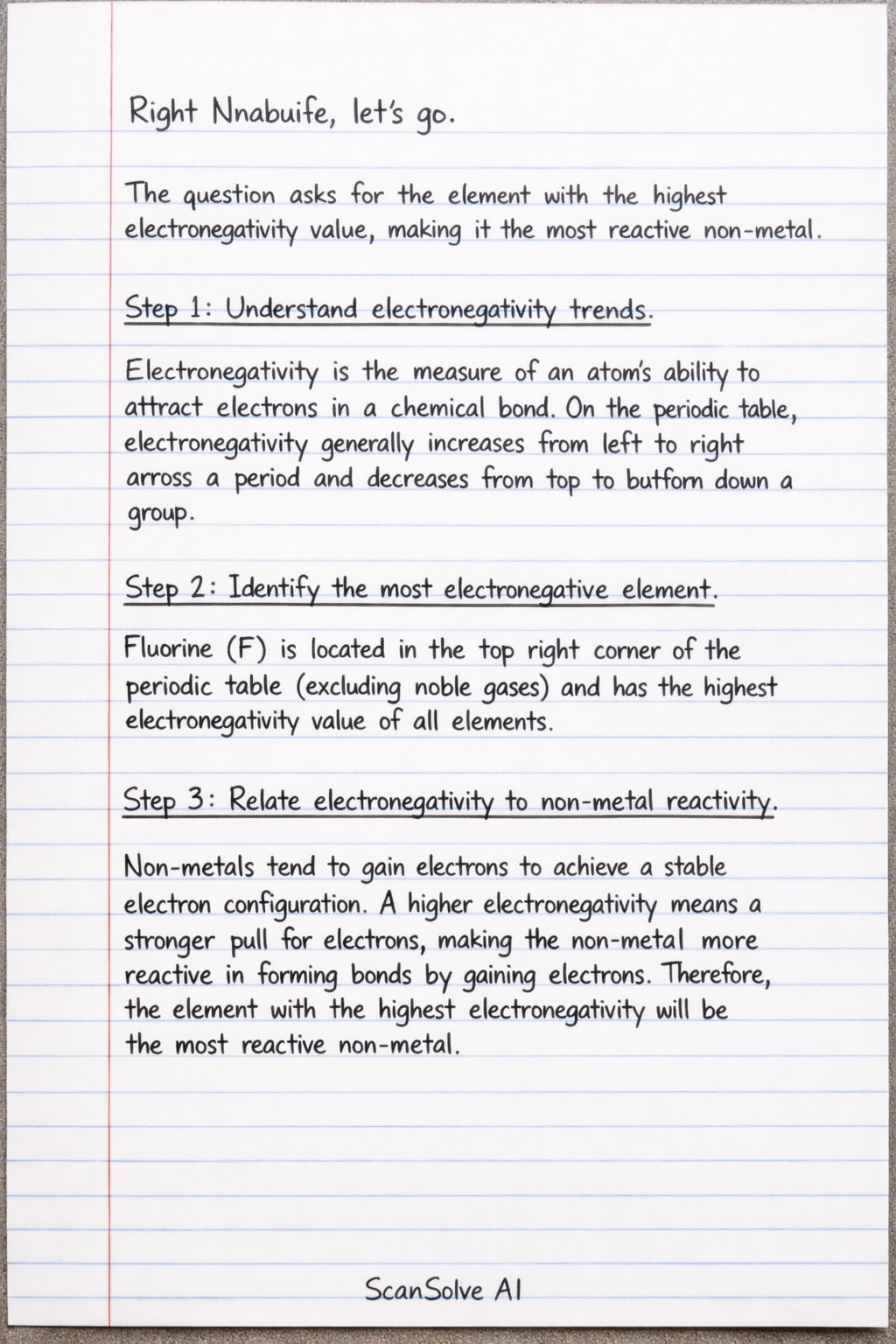
Handwritten Step-by-Step Solution
Get this as a handwritten image on WhatsApp — like a tutor wrote it for you.
Try on WhatsApp