
We read your photo as:
Calculate the amount of ethanoic acid in moles and the number of water molecules produced, given the molarity of ethanoic acid solution A is 0.100 mol dm-3.
ScanSolve AI Answer
Step-by-step solution
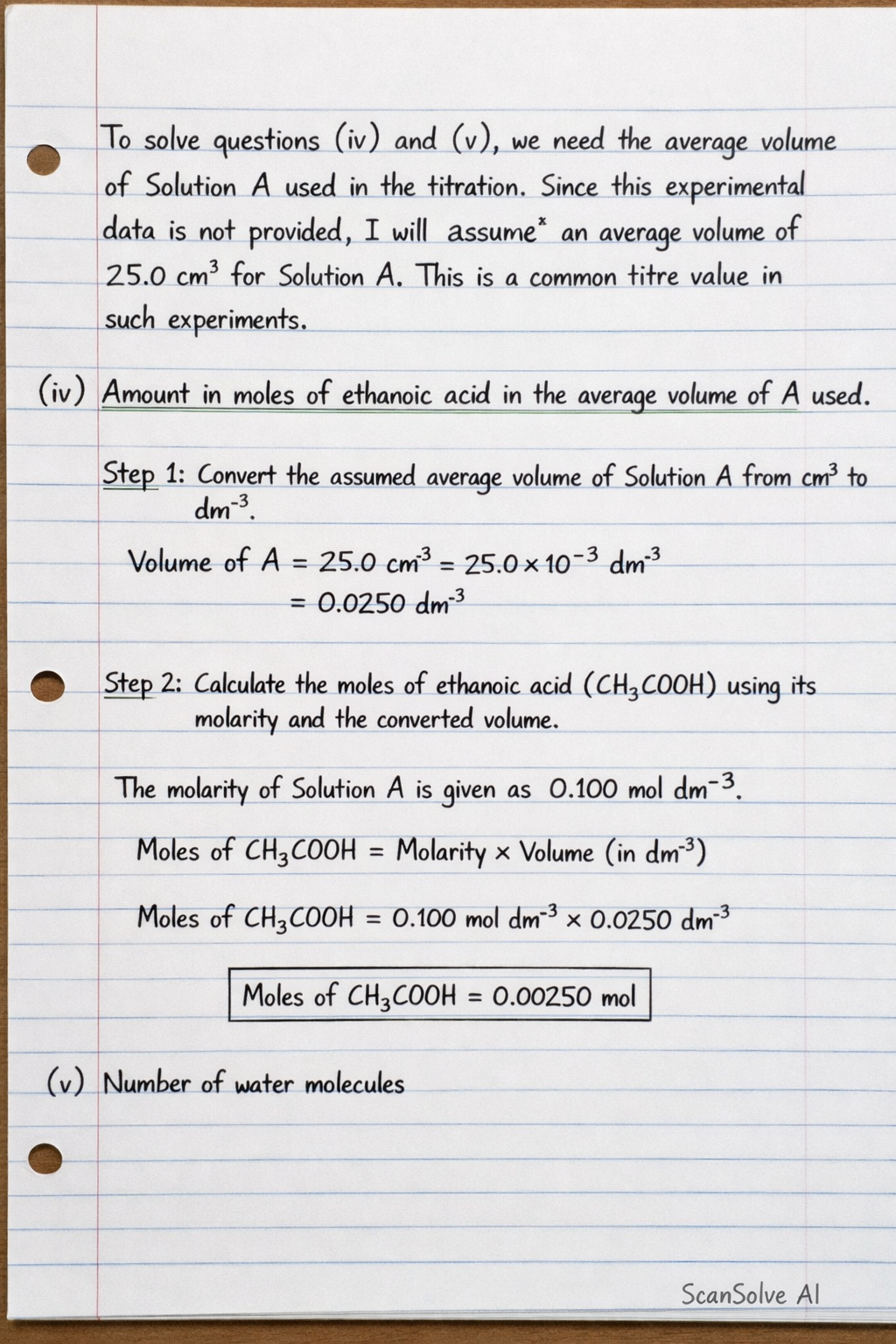
4 stepsTo solve questions (iv) and (v), we need the average volume of Solution A used in the titration. Since this experimental data is not provided, I will assume an average volume of for Solution A. This is a common titre value in such experiments.
Part iv· 2 steps
Amount in moles of ethanoic acid in the average volume of A used.
Convert the assumed average volume of Solution A from to .
Calculate the moles of ethanoic acid () using its molarity and the converted volume.
The molarity of Solution A is given as .
Part v· 2 steps
Number of water molecules
Determine the moles of water produced from the balanced chemical equation.
The balanced equation for the reaction is:
From the stoichiometry, 1 mole of reacts to produce 1 mole of .
Therefore, the moles of water produced are equal to the moles of ethanoic acid reacted:Calculate the number of water molecules using Avogadro's constant.
Avogadro's constant () is given as .
Rounding to three significant figures:
Still stuck on this one?
Ask a follow-up, and the answer starts from this question.
More Chemistry Questions
Handwritten Step-by-Step Solution
Get this as a handwritten image on WhatsApp — like a tutor wrote it for you.
Try on WhatsApp