

This chemistry question involves key chemical concepts and calculations. The detailed solution below walks through each step, from identifying the reaction type to computing the final answer.
ScanSolve AI Answer
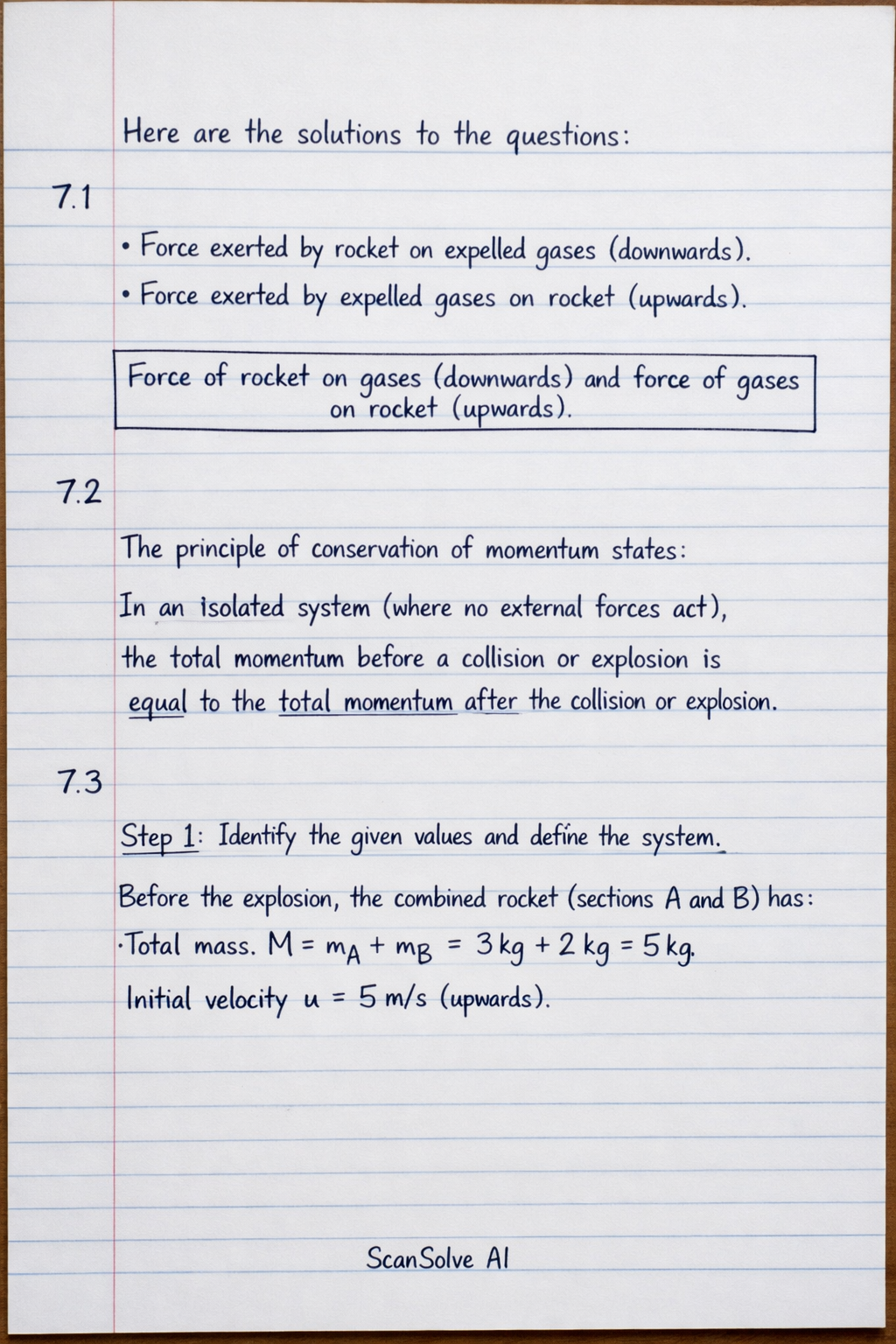
Here are the solutions to the questions: 7.1 An action-reaction pair of forces involved in the launching of the rocket is: • The force exerted by the rocket on the expelled gases (downwards). • The force exerted by the expelled gases on the rocket (upwards). Force of rocket on gases (downwards) and force of gases on rocket (upwards) 7.2 The principle of conservation of momentum states that in an isolated system (where no external forces act), the total momentum before a collision or explosion is equal to the total momentum after the collision or explosion. 7.3 Step 1: Identify the given values and define the system. Before the explosion, the combined rocket (sections A and B) has: Total mass M = m_A + m_B = 3 kg + 2 kg = 5 kg. Initial velocity u = 5 m · s^-1 (upwards). After the explosion: Mass of section A: m_A = 3 kg. Mass of section B: m_B = 2 kg. Velocity of section B: v_B = 8 m · s^-1 (upwards). Let the velocity of section A after the explosion be v_A. Step 2: Apply the principle of conservation of momentum. The total momentum before the explosion equals the total momentum after the explosion. Let upwards be the positive direction. M u = m_A v_A + m_B v_B (5 kg)(5 m · s^-1) = (3 kg) v_A + (2 kg)(8 m · s^-1) 25 kg · m · s^-1 = 3 v_A + 16 kg · m · s^-1 Step 3: Calculate the velocity of section A. 3 v_A = 25 - 16 3 v_A = 9 v_A = (9)/(3) v_A = 3 m · s^-1 Since v_A is positive, the direction is upwards. 3 m·s^-1 upwards That's 2 down. 3 left today — send the next one.