
We read your photo as:
An organic compound L is known to contain only C, H, and O. It gives a luminous sooty flame. When heated with aqueous NH3, it gives off a gas which turns limewater milky. It is also found that the par
Chemistry
ScanSolve AI Answer
Answer
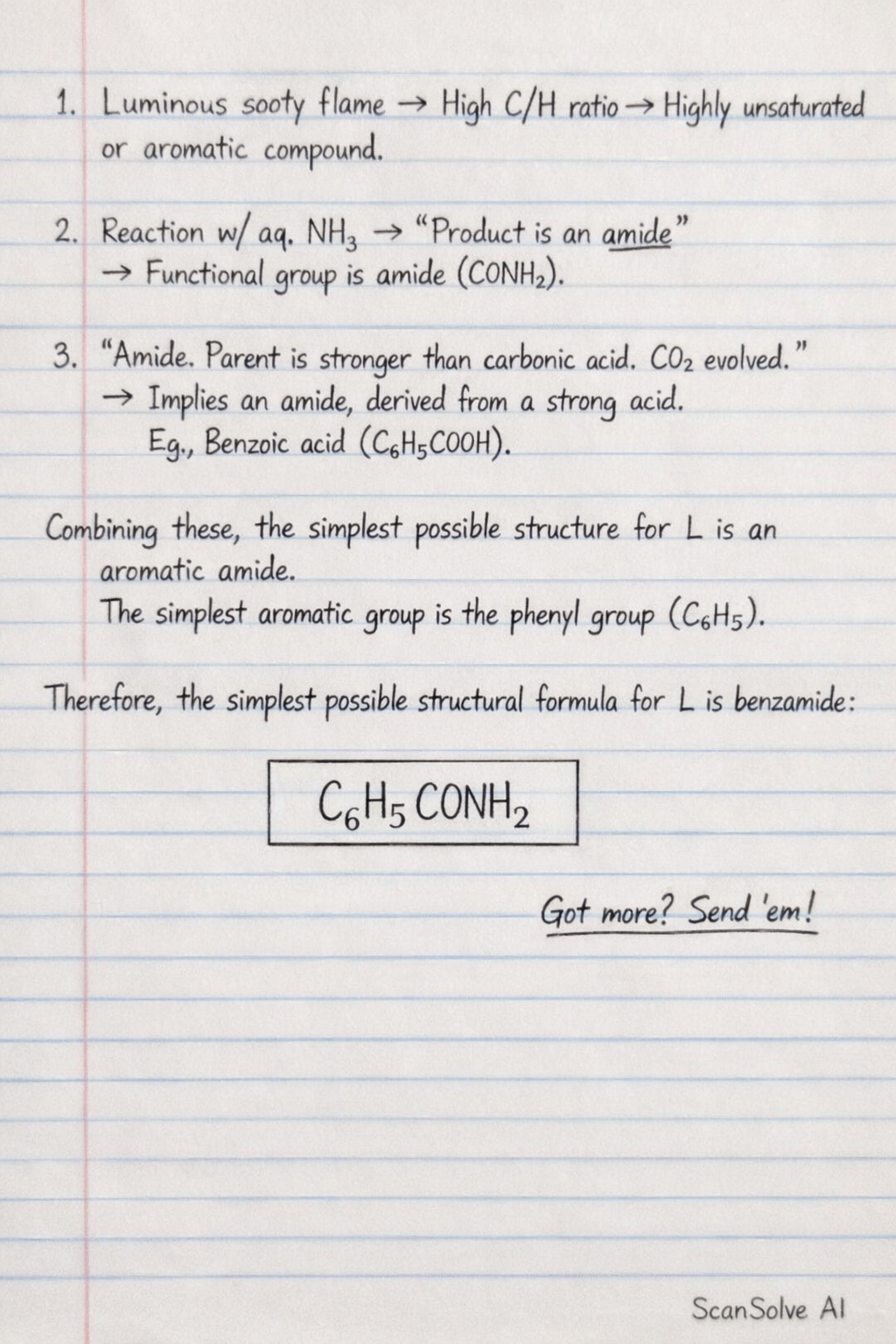
Based on the observations and inferences:
- The "luminous sooty flame" indicates a high carbon-to-hydrogen ratio, characteristic of a highly unsaturated or aromatic compound.
- The inference "Product is an amide" from the reaction with aqueous clearly identifies the functional group as an amide ().
- The inference "Substance is an amide. Parent is stronger than carbonic acid evolved" further confirms it is an amide and that the carboxylic acid from which it is derived is strong enough to react with carbonates. Benzoic acid is an example of such a parent acid.
Combining these, the simplest possible structural form for L is an aromatic amide. The simplest aromatic group is the phenyl group ().
Therefore, the simplest possible structural formula for L is benzamide:
Was this helpful?
Try one yourself
A new problem that tests the same skill.
Still stuck on this one?
Ask a follow-up, and the answer starts from this question.
Got a different question?Ask your own question
More Chemistry Questions
QState one use of carbon (IV) oxide, ammonia, and nitrogen gas. Name the organic compounds…QAn organic compound contains 59.0% C, 7.15% H, 26.20% O, and 7.65% N and has a molar mass of 183…QWhat inferences can be drawn from observing an organic solid melting and burning with a yellow…QAno organic compound contains 52.17%of carbon, 13% of hydrogen and the rest being oxygen. Given that…QFor an organic compound that does not react with both hydrogen cyanide (HCN) and hydroxylamine…
Browse by topic:Organic Chemistry
Handwritten Step-by-Step Solution
Get this as a handwritten image on WhatsApp — like a tutor wrote it for you.
Try on WhatsApp