
We read your photo as:
An organic compound contains 59.0% C, 7.15% H, 26.20% O, and 7.65% N and has a molar mass of 183 g/mol. What is its molecular formula? (Take C = 12, O = 16, H = 1, N = 14) N.B: Show all working
ScanSolve AI Answer
Answers
3 partsStep-by-step solution
9 stepsHere are the solutions to the questions:
Part 1· 6 steps
Molecular Formula
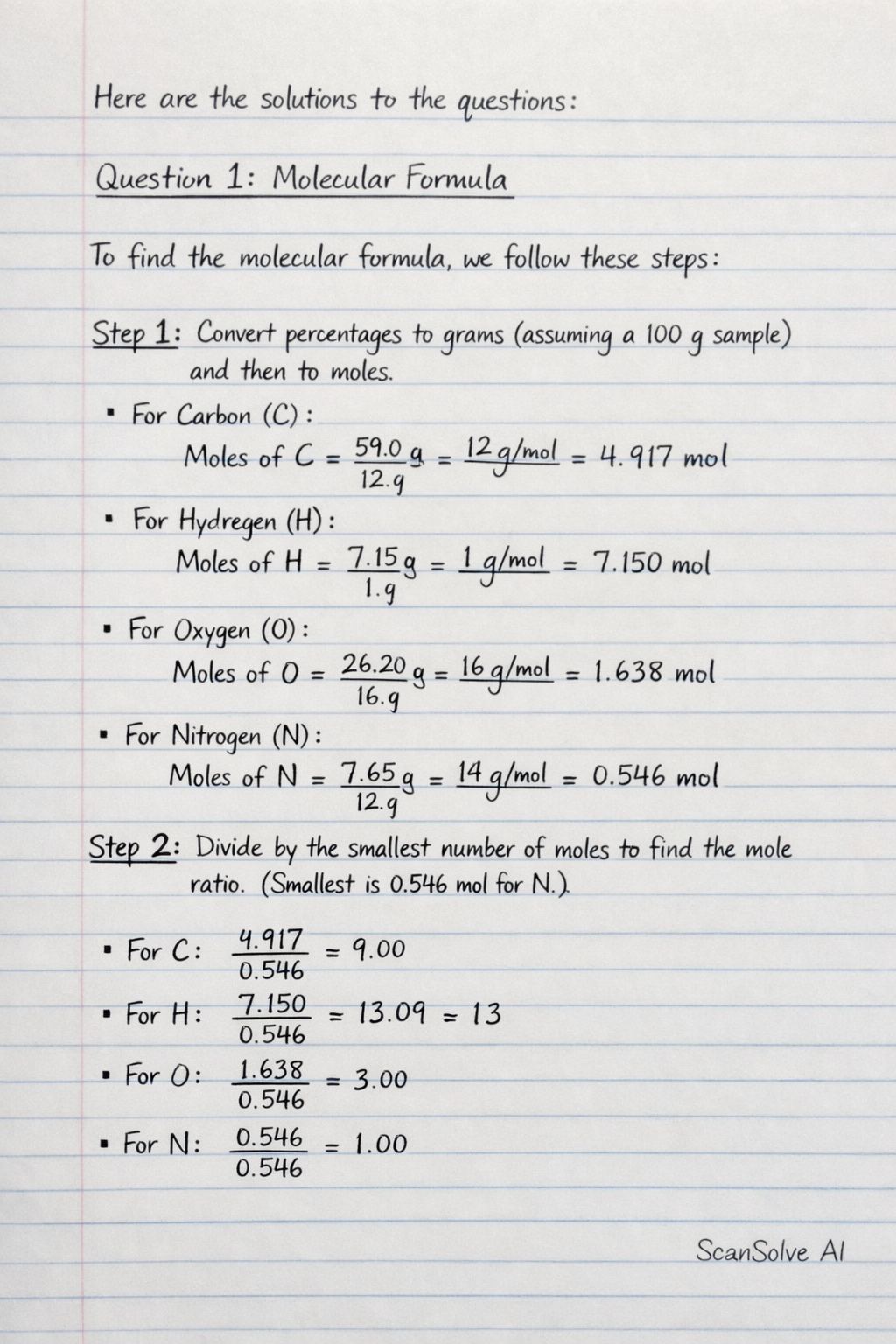
To find the molecular formula, we follow these steps:
Convert percentages to grams (assuming a 100 g sample) and then to moles.
- For Carbon (C):
- For Hydrogen (H):
- For Oxygen (O):
- For Nitrogen (N):
Divide by the smallest number of moles to find the mole ratio.
The smallest number of moles is (for N).
- For C:
- For H:
- For O:
- For N:
Write the empirical formula based on these ratios.
The empirical formula is .
Calculate the empirical formula mass.
Determine the ratio of the molar mass to the empirical formula mass.
Multiply the subscripts in the empirical formula by to get the molecular formula.
Since , the molecular formula is the same as the empirical formula.
The molecular formula is .
Part 2
Definition of Molecular Formula
A chemical formula that shows the actual number and kinds of atoms present in one molecule of a compound is called a molecular formula.
The answer is .
Part 3
Empirical Formula
To find the empirical formula from the molecular formula , we need to find the simplest whole-number ratio of the atoms.
Identify the subscripts for each element
C=8, H=10, N=4, O=2.
Find the greatest common divisor (GCD) of these subscripts.
The GCD of 8, 10, 4, and 2 is 2.
Divide each subscript by the GCD.
- For C:
- For H:
- For N:
- For O:
The empirical formula is .
Try one yourself
A new problem that tests the same skill.
Still stuck on this one?
Ask a follow-up, and the answer starts from this question.
More Chemistry Questions
Handwritten Step-by-Step Solution
Get this as a handwritten image on WhatsApp — like a tutor wrote it for you.
Try on WhatsApp