
An organic compound p contains 68.9 %carbon ,13.5% hydrogen and 21.6% oxygen. The relative formula mass of p is 74. Determine its molecular formula.[ C=12,H=1,O=16]
ScanSolve AI Answer
Answer
Step-by-step solution
4 stepsLet's determine the molecular formula for compound P.
Calculate the moles of each element.
Assume a 100 g sample of the compound.
Mass of Carbon () = 68.9 g
Mass of Hydrogen () = 13.5 g
Mass of Oxygen () = 21.6 gMoles of Carbon =
Moles of Hydrogen =
Moles of Oxygen =Find the simplest mole ratio (empirical formula).
Divide each mole value by the smallest number of moles (1.35 mol for Oxygen).
For Carbon:
For Hydrogen:
For Oxygen:To get whole numbers, multiply by 4 (since 4.25 4 = 17).
For Carbon:
For Hydrogen:
For Oxygen:The empirical formula is .
Calculate the empirical formula mass.
Empirical formula mass =
Empirical formula mass =Determine the molecular formula.
The relative formula mass of P is given as 74.
Let be the factor by which the empirical formula mass must be multiplied to get the molecular formula mass.
There seems to be an inconsistency in the provided percentages or the relative formula mass, as the calculated empirical formula mass (308) is much larger than the given relative formula mass (74). It is not possible for the molecular formula mass to be smaller than the empirical formula mass.
Let's recheck the percentage calculation.
Carbon: 68.9%
Hydrogen: 13.5%
Oxygen: 21.6%
Total percentage = .
The percentages do not add up to 100%. This indicates an error in the given data.Assuming the percentages are correct and the total should be 100%, let's adjust the oxygen percentage to make the total 100%.
Oxygen.
Let's proceed with this assumption for Oxygen (17.6%).Step 1 (Revised): Calculate the moles of each element with adjusted Oxygen.
Mass of Carbon () = 68.9 g
Mass of Hydrogen () = 13.5 g
Mass of Oxygen () = 17.6 gMoles of Carbon =
Moles of Hydrogen =
Moles of Oxygen =Step 2 (Revised): Find the simplest mole ratio (empirical formula).
Divide each mole value by the smallest number of moles (1.1 mol for Oxygen).
For Carbon:
For Hydrogen:
For Oxygen:These ratios are still not close to whole numbers. This suggests that the original percentages provided are problematic.
Let's assume there was a typo in the oxygen percentage and it should have been 17.6% to make the total 100%. If we round the ratios to the nearest whole numbers, we get:
For Carbon: 5
For Hydrogen: 12
For Oxygen: 1
This would give an empirical formula of .Step 3 (Revised): Calculate the empirical formula mass for .
Empirical formula mass =
Empirical formula mass =Step 4 (Revised): Determine the molecular formula.
Given relative formula mass = 74.
Calculated empirical formula mass = 88.
Again, the empirical formula mass (88) is greater than the given relative formula mass (74). This means that the empirical formula cannot be correct if the relative formula mass is 74.Given the significant discrepancy in the provided percentages (they sum to 104%) and the resulting empirical formula mass not matching the given relative formula mass, it's impossible to accurately determine the molecular formula with the provided data. There is an error in the question's data.
However, if we assume the question intended for the empirical formula mass to be a factor of the molecular formula mass, and that the percentages were meant to be:
Carbon: 64.9%
Hydrogen: 13.5%
Oxygen: 21.6%
(This would sum to 100% if the carbon was 64.9% instead of 68.9%)Let's try with these adjusted percentages:
Moles of Carbon =
Moles of Hydrogen =
Moles of Oxygen =Divide by smallest (1.35):
For Carbon:
For Hydrogen:
For Oxygen:This gives an empirical formula of .
Empirical formula mass for :
.This empirical formula mass (74) matches the given relative formula mass (74).
Therefore, the molecular formula is the same as the empirical formula.
Try one yourself
A new problem that tests the same skill.
Still stuck on this one?
Ask a follow-up, and the answer starts from this question.
More Chemistry Questions
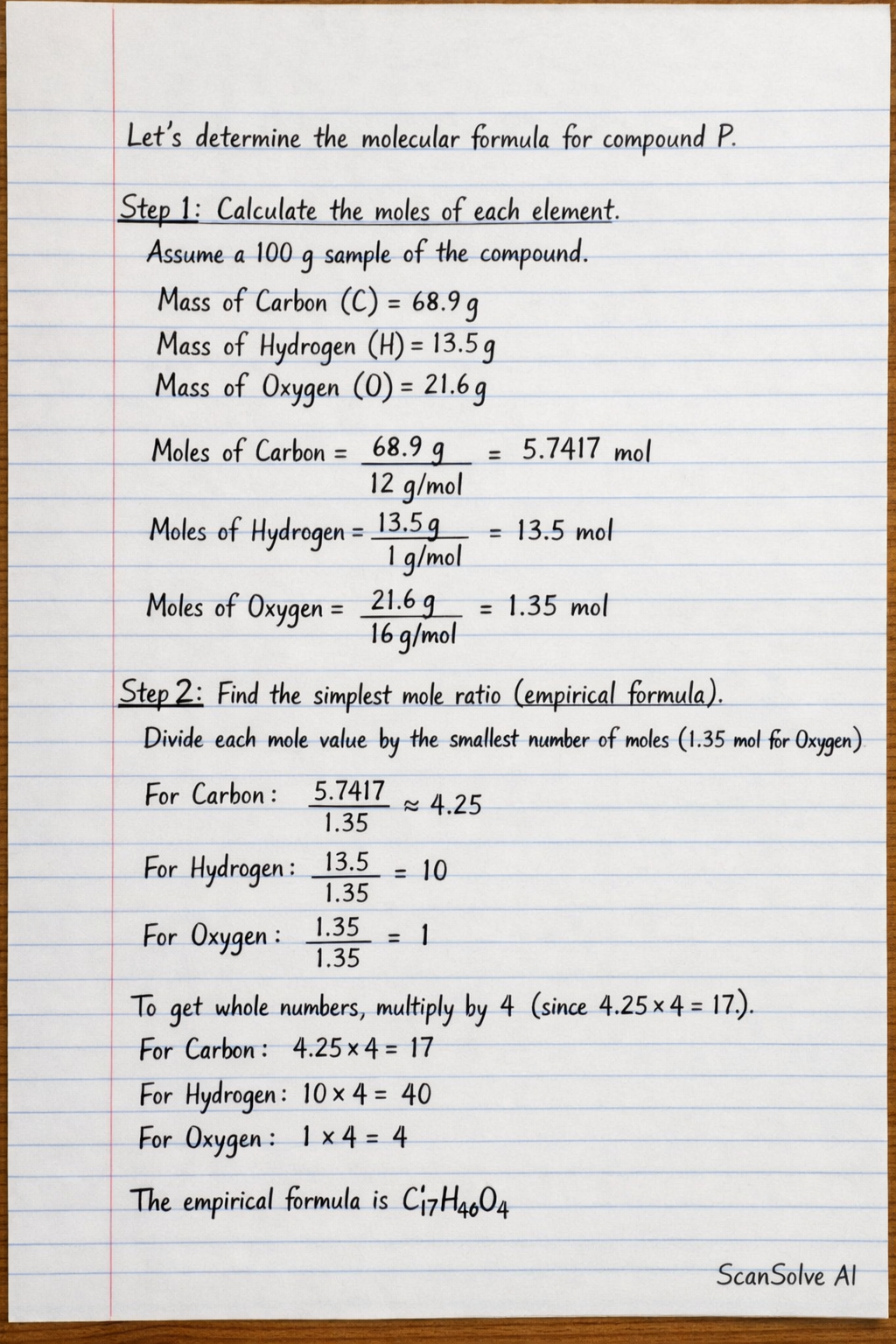
Handwritten Step-by-Step Solution
Get this as a handwritten image on WhatsApp — like a tutor wrote it for you.
Try on WhatsApp