
We read your photo as:
Draw a line graph to illustrate your results. What will be on the x-axis and what will be on the y-axis? Give your graph a heading.
ScanSolve AI Answer
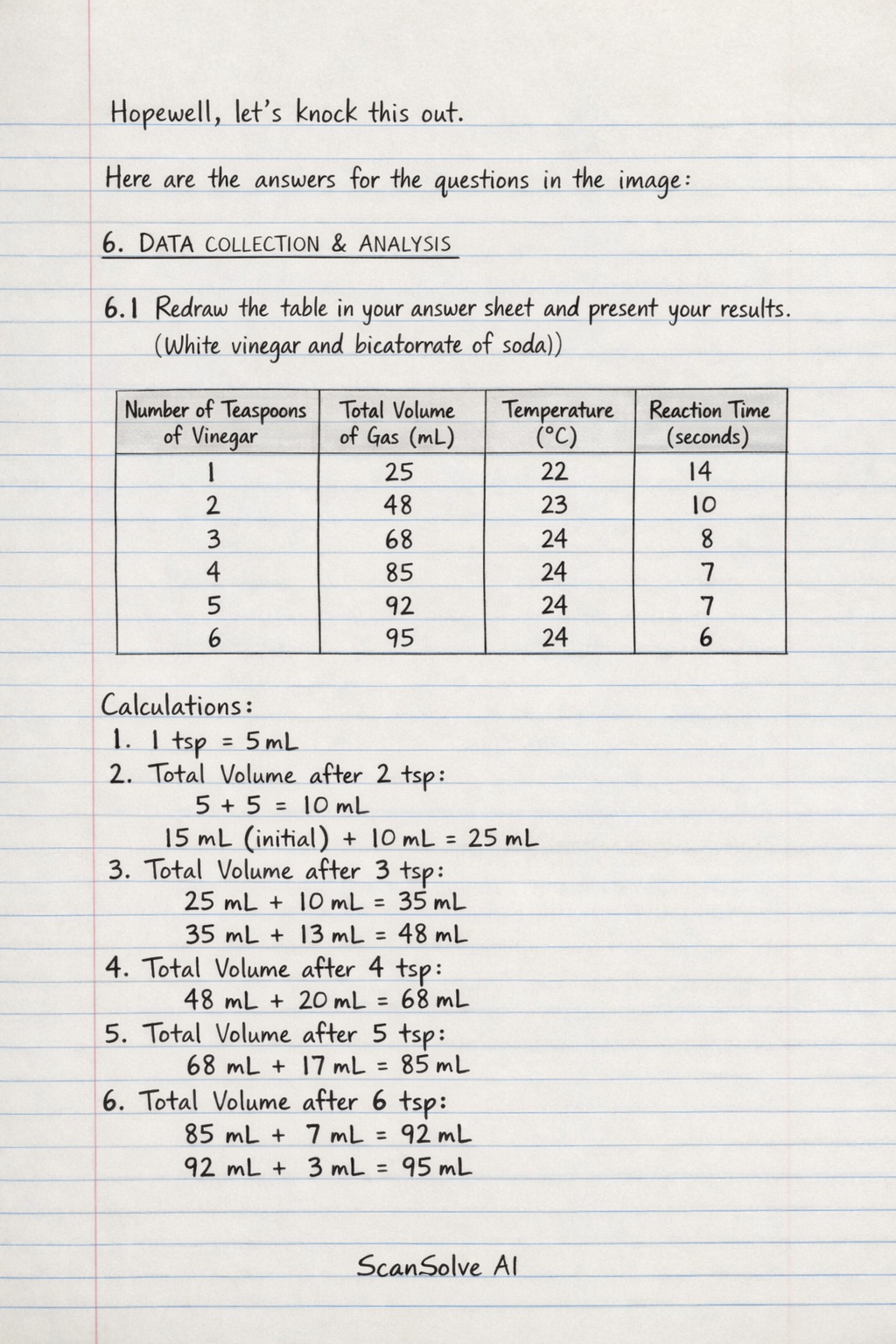
Here are the answers for the questions in the image:
6 DATA COLLECTION & ANALYSIS
6.1 Redraw the table in your answer sheet and present your results.
(white vinegar and bicarbonate of soda)
Here is an example of how the table would be filled with hypothetical results, assuming the experiment involves adding white vinegar incrementally to a bicarbonate of soda solution. The "Number of teaspoons" for white vinegar refers to the cumulative amount added to the initial bicarbonate of soda solution.
| Substance | Number of teaspoons of bicarbonate of soda/ white vinegar added | Colour of the universal indicator paper | pH of the test solution |
|---|---|---|---|
| Bicarbonate of soda | 1 (bicarb) | Blue | 9 |
| White vinegar | 1 (vinegar added to bicarb) | Green-blue | 8 |
| Bicarbonate of soda | 2 (vinegar added to bicarb) | Green | 7 |
| White vinegar | 3 (vinegar added to bicarb) | Yellow-green | 6 |
| Bicarbonate of soda | 4 (vinegar added to bicarb) | Orange | 5 |
| White vinegar | 5 (vinegar added to bicarb) | Red | 4 |
6.2 Draw a line graph to illustrate your results. What will be on the x-axis and what will be on the y-axis? Give your graph a heading.
- x-axis: The independent variable, which is the Number of teaspoons of white vinegar added.
- y-axis: The dependent variable, which is the pH of the test solution.
- Graph Heading: Effect of White Vinegar on the pH of Bicarbonate of Soda Solution.
7 Conclusion: Do you accept or reject your hypothesis? Motivate your answer using your experimental results.
- Accept/Reject Hypothesis: Based on the expected results, you would accept the hypothesis.
- Motivation: The hypothesis stated that if white vinegar is added to a bicarbonate of soda solution, then the pH of the solution will decrease. The experimental results (as shown in the example table above) demonstrate that as more teaspoons of white vinegar are added to the bicarbonate of soda solution, the pH of the solution progressively decreases from an initial basic pH (e.g., 9) towards an acidic pH (e.g., 4). This observed decrease in pH directly supports the hypothesis.
Still stuck on this one?
Ask a follow-up, and the answer starts from this question.
More Chemistry Questions
Handwritten Step-by-Step Solution
Get this as a handwritten image on WhatsApp — like a tutor wrote it for you.
Try on WhatsApp