
We read your photo as:
For an organic compound that does not react with both hydrogen cyanide (HCN) and hydroxylamine (NH₂OH).
ScanSolve AI Answer
Answer
Step-by-step solution
2 stepsThe question asks for an organic compound that does not react with both hydrogen cyanide (HCN) and hydroxylamine ().
Reaction with Hydrogen Cyanide (HCN)
Hydrogen cyanide undergoes nucleophilic addition reactions with compounds containing a carbonyl group (), specifically aldehydes and ketones, to form cyanohydrins.
- Alkanones (ketones) have a group and react with HCN.
- Alkanals (aldehydes) have a group and react with HCN.
- Alkanoic acids have a group as part of a carboxyl group (), but their carbonyl carbon is less reactive towards nucleophilic addition compared to aldehydes and ketones, so they generally do not form cyanohydrins.
- Alkenes have a carbon-carbon double bond () but no group, so they do not react with HCN in this manner.
Reaction with Hydroxylamine ()
Hydroxylamine reacts with compounds containing a carbonyl group (), specifically aldehydes and ketones, to form oximes. This is a nucleophilic addition-elimination reaction.
- Alkanones (ketones) have a group and react with .
- Alkanals (aldehydes) have a group and react with .
- Alkanoic acids do not typically react with hydroxylamine to form oximes at the carboxyl carbon.
- Alkenes have no group, so they do not react with to form oximes.
Based on this analysis:
- Alkanones and Alkanals react with both HCN and .
- Alkanoic acids generally do not undergo these specific reactions.
- Alkenes do not have a carbonyl group () and therefore do not undergo these characteristic reactions with either HCN or .
Thus, an alkene is the compound that does not undergo a reaction with both hydrogen cyanide and hydroxylamine.
The correct option is B.
Try one yourself
A new problem that tests the same skill.
Still stuck on this one?
Ask a follow-up, and the answer starts from this question.
More Chemistry Questions
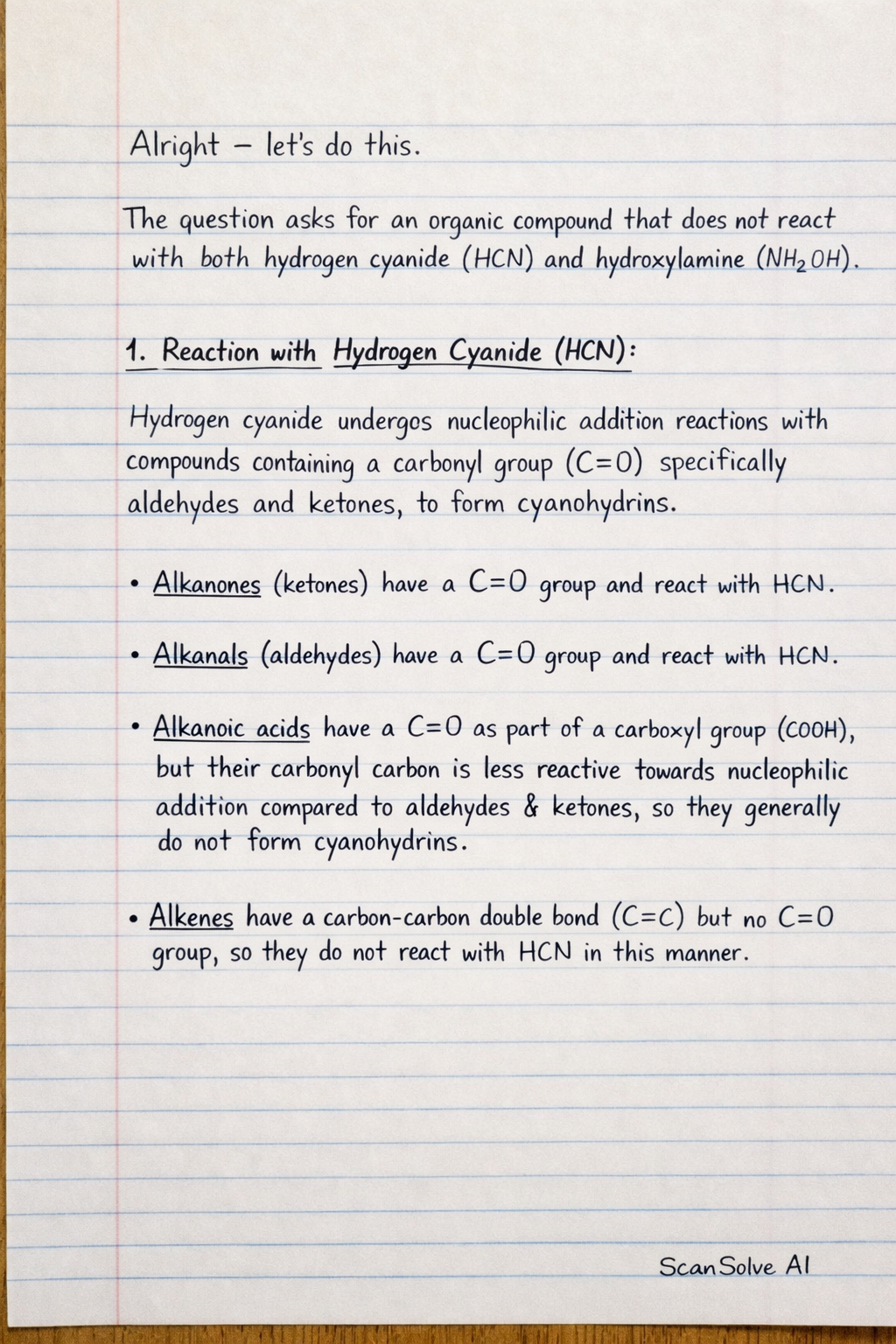
Handwritten Step-by-Step Solution
Get this as a handwritten image on WhatsApp — like a tutor wrote it for you.
Try on WhatsApp