
And suggest it's mode of formation from glycerol
ScanSolve AI Answer
Step-by-step solution
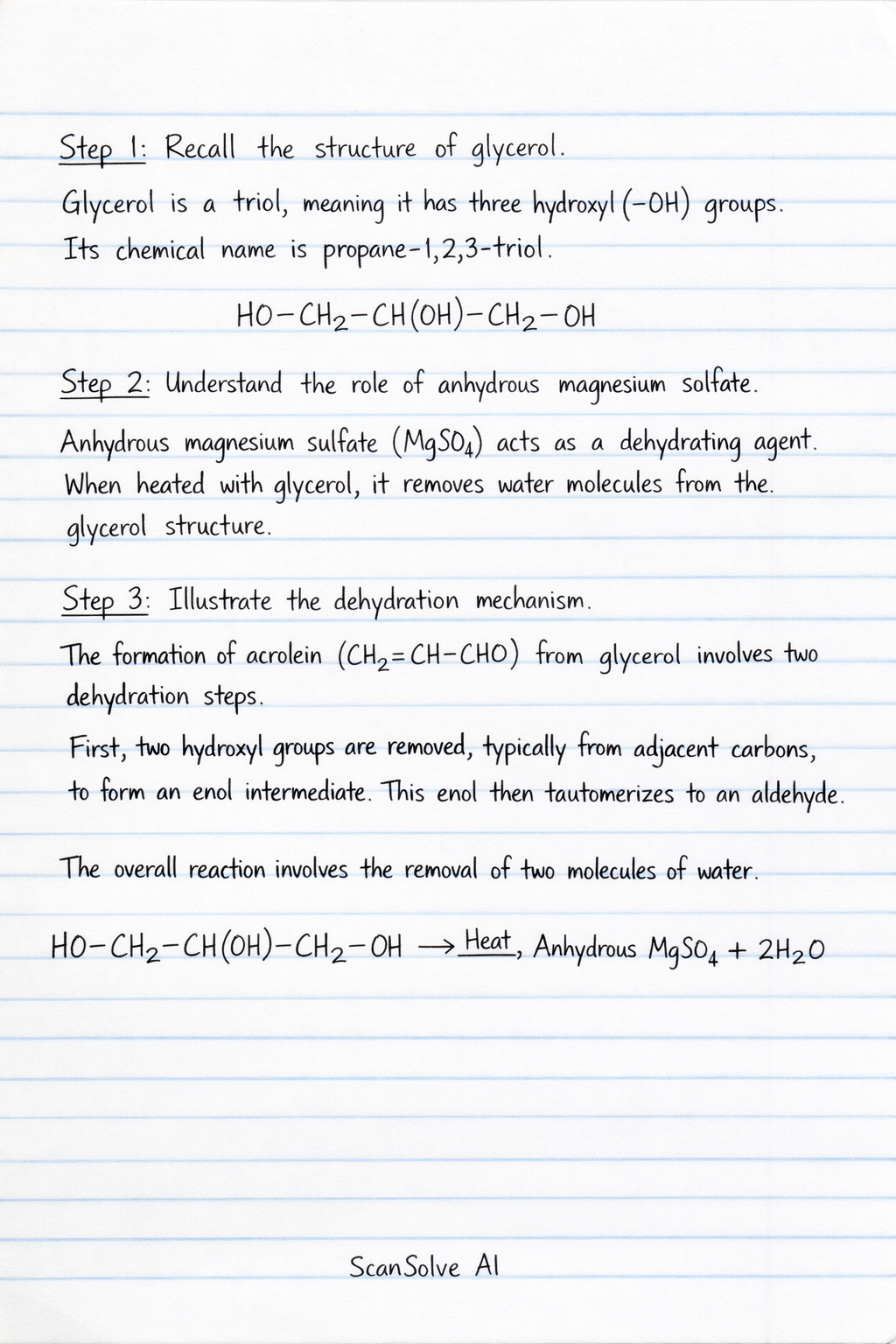
3 stepsRecall the structure of glycerol.
Glycerol is a triol, meaning it has three hydroxyl () groups. Its chemical name is propane-1,2,3-triol.
Understand the role of anhydrous magnesium sulfate.
Anhydrous magnesium sulfate () acts as a dehydrating agent. When heated with glycerol, it removes water molecules from the glycerol structure.
Illustrate the dehydration mechanism.
The formation of acrolein () from glycerol involves two dehydration steps.
First, two hydroxyl groups are removed, typically from adjacent carbons, to form an enol intermediate. This enol then tautomerizes to an aldehyde.
The overall reaction involves the removal of two molecules of water.The mode of formation involves the dehydration of glycerol, where two molecules of water are eliminated from the glycerol molecule to form the -unsaturated aldehyde, acrolein. This typically proceeds via an initial dehydration to form an enol, which then tautomerizes to the more stable aldehyde.
Still stuck on this one?
Ask a follow-up, and the answer starts from this question.
More Chemistry Questions
Handwritten Step-by-Step Solution
Get this as a handwritten image on WhatsApp — like a tutor wrote it for you.
Try on WhatsApp