
We read your photo as:
Which organic compound, given its properties (high boiling point, viscous, non-toxic, miscible with water, hygroscopic), is best described by the provided options?
Chemistry
ScanSolve AI Answer
The question describes a liquid with several key properties: high boiling point, viscous, non-toxic, miscible with water, and very hygroscopic. We need to identify which of the given organic compounds best fits this description.
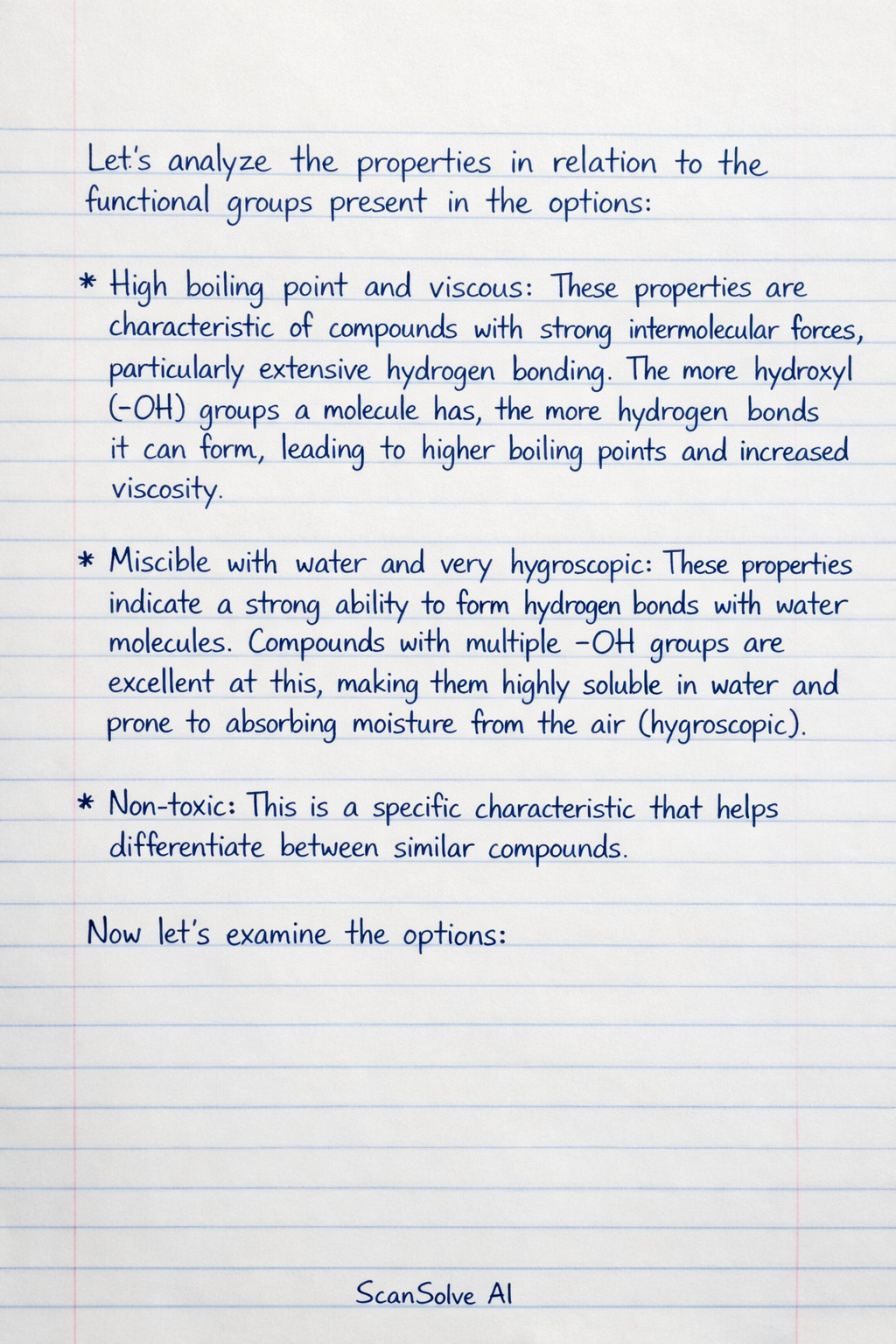
Let's analyze the properties in relation to the functional groups present in the options:
- High boiling point and viscous: These properties are characteristic of compounds with strong intermolecular forces, particularly extensive hydrogen bonding. The more hydroxyl (-OH) groups a molecule has, the more hydrogen bonds it can form, leading to higher boiling points and increased viscosity.
- Miscible with water and very hygroscopic: These properties indicate a strong ability to form hydrogen bonds with water molecules. Compounds with multiple -OH groups are excellent at this, making them highly soluble in water and prone to absorbing moisture from the air (hygroscopic).
- Non-toxic: This is a specific characteristic that helps differentiate between similar compounds.
Now let's examine the options:
- A. (1-propanol): This is a primary alcohol with one -OH group. It can form hydrogen bonds, but only to a limited extent compared to polyols. It is moderately viscous and has a boiling point of about 97 °C. It is toxic if ingested.
- B. (2-propanol): This is a secondary alcohol with one -OH group. Similar to 1-propanol, it forms hydrogen bonds but is less viscous and has a lower boiling point (about 82.5 °C) than 1-propanol. It is also toxic.
- C. (2-butanol): This is a secondary alcohol with one -OH group. Its properties are similar to 1-propanol and 2-propanol, with a boiling point of about 99.5 °C. It is also toxic.
- D. (Propane-1,2,3-triol, commonly known as glycerol): This compound has three -OH groups. The presence of multiple hydroxyl groups leads to:
- Very strong hydrogen bonding: This results in a very high boiling point (290 °C) and high viscosity. Glycerol is famously known for its thick, syrupy consistency.
- Excellent miscibility with water and high hygroscopicity: The three -OH groups allow it to form extensive hydrogen bonds with water, making it completely miscible and highly effective at absorbing moisture from the air.
- Non-toxic: Glycerol is widely used in food, pharmaceuticals, and cosmetics, confirming its non-toxic nature.
Comparing all the options, glycerol (D) perfectly matches all the described properties: high boiling point, viscous, non-toxic, miscible with water, and very hygroscopic.
The final answer is .
Was this helpful?
Still stuck on this one?
Ask a follow-up, and the answer starts from this question.
Got a different question?Ask your own question
More Chemistry Questions
QQ5: Organic Compound Q (C4H8O₂)QThe question describes an organic compound that:QName the following organic compound:QName the following compounds: CH3CH(CH3)CH(OH)CH3 (ii) CH3CH(CH3)(OH)CH3 (iii) CH2(Br)CH2CH(OH)CH3…QName the following organic compounds: 1. 4-propylheptane 2. 1-bromo-3-chloro-2-fluorobutane
Browse by topic:Organic Chemistry
Handwritten Step-by-Step Solution
Get this as a handwritten image on WhatsApp — like a tutor wrote it for you.
Try on WhatsApp