
We read your photo as:
Arrange the hydroxides of Group II elements (Be to Ba) in decreasing order of solubility and explain the trend. State two ways in which the chemistry of lithium or its compounds differ from those of o
ScanSolve AI Answer
Here are the solutions to the questions:
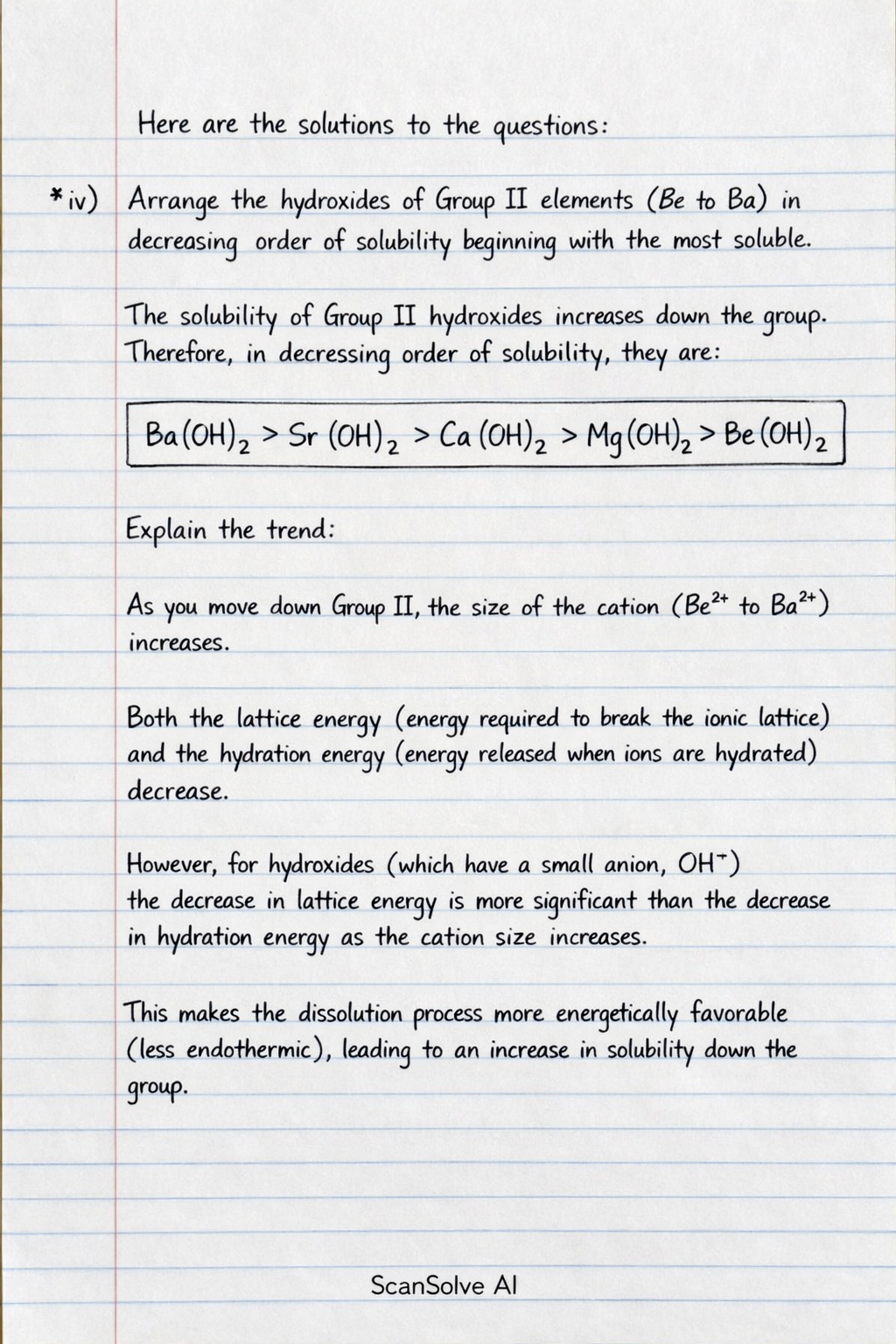
iv) Arrange the hydroxides of Group II elements (Be to Ba) in decreasing order of solubility beginning with the most soluble.
The solubility of Group II hydroxides increases down the group. Therefore, in decreasing order of solubility, they are:
Explain the trend:
As you move down Group II, the size of the cation ( to ) increases. Both the lattice energy (energy required to break the ionic lattice) and the hydration energy (energy released when ions are hydrated) decrease. However, for hydroxides (which have a small anion, ), the decrease in lattice energy is more significant than the decrease in hydration energy as the cation size increases. This makes the dissolution process more energetically favorable (less endothermic), leading to an increase in solubility down the group.
v) State two ways in which the chemistry of lithium or its compounds differ from those of other alkali elements.
- Formation of nitrides: Lithium is the only alkali metal that reacts directly with nitrogen gas to form a stable nitride, . Other alkali metals do not form nitrides under normal conditions.
- Thermal stability of carbonates: Lithium carbonate () is thermally unstable and decomposes easily upon heating to form lithium oxide and carbon dioxide. In contrast, the carbonates of other alkali metals are much more thermally stable and generally do not decompose at typical laboratory temperatures.
e) Nitric acid is manufactured by the catalytic oxidation of ammonia.
i) Write a balanced equation giving the reaction conditions for the conversion of ammonia to nitrogen monoxide.
ii) Give the formula and name of a compound of nitrogen in the +5 oxidation state commonly used as a fertilizer.
- Formula:
- Name: Potassium nitrate
f) Sulphuric acid is prepared from sulphur dioxide through the reaction .
i) State the conditions used to maximize the yield of sulphur trioxide.
- Temperature: An optimum temperature of is used. While lower temperatures favor the exothermic forward reaction, this range provides a good compromise between yield and reaction rate.
- Pressure: A moderate pressure of is used. Higher pressure favors the side with fewer moles of gas, increasing yield.
- Catalyst: is used to increase the rate of reaction.
ii) What will be observed when sulphur dioxide gas is bubbled through a solution of ?
Sulphur dioxide () is a reducing agent, and potassium permanganate () is a strong oxidizing agent (purple solution). When is bubbled through solution, the reduces the purple ions to colourless ions.
Observation: The .
Still stuck on this one?
Ask a follow-up, and the answer starts from this question.
More Chemistry Questions
Handwritten Step-by-Step Solution
Get this as a handwritten image on WhatsApp — like a tutor wrote it for you.
Try on WhatsApp