
We read your photo as:
Explain the trends in ionization energy across a period and down a group, and how these trends relate to the ionization energies of alkali metals and alkaline earth metals.
ScanSolve AI Answer
-
Trends in Ionization Energy:
- Across a period: Ionization energy generally increases. For example, Li has kJ/mol, while Be has kJ/mol. This is due to increasing nuclear charge and decreasing atomic radius, which holds valence electrons more tightly.
- Down a group: Ionization energy generally decreases. This occurs because atomic radius increases and inner electrons shield the valence electrons more effectively, making them easier to remove. (The provided table does not contain data to illustrate this trend).
-
Alkali Metals (e.g., Lithium): Lithium () readily loses its single valence electron ( kJ/mol) to form a stable ion with a (noble gas) electron configuration. The second ionization energy ( kJ/mol) is significantly higher (approximately 14 times ) because it requires removing an electron from a stable, full inner shell. Therefore, forming +2 or +3 ions is energetically unfavorable.
-
Alkaline Earth Metals (e.g., Beryllium): Beryllium () readily loses both its valence electrons ( kJ/mol, kJ/mol) to form a stable ion with a (noble gas) electron configuration. The third ionization energy ( kJ/mol) is significantly higher (approximately 8.5 times ) because it requires removing an electron from a stable, full inner shell. Therefore, forming +3 or +4 ions is energetically unfavorable.
Still stuck on this one?
Ask a follow-up, and the answer starts from this question.
More Chemistry Questions
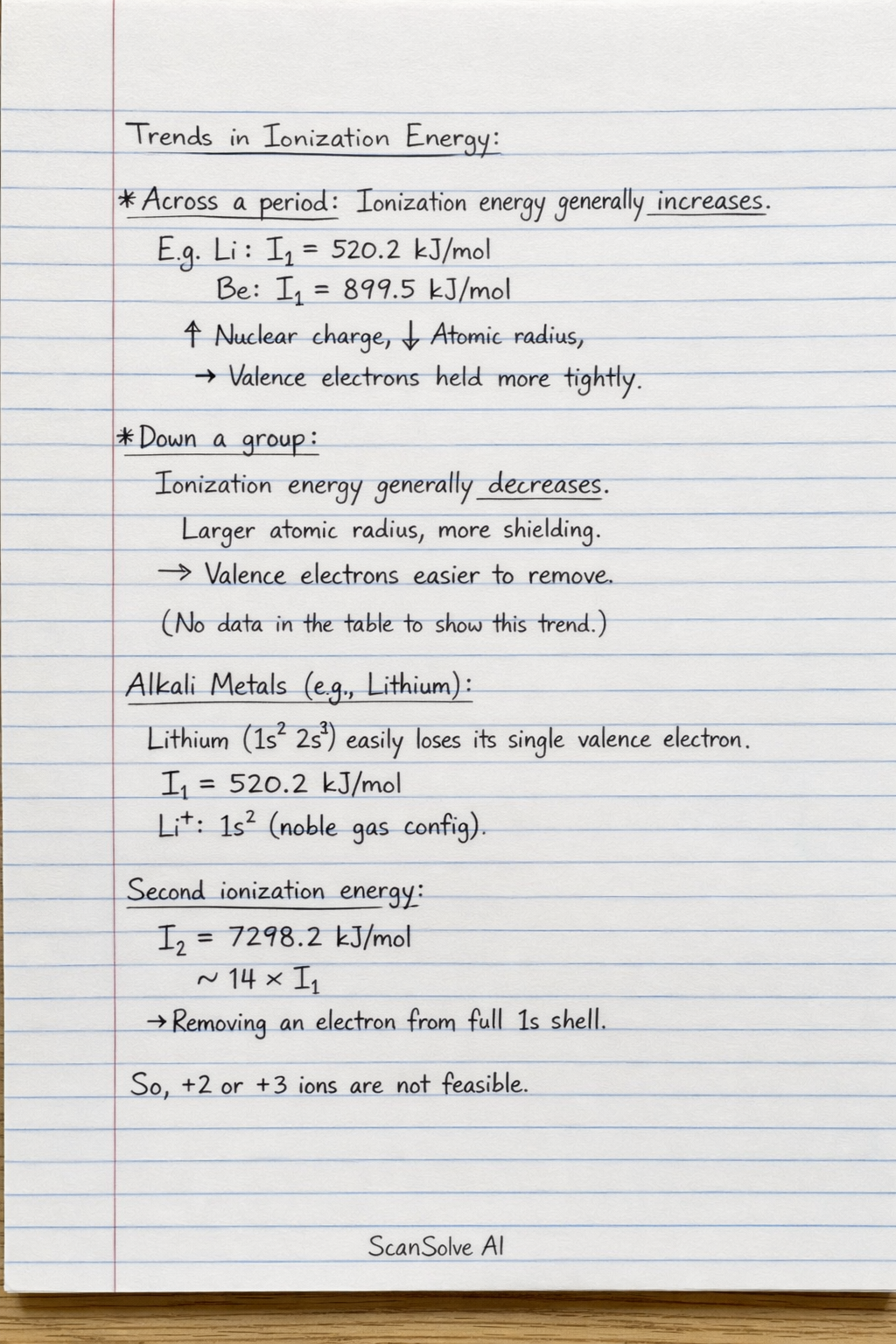
Handwritten Step-by-Step Solution
Get this as a handwritten image on WhatsApp — like a tutor wrote it for you.
Try on WhatsApp