
We read your photo as:
Explain the trend in boiling/melting points and reactivity for alkali metals and halogens down their respective groups, and why noble gases are unreactive.
ScanSolve AI Answer
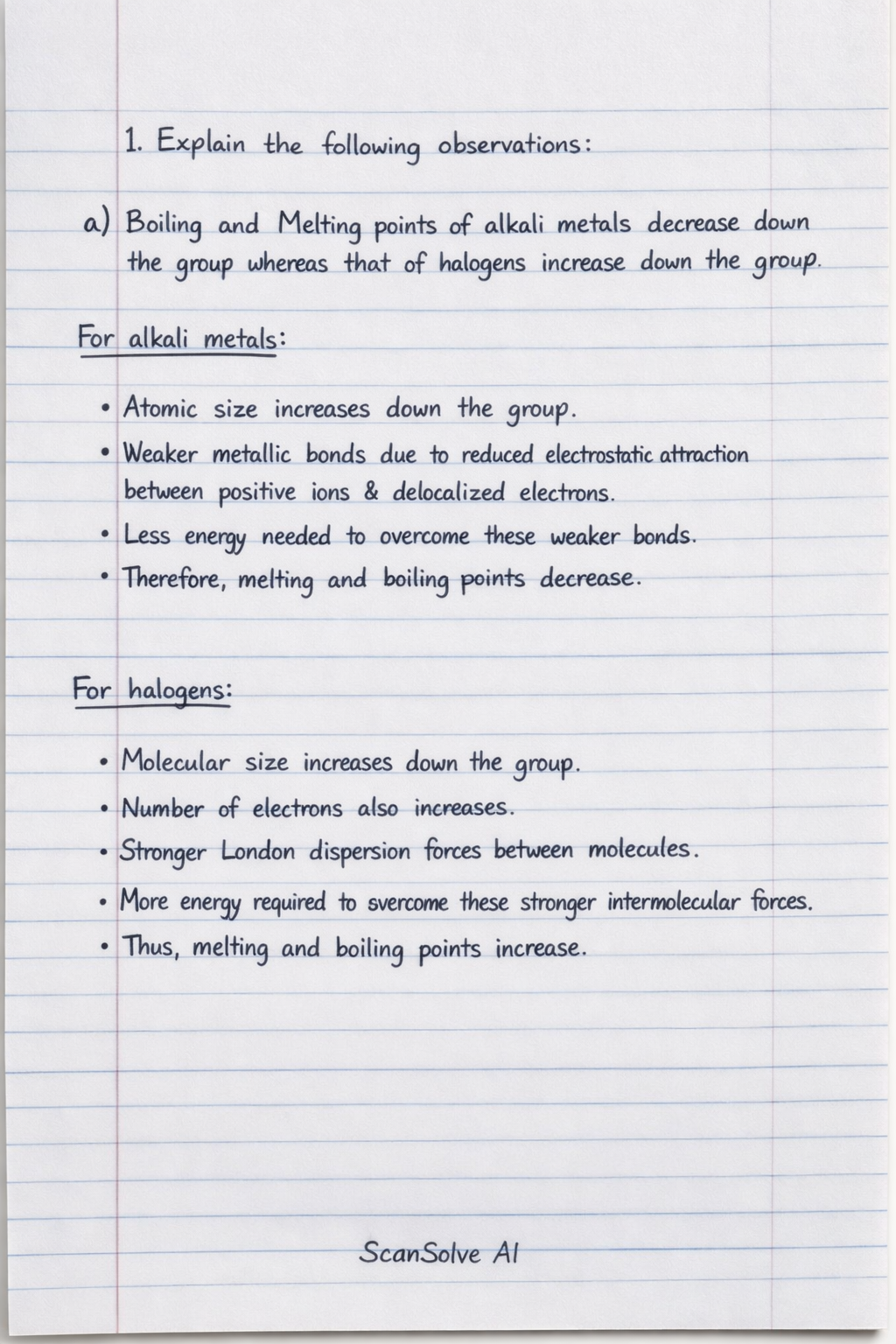
1. Explain the following observations:
a) Boiling and Melting points of alkali metals decrease down the group whereas that of halogens increase down the group.
For alkali metals, atomic size increases down the group, weakening the metallic bonds due to reduced electrostatic attraction between the positive ions and delocalized electrons. Less energy is needed to overcome these weaker bonds, so melting and boiling points decrease. For halogens, molecular size and the number of electrons increase down the group, leading to stronger London dispersion forces between molecules. More energy is required to overcome these stronger intermolecular forces, causing melting and boiling points to increase.
b) The order of reactivity increases down group I but decreases down group VII(7).
In Group I (alkali metals), reactivity increases down the group because atomic size increases, making it easier for the atom to lose its single valence electron due to reduced nuclear attraction and increased shielding. In Group VII (halogens), reactivity decreases down the group because atomic size increases, making it harder for the atom to gain an electron due to increased distance from the nucleus and greater shielding, which reduces the attraction for an incoming electron.
c) Noble gases are generally unreactive.
Noble gases have a full outer electron shell (a stable octet or duplet for helium). This electron configuration is highly stable, meaning they have no tendency to lose, gain, or share electrons to form chemical bonds under normal conditions.
2. Rubidium (Rb) is a member of the alkali metals. Predict how the element reacts with:
a) Cold water:
Rubidium reacts extremely vigorously with cold water, producing rubidium hydroxide and hydrogen gas. The reaction is highly exothermic, causing the hydrogen gas to ignite explosively.
b) Air:
Rubidium reacts readily with oxygen in the air, tarnishing quickly. It typically forms rubidium superoxide.
c) Chlorine:
Rubidium reacts very vigorously with chlorine gas to form rubidium chloride, an ionic salt.
d) Hydrochloric acid:
Rubidium reacts extremely vigorously with hydrochloric acid, producing rubidium chloride and hydrogen gas. The reaction is very exothermic and potentially explosive.
Still stuck on this one?
Ask a follow-up, and the answer starts from this question.
More Chemistry Questions
Handwritten Step-by-Step Solution
Get this as a handwritten image on WhatsApp — like a tutor wrote it for you.
Try on WhatsApp