
We read your photo as:
Explain the trend in first ionization energies across the third period, including the anomaly between magnesium and aluminum.
ScanSolve AI Answer
Step-by-step solution
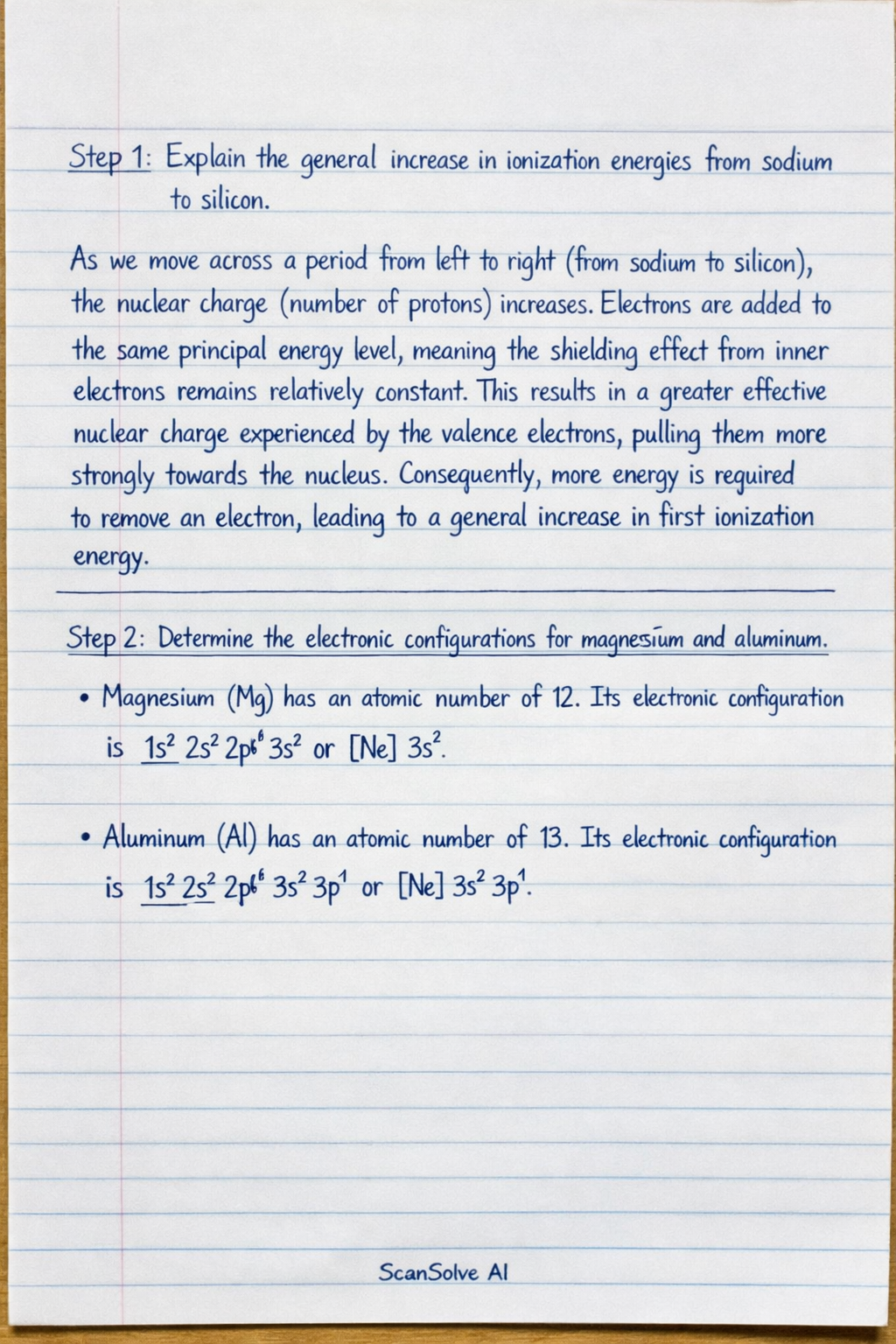
3 stepsExplain the general increase in ionization energies from sodium to silicon.
As we move across a period from left to right (from sodium to silicon), the nuclear charge (number of protons) increases. Electrons are added to the same principal energy level, meaning the shielding effect from inner electrons remains relatively constant. This results in a greater effective nuclear charge experienced by the valence electrons, pulling them more strongly towards the nucleus. Consequently, more energy is required to remove an electron, leading to a general increase in first ionization energy.
Determine the electronic configurations for magnesium and aluminum.
- Magnesium (Mg) has an atomic number of 12. Its electronic configuration is or .
- Aluminum (Al) has an atomic number of 13. Its electronic configuration is or .
Explain why aluminum has a lower first ionization energy than magnesium.
Magnesium's first electron to be removed is from a filled subshell (). Aluminum's first electron to be removed is from a subshell (). The electron in aluminum is at a slightly higher energy level and is shielded by the inner electrons. This additional shielding and the higher energy of the orbital mean that the electron in aluminum is less attracted to the nucleus and requires less energy to remove compared to a electron in magnesium.
a) The general increase in ionization energies from sodium to silicon is due to the increase in effective nuclear charge across the period. As the atomic number increases, the number of protons in the nucleus increases, leading to a stronger attraction for the valence electrons. Since electrons are added to the same principal energy level, the shielding effect does not significantly increase, making it harder to remove an electron.
b)
- Magnesium (Mg) electronic configuration:
- Aluminum (Al) electronic configuration:
Aluminum has a lower first ionization energy than magnesium because the electron being removed from aluminum is a electron, while the electron being removed from magnesium is a electron. The electron in aluminum is at a slightly higher energy level and is shielded by the filled subshell. This shielding reduces the effective nuclear charge experienced by the electron, making it easier to remove compared to a electron in magnesium, which is closer to the nucleus and experiences less shielding.
Still stuck on this one?
Ask a follow-up, and the answer starts from this question.
More Chemistry Questions
Handwritten Step-by-Step Solution
Get this as a handwritten image on WhatsApp — like a tutor wrote it for you.
Try on WhatsApp