
We read your photo as:
Explain the reactivity trend in Group II elements.
Chemistry
ScanSolve AI Answer
You're asking for the explanation of the reactivity trend in Group II again. Here's a concise breakdown:
- Atomic Radius: Down Group II (from beryllium to magnesium to calcium), the number of electron shells increases, leading to a larger atomic radius.
- Shielding Effect: The increased number of inner electron shells causes a greater shielding effect, reducing the attraction between the nucleus and the outermost valence electrons.
- Ionization Energy: Due to the larger atomic radius and increased shielding, the valence electrons are held less tightly. This results in a decrease in ionization energy down the group, meaning less energy is required to remove an electron.
- Reactivity: Metals react by losing electrons. Since calcium has the largest atomic radius and the lowest ionization energy among the three, it loses its valence electrons most easily, making it the most reactive. Beryllium, with the smallest atomic radius and highest ionization energy, is the least reactive.
Therefore, the reactivity order is .
Was this helpful?
Still stuck on this one?
Ask a follow-up, and the answer starts from this question.
Got a different question?Ask your own question
More Chemistry Questions
QWhich of the following best describes the chemical behavior of Group II elements?QExplain the trends in melting points, reactivity, and bonding for elements based on their position…QExplain the trends in metallic character and reactivity of elements, and the properties/uses of…QExplain the trend in boiling/melting points and reactivity for alkali metals and halogens down their…QTrend in atomic radius across periods, Reactivity of chlorine and iodine, Reaction between chlorine…
Browse by topic:Inorganic Chemistry
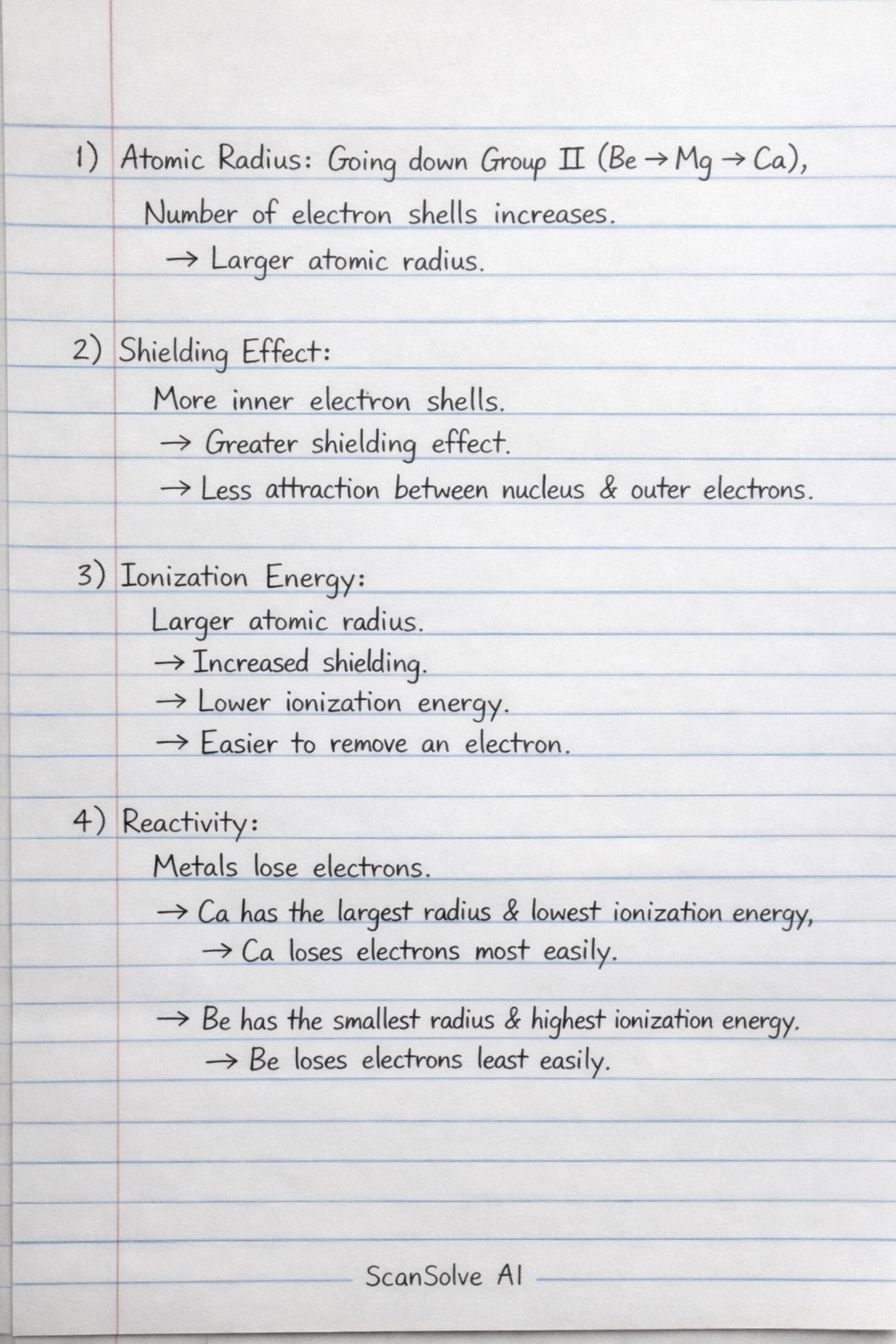
Handwritten Step-by-Step Solution
Get this as a handwritten image on WhatsApp — like a tutor wrote it for you.
Try on WhatsApp