
We read your photo as:
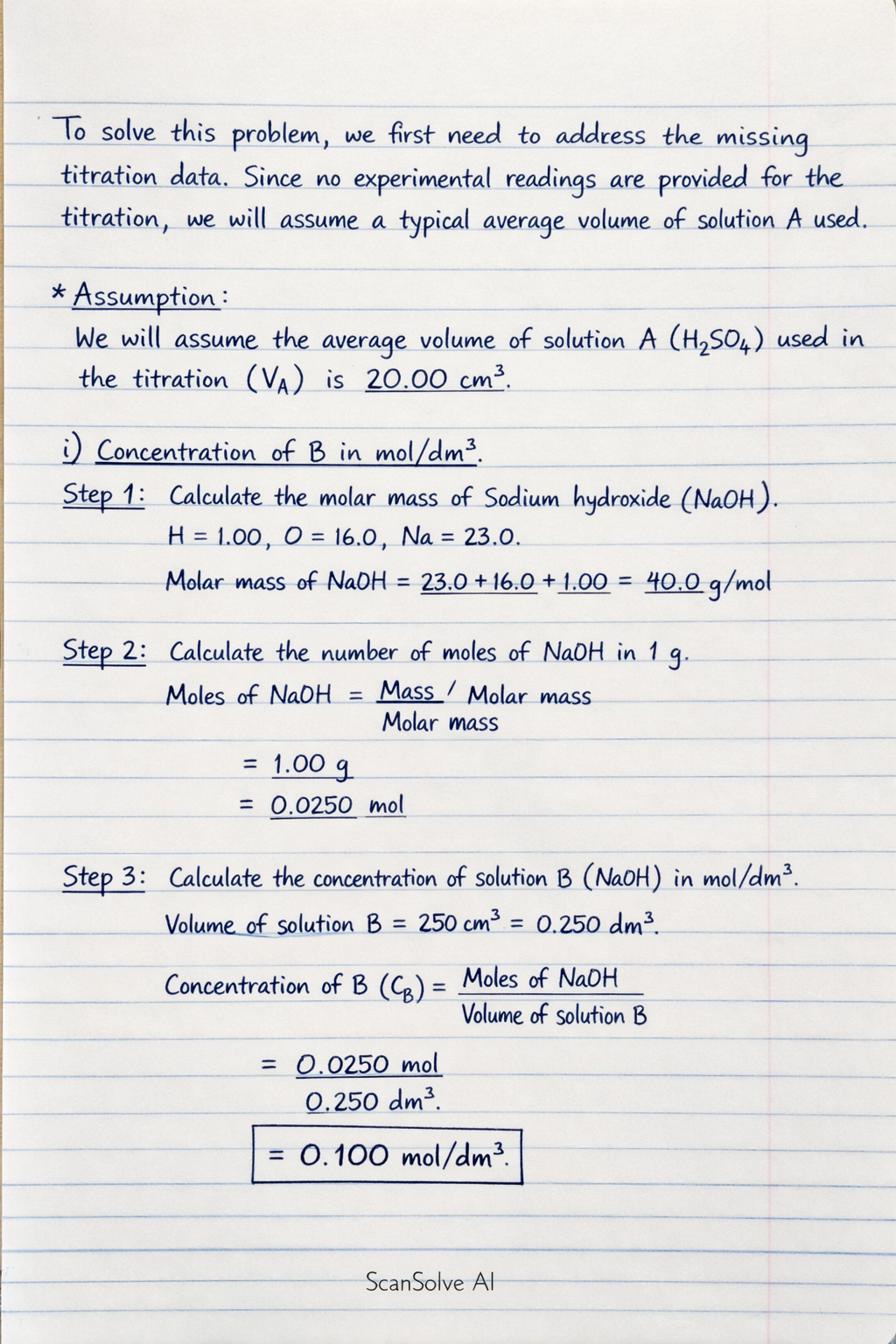
Assumption: We will assume the average volume of solution A (H2SO4) used in the titration (V_A) is 20.00 cm3.
ScanSolve AI Answer
This answer stops before the end.
It was cut off when it was first written. Ask ScanSolve this question again for the full working.
To solve this problem, we first need to address the missing titration data. Since no experimental readings are provided for the titration, we will assume a typical average volume of solution A used.
Assumption: We will assume the average volume of solution A (HSO) used in the titration () is \textbf{20.00 cm^3}.
i) Concentration of B in mol/dm
Step 1: Calculate the molar mass of Sodium hydroxide (NaOH).
The relative atomic masses are H=1.00, O=16.0, Na=23.0.
Step 2: Calculate the number of moles of NaOH in 1 g.
Step 3: Calculate the concentration of solution B (NaOH) in mol/dm.
The volume of solution B is 250 cm, which is 0.250 dm.
ii) Concentration of A in mol/dm
Step 4: Write the balanced chemical equation and determine the mole ratio.
The balanced equation is:
From the equation, 1 mole of HSO reacts with 2 moles of NaOH. So, and .
Step 5: Use the titration formula to calculate the concentration of A (HSO).
Given:
(from part i)
(assumed average volume)
The titration formula is:
Rearranging to solve for :
iii) Number of hydrogen ions in 1.0 dm of A
Step 6: Calculate the moles of HSO in 1.0 dm of solution A.
The concentration of A () is 0.0625 mol/dm.
Step 7: Determine the moles of hydrogen ions (H) produced.
Sulfuric acid (HSO) is a strong acid and dissociates completely in water:
Each mole of HSO produces 2 moles of H ions.
Still stuck on this one?
Ask a follow-up, and the answer starts from this question.
More Chemistry Questions
Handwritten Step-by-Step Solution
Get this as a handwritten image on WhatsApp — like a tutor wrote it for you.
Try on WhatsApp