
We read your photo as:
(i) The chemical equation for the reaction when carbon (IV) oxide gas is passed over heated charcoal is:
ScanSolve AI Answer
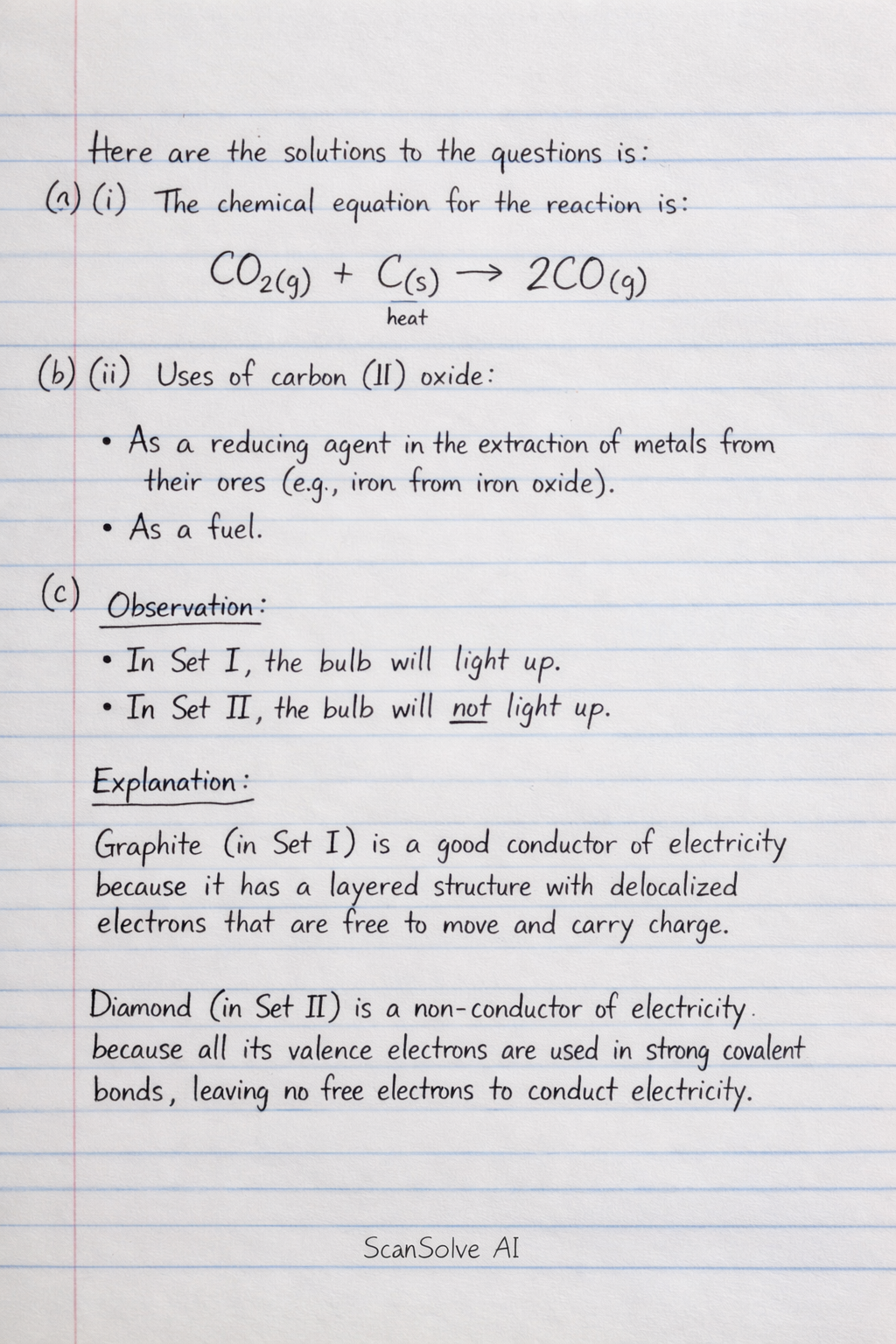
Here are the solutions to the questions:
(b) (i) The chemical equation for the reaction when carbon (IV) oxide gas is passed over heated charcoal is:
(b) (ii) One use of carbon (II) oxide is:
- As a reducing agent in the extraction of metals from their ores (e.g., iron from iron oxide).
- As a fuel.
(c)
Observation:
In Set I, the bulb will light up.
In Set II, the bulb will not light up.
Explanation:
Graphite (in Set I) is a good conductor of electricity because it has a layered structure with delocalized electrons that are free to move and carry charge. Diamond (in Set II) is a non-conductor of electricity because all its valence electrons are used in strong covalent bonds within its rigid tetrahedral structure, leaving no free electrons to conduct electricity.
Still stuck on this one?
Ask a follow-up, and the answer starts from this question.
More Chemistry Questions
Handwritten Step-by-Step Solution
Get this as a handwritten image on WhatsApp — like a tutor wrote it for you.
Try on WhatsApp