
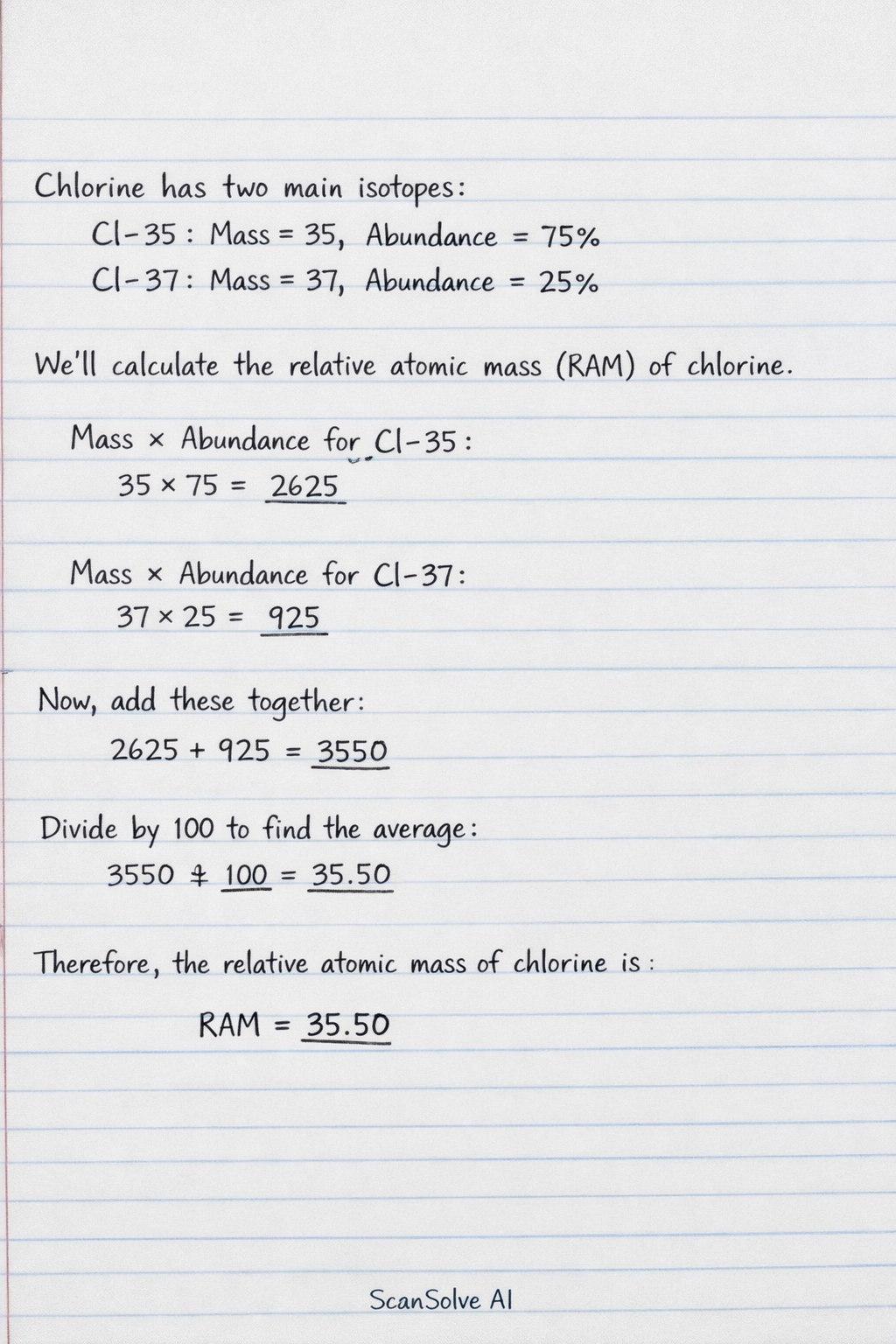
This chemistry question involves key chemical concepts and calculations. The detailed solution below walks through each step, from identifying the reaction type to computing the final answer.
ScanSolve AI Answer
Relative atomic mass (RAM) is the average mass of atoms of an element, taking into account the masses and natural abundances of its isotopes. It is a ratio, comparing the average mass of an atom of an element to (1)/(12) the mass of a carbon-12 atom. To understand how it's calculated, imagine you have a basket of apples, but some are slightly heavier than others. If you want to find the average weight of an apple from the basket, you can't just pick one of each type and average their weights. You need to know how many of each type of apple you have. If there are many more heavy apples, the average weight will be closer to the weight of the heavy apples. In chemistry, atoms of the same element can have slightly different masses (these are called isotopes). To find the relative atomic mass, we multiply the mass of each isotope by how common it is (its percentage abundance), add these values together, and then divide by 100. This gives us a weighted average that reflects the natural mix of isotopes. Here is an example calculation: Example: Chlorine has two main isotopes: Chlorine-35 and Chlorine-37. Chlorine-35 has an isotopic mass of 34.9689 amu and a natural abundance of 75.77\%. Chlorine-37 has an isotopic mass of 36.9659 amu and a natural abundance of 24.23\%. Calculate the relative atomic mass of chlorine. Step 1: Write down the formula for relative atomic mass using percentage abundance. Relative Atomic Mass = (mass of isotope 1 × \% abundance 1) + (mass of isotope 2 × \% abundance 2)100 Step 2: Substitute the given values into the formula. Relative Atomic Mass = ((34.9689 × 75.77) + (36.9659 × 24.23))/(100) Step 3: Perform the multiplications. Relative Atomic Mass = ((2649.600693) + (895.608997))/(100) Step 4: Add the products and divide by 100. Relative Atomic Mass = (3545.20969)/(100) Relative Atomic Mass = 35.4520969 Step 5: Round to an appropriate number of significant figures (usually two decimal places for RAM). Relative Atomic Mass ≈ 35.45 The relative atomic mass of chlorine is 35.45. What's next?