
We read your photo as:
Explain what isotopes are and how to calculate the average atomic mass of an element.
ScanSolve AI Answer
Answer
Step-by-step solution
2 stepsHere is a technical write-up to help Justine understand the concepts of different atoms of an element and how their masses are determined:
Technical Explanation: Isotopes and Average Atomic Mass
1. How an element can have different atoms (Isotopes)
An element is defined by the number of protons in its nucleus. However, atoms of the same element can have different numbers of neutrons. These variations are called isotopes. For example, sodium (Na) typically has 11 protons and 12 neutrons, giving it a mass of 23 u. Magnesium (Mg), on the other hand, has 12 protons but can have 12, 13, or 14 neutrons, leading to isotopes with masses of 24 u, 25 u, and 26 u, respectively. The chemical properties of isotopes of an element are nearly identical because they have the same number of electrons.
2. How the mass of one atom of an element with different atoms is worked out
When an element has multiple isotopes, the "mass of one atom" usually refers to its average atomic mass. This is a weighted average of the masses of all its naturally occurring isotopes, taking into account their relative abundances. It is not a simple average because isotopes do not necessarily occur at the same rate in a natural sample.
The formula for calculating average atomic mass is:
Let's calculate the average atomic mass for Magnesium using the provided data:
- Isotope 1: Mass = , Abundance =
- Isotope 2: Mass = , Abundance =
- Isotope 3: Mass = , Abundance =
Calculate the contribution of each isotope to the average atomic mass.
Sum the contributions to find the average atomic mass.
This calculated value is consistent with the average atomic mass of Magnesium found on the periodic table.
Regarding Lithium, its average atomic mass is given as , with isotopes of masses and . If these isotopes occurred at the same rate ( each), the average would be . Since the actual average is , it indicates that the isotope with mass is much more abundant than the isotope with mass . This confirms that isotopes in a natural sample do not necessarily occur at the same rate.
Try one yourself
A new problem that tests the same skill.
Still stuck on this one?
Ask a follow-up, and the answer starts from this question.
More Chemistry Questions
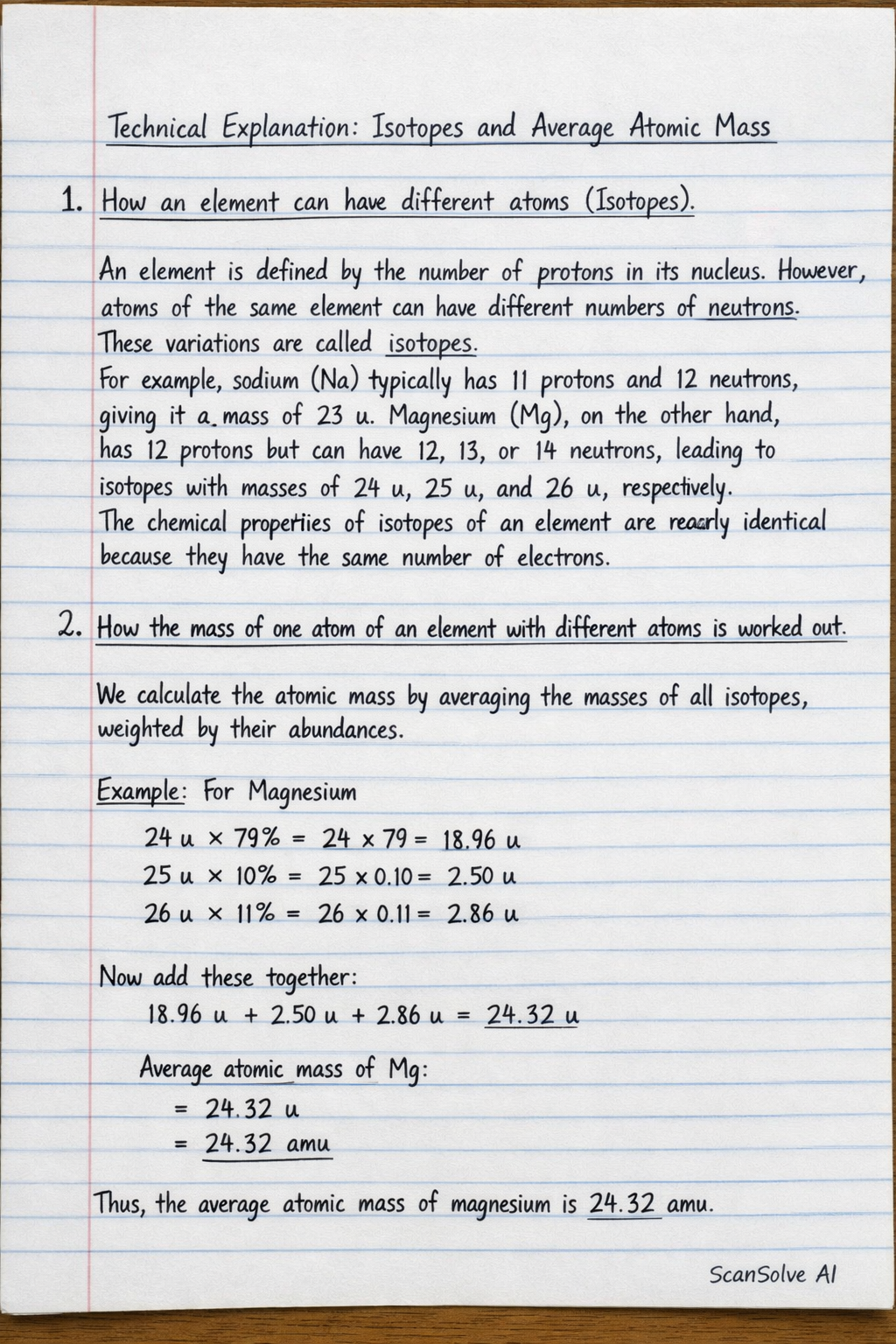
Handwritten Step-by-Step Solution
Get this as a handwritten image on WhatsApp — like a tutor wrote it for you.
Try on WhatsApp