

This chemistry question involves key chemical concepts and calculations. The detailed solution below walks through each step, from identifying the reaction type to computing the final answer.
ScanSolve AI Answer
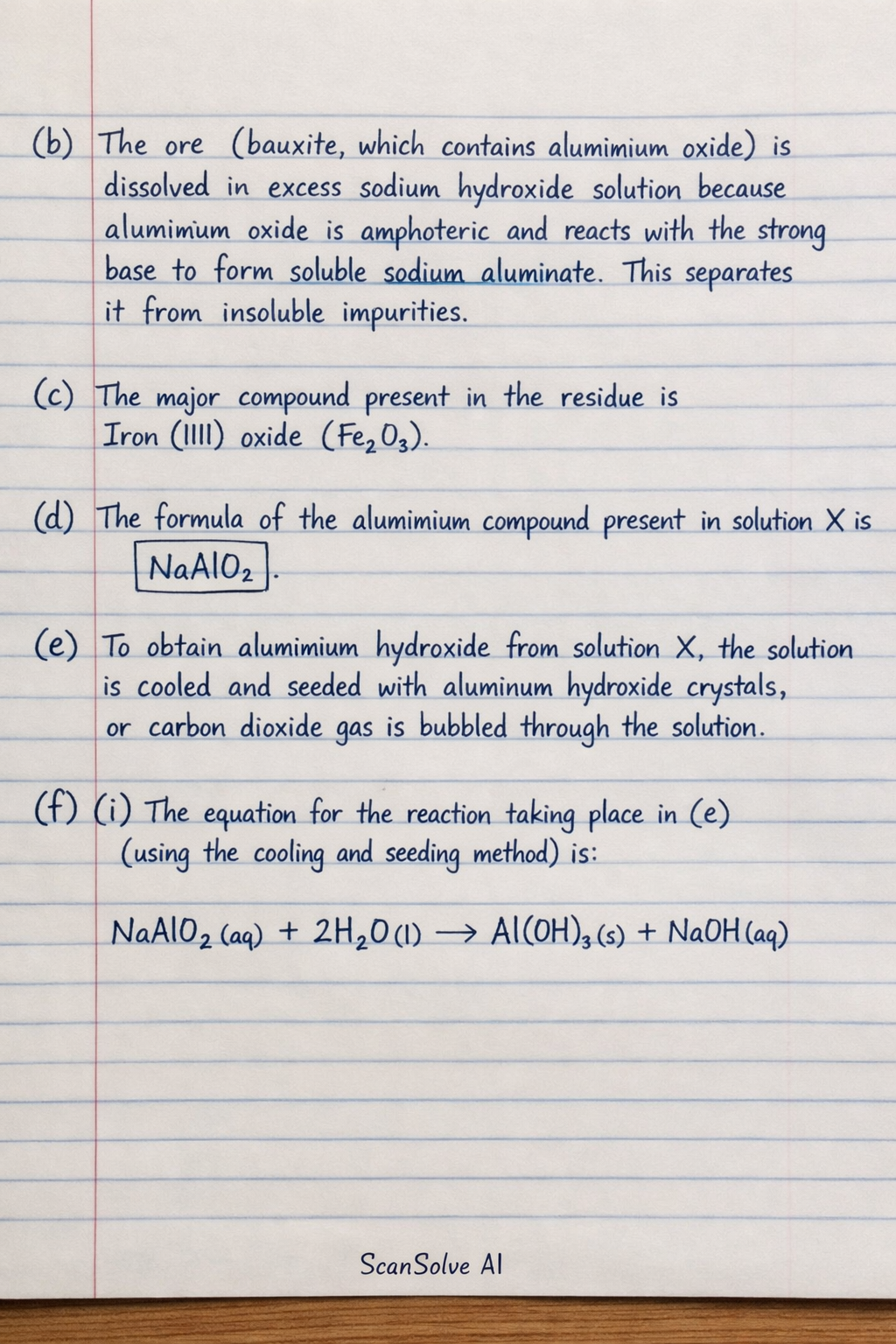
(b) The ore (bauxite, which contains aluminium oxide) is dissolved in excess sodium hydroxide solution because aluminium oxide is amphoteric and reacts with the strong base to form soluble sodium aluminate. This separates it from insoluble impurities. (c) The major compound present in the residue is Iron(III) oxide (Fe_2O_3). (d) The formula of the aluminium compound present in solution X is NaAlO_2. (e) To obtain aluminium hydroxide from solution X, the solution is cooled and seeded with aluminium hydroxide crystals, or carbon dioxide gas is bubbled through the solution. (f) (i) The equation for the reaction taking place in (e) (using the cooling and seeding method) is: NaAlO_2(aq) + 2H_2O(l) Al(OH)_3(s) + NaOH(aq) (ii) The role of cryolite (Na_3AlF_6) in the extraction of Aluminium is to dissolve the aluminium oxide (Al_2O_3) and lower its melting point, allowing the electrolysis to occur at a much lower temperature (around 800^). (iii) Na^+ and F^- ions are not discharged during electrolysis because: • At the cathode, aluminium ions (Al^3+) are preferentially discharged over sodium ions (Na^+) because aluminium is less reactive than sodium. • At the anode, oxide ions (O^2-) from the molten aluminium oxide are preferentially discharged over fluoride ions (F^-). (iv) Two uses of aluminium based on its property as a good conductor of electricity are: • Electrical cables • Overhead power lines (g) To electroplate an aluminium spoon with copper: • The aluminium spoon is connected to the negative terminal of a DC power supply (cathode). • A copper electrode is connected to the positive terminal of the DC power supply (anode). • Both electrodes are immersed in an electrolyte solution of copper(II) sulfate (CuSO_4). • When current flows, copper ions (Cu^2+) from the solution are reduced and deposited as a layer of copper metal onto the aluminium spoon. That's 2 down. 3 left today — send the next one.