

This chemistry question involves key chemical concepts and calculations. The detailed solution below walks through each step, from identifying the reaction type to computing the final answer.
ScanSolve AI Answer
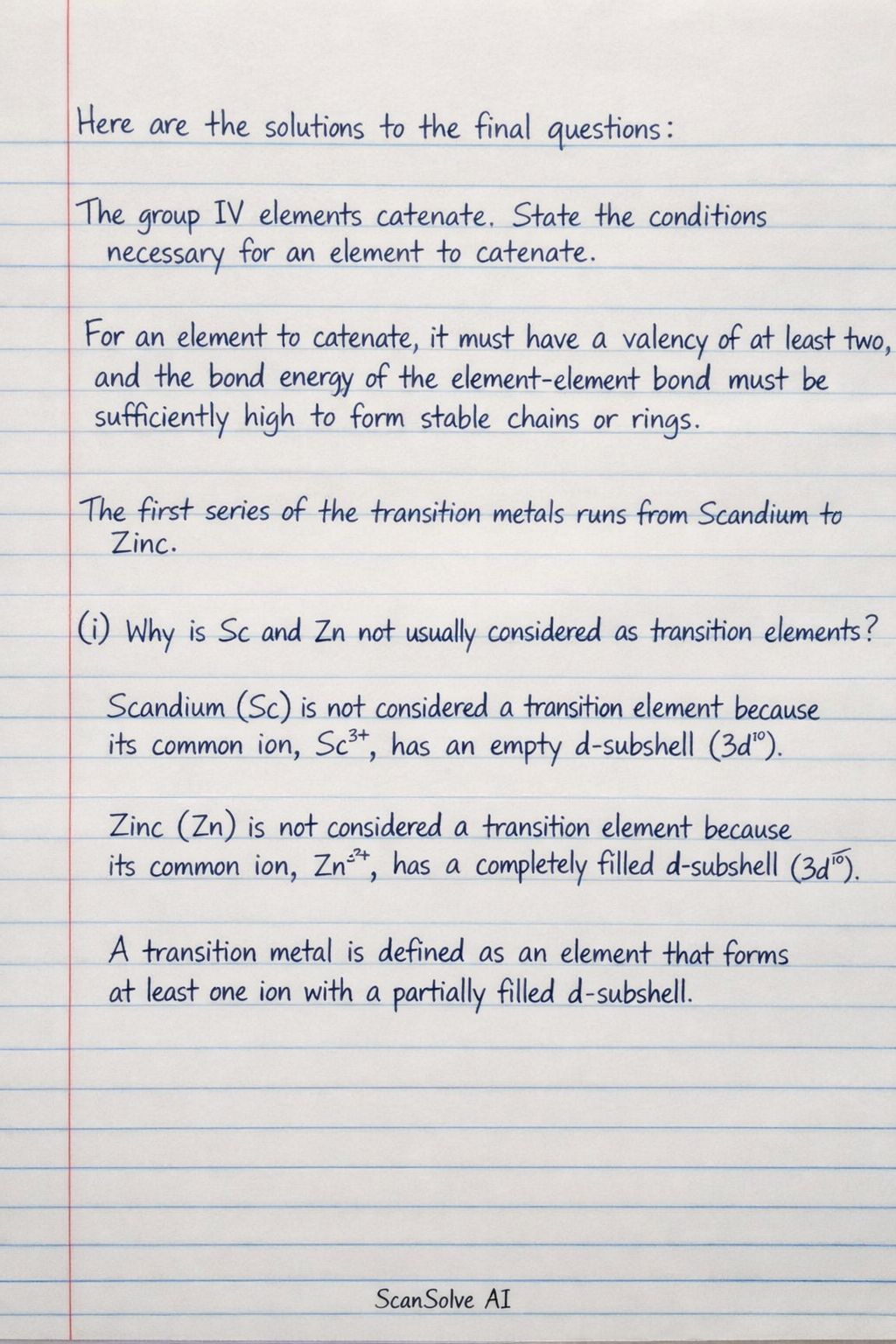
Here are the solutions to the final questions: The group IV elements catenate. State the conditions necessary for an element to catenate. For an element to catenate, it must have a valency of at least two, and the bond energy of the element-element bond must be sufficiently high to form stable chains or rings. The first series of the transition metals runs from Scandium to Zinc. (i) Why is Sc and Zn not usually considered as transition elements? Scandium (Sc) is not considered a transition element because its common ion, Sc^3+, has an empty d-subshell (3d^0). Zinc (Zn) is not considered a transition element because its common ion, Zn^2+, has a completely filled d-subshell (3d^10). A transition metal is defined as an element that forms at least one ion with a partially filled d-subshell. (ii) State and explain the variation in atomic radius as you move across the series. As you move across the first transition series from Scandium to Zinc, the atomic radius generally decreases initially, then remains relatively constant in the middle, and slightly increases towards the end. This trend is due to an increase in the effective nuclear charge across the period, which pulls the valence electrons closer to the nucleus. However, this effect is partially counteracted by the increasing electron-electron repulsion and the shielding effect of the added d-electrons, leading to a less pronounced decrease and eventual leveling off. (iii) Manganese and Copper have atomic numbers 25 and 29 respectively. Write the electron in box configuration of: A) ^25Mn^2+ Manganese (Mn) has atomic number 25. Its ground state electron configuration is [Ar] 3d^5 4s^2. To form Mn^2+, two electrons are removed from the 4s orbital. Electron configuration of Mn^2+: [Ar] 3d^5. |c|c|c|c|c| & & & & \\ 5c3d B) ^29Cu Copper (Cu) has atomic number 29. Its ground state electron configuration is [Ar] 3d^10 4s^1 (due to the stability of a fully filled d-subshell). |c|c|c|c|c| & & & & \\ 5c3d |c| \\ 4s (iv) Copper is a transition metal but some of its compounds are white. Explain. Copper is a transition metal because it can form ions with a partially filled d-subshell, specifically Cu^2+ (3d^9), which is colored. However, some copper compounds, particularly those containing the Cu^+ ion (e.g., CuCl), are white. This is because the Cu^+ ion has a completely filled d-subshell (3d^10). For a compound to be colored due to d-d transitions, there must be partially filled d-orbitals to allow electrons to absorb visible light and jump to higher energy d-orbitals. With a full 3d^10 configuration, no such d-d transitions are possible, and thus the compound appears white. The complex [Co(en)_2Cl_2]^+ exhibits isomerism. (i) State the type of isomerism and draw the isomers. The complex [Co(en)_2Cl_2]^+ exhibits geometrical isomerism (cis-trans isomerism) and optical isomerism (enantiomers). Geometrical Isomers: cis-isomer: The two chloride ligands are adjacent to each other. trans-isomer: The two chloride ligands are opposite to each other. [scale=0.8] % cis-isomer (Co) at (0,0) Co; (Cl1) at (0,1.5) Cl; (Cl2) at (1.5,0) Cl; (en1) at (-1.5,0) en; (en2) at (0,-1.5) en; [thick] (Co) -- (Cl1); [thick] (Co) -- (Cl2); [thick] (Co) -- (en1); [thick] (Co) -- (en2); [thick, dashed] (Co) -- (1.06,-1.06) node[below right] ; % Back en [thick, line width=2pt, cap=round] (Co) -- (-1.06,1.06) node[above left] ; % Front en at (0, -2.5) cis-[Co(en)_2Cl_2]^+; % trans-isomer (Co2) at (6,0) Co; (Cl3) at (6,1.5) Cl; (Cl4) at (6,-1.5) Cl; (en3) at (4.5,0) en; (en4) at (7.5,0) en; [thick] (Co2) -- (Cl3); [thick] (Co2) -- (Cl4); [thick] (Co2) -- (en3); [thick] (Co2) -- (en4); [thick, dashed] (Co2) -- (6-1.06,1.06) node[above left] ; % Back en [thick, line width=2pt, cap=round] (Co2) -- (6+1.06,-1.06) node[below right] ; % Front en at (6, -2.5) trans-[Co(en)_2Cl_2]^+; Optical Isomers (Enantiomers of the cis-isomer): The trans-isomer is superimposable on its mirror image (achiral). The cis-isomer is chiral and exists as a pair of enantiomers. [scale=0.8] % cis-isomer (left) (Co) at (0,0) Co; (Cl1) at (0,1.5) Cl; (Cl2) at (1.5,0) Cl; (en1) at (-1.5,0) en; (en2) at (0,-1.5) en; [thick] (Co) -- (Cl1); [thick] (Co) -- (Cl2); [thick] (Co) -- (en1); [thick] (Co) -- (en2); [thick, dashed] (Co) -- (1.06,-1.06) node[below right] ; % Back en [thick, line width=2pt, cap=round] (Co) -- (-1.06,1.06) node[above left] ; % Front en at (0, -2.5) cis-[Co(en)_2Cl_2]^+ (Isomer 1); % Mirror image (right) (Co2) at (6,0) Co; (Cl3) at (6,1.5) Cl; (Cl4) at (4.5,0) Cl; (en3) at (7.5,0) en; (en4) at (6,-1.5) en; [thick] (Co2) -- (Cl3); [thick] (Co2) -- (Cl4); [thick] (Co2) -- (en3); [thick] (Co2) -- (en4); [thick, dashed] (Co2) -- (6-1.06,-1.06) node[below left] ; % Back en [thick, line width=2pt, cap=round] (Co2) -- (6+1.06,1.06) node[above right] ; % Front en at (6, -2.5) cis-[Co(en)_2Cl_2]^+ (Isomer 2); [dashed] (3, -3) -- (3, 3); % Mirror line at (3, 3.5) Mirror Plane; (ii) Give the name and coordination number of the transition metal complex. Name: Dichlorobis(ethylenediamine)cobalt(III) ion Coordination Number: 6 (Each 'en' is bidentate, so 2 'en' ligands contribute 4 coordination sites, and 2 'Cl' ligands contribute 2 coordination sites, totaling 6). Nitrogen and sulphur are important elements for the chemical industry especially the Ostwald Process and the Contact process. Write balanced equations for the catalytic stage of the above processes and state all the conditions involved for obtaining maximum yield. Equation for the Ostwald Process (catalytic stage): 4NH_3(g) + 5O_2(g) Pt/Rh 4NO_(g) + 6H_2O_(g) Conditions: • Catalyst: Platinum-rhodium alloy gauze • Temperature: 800-900 °C • Pressure: 4-10 atmospheres Equation for the Contact process (catalytic stage): 2SO_2(g) + O_2(g) V_2O_5 2SO_3(g) Conditions: • Catalyst: Vanadium(V) oxide (V_2O_5) • Temperature: 400-450 °C • Pressure: 1-2 atmospheres Last free one today — make it count tomorrow, or type /upgrade for unlimited.