

This chemistry question involves key chemical concepts and calculations. The detailed solution below walks through each step, from identifying the reaction type to computing the final answer.
ScanSolve AI Answer
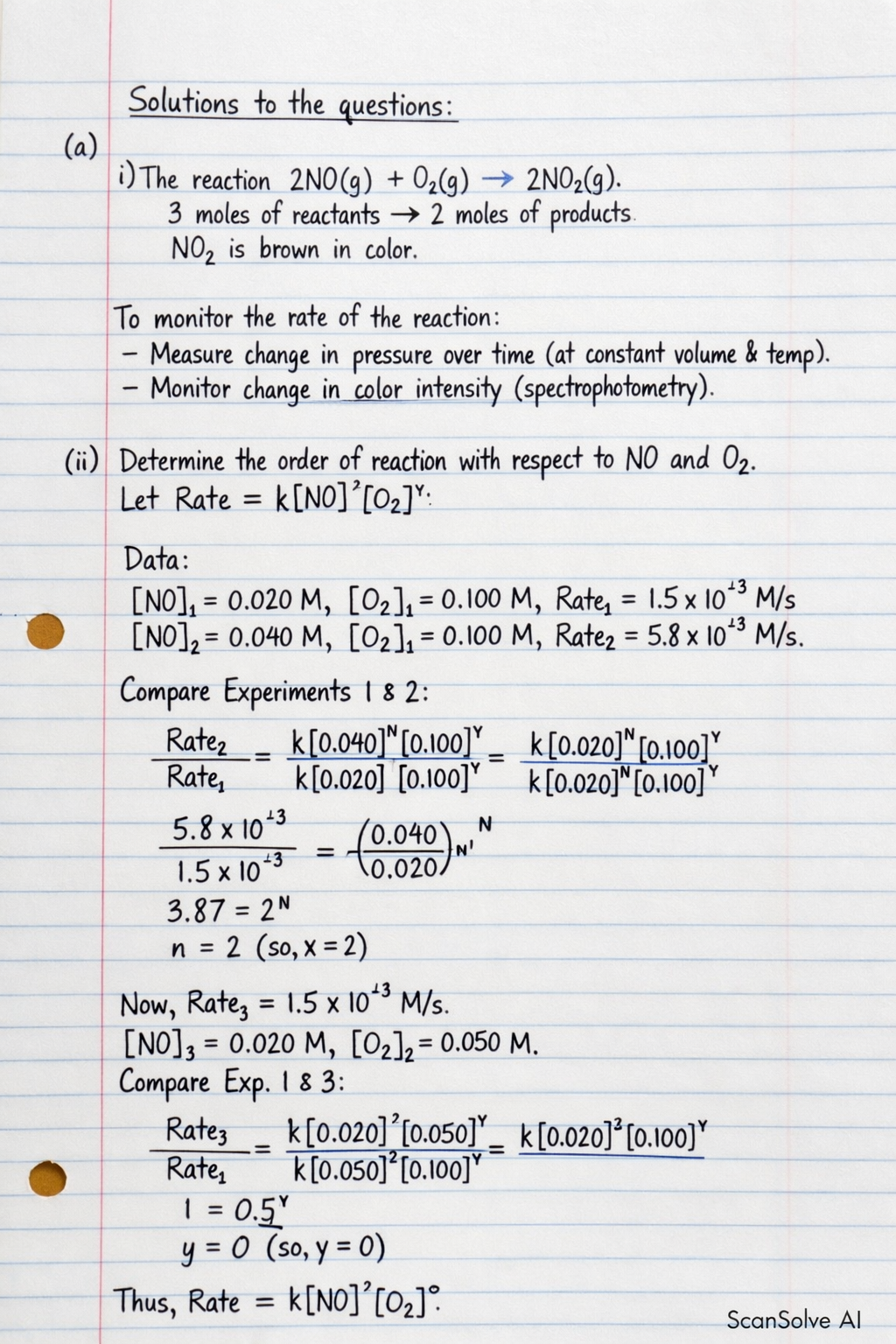
Here are the solutions to the questions: a) i) The reaction 2NO(g) + O_2(g) → 2NO_2(g) involves a change in the number of moles of gas (3 moles of reactants to 2 moles of products) and the formation of a colored gas (NO_2 is brown). One method to monitor the rate of the reaction is by measuring the change in pressure over time at constant volume and temperature, or by monitoring the change in color intensity (spectrophotometry) due to the formation of NO_2. ii) Determine the order of reaction with respect to NO and O_2. Let the rate law be Rate = k[NO]^x[O_2]^y. To find the order with respect to O_2 (y): Compare Experiment 1 and Experiment 2, where [NO] is constant. Rate_2Rate_1 = k[NO]_2^x[O_2]_2^yk[NO]_1^x[O_2]_1^y 6.40 × 10^-33.21 × 10^-3 = (1.30 × 10^-2)^x (2.20 × 10^-2)^y(1.30 × 10^-2)^x (1.10 × 10^-2)^y 1.99 ≈ (2.20 × 10^-21.10 × 10^-2)^y 2 ≈ (2)^y Therefore, y = 1. The reaction is first order with respect to O_2. To find the order with respect to NO (x): Compare Experiment 1 and Experiment 3, where [O_2] is constant. Rate_3Rate_1 = k[NO]_3^x[O_2]_3^yk[NO]_1^x[O_2]_1^y 12.8 × 10^-33.21 × 10^-3 = (2.60 × 10^-2)^x (1.10 × 10^-2)^y(1.30 × 10^-2)^x (1.10 × 10^-2)^y 3.99 ≈ (2.60 × 10^-21.30 × 10^-2)^x 4 ≈ (2)^x Therefore, x = 2. The reaction is second order with respect to NO. iii) The rate equation for the reaction is: Rate = k[NO]^2[O_2] iv) Calculate the value of the rate constant, k. Using Experiment 1 data: Rate = 3.21 × 10^-3 mol dm^-3 s^-1 [NO] = 1.30 × 10^-2 mol dm^-3 [O_2] = 1.10 × 10^-2 mol dm^-3 Substitute these values into the rate equation: 3.21 × 10^-3 = k (1.30 × 10^-2)^2 (1.10 × 10^-2) 3.21 × 10^-3 = k (1.69 × 10^-4) (1.10 × 10^-2) 3.21 × 10^-3 = k (1.859 × 10^-6) k = 3.21 × 10^-31.859 × 10^-6 k = 1726.73 mol^-2 dm^6 s^-1 Rounding to three significant figures: k = 1.73 × 10^3 mol^-2 dm^6 s^-1 b) i) Negative deviation from Raoult's law means that the actual vapor pressure of the solution is lower than what is predicted by Raoult's law. This occurs when the attractive forces between unlike molecules (A-B interactions) are stronger than the average of the attractive forces between like molecules (A-A and B-B interactions), leading to a lower tendency for molecules to escape into the vapor phase. ii) A boiling point-composition curve for a mixture with negative deviation from Raoult's law that forms an azeotrope will show a maximum boiling point. The curve will start at the boiling point of pure propanone (56.5 °C), rise to a maximum at 80% trichloromethane (the azeotropic composition), and then decrease to the boiling point of pure trichloromethane (61.2 °C). The vapor curve will lie below the liquid curve, touching at the azeotropic point. iii) (This part is missing from the image, assuming it refers to the graph description above) iv) Since the mixture forms an azeotrope, simple fractional distillation cannot completely separate the components. One method that can be used to separate the mixture into its pure components is azeotropic distillation (by adding a third component to alter the volatility) or extractive distillation. c) i) Radioactive decay is the spontaneous process by which an unstable atomic nucleus transforms into a more stable nucleus by emitting radiation (such as alpha particles, beta particles, or gamma rays) and releasing energy. ii) For the decay of ^238U by emitting 2 alpha particles and 2 beta particles: Initial nucleus: ^238_92U Alpha particle: ^4_2 Beta particle: ^0_-1 Step 1: Emission of 2 alpha particles ($2 ×