This chemistry question involves key chemical concepts and calculations. The detailed solution below walks through each step, from identifying the reaction type to computing the final answer.
ScanSolve AI Answer
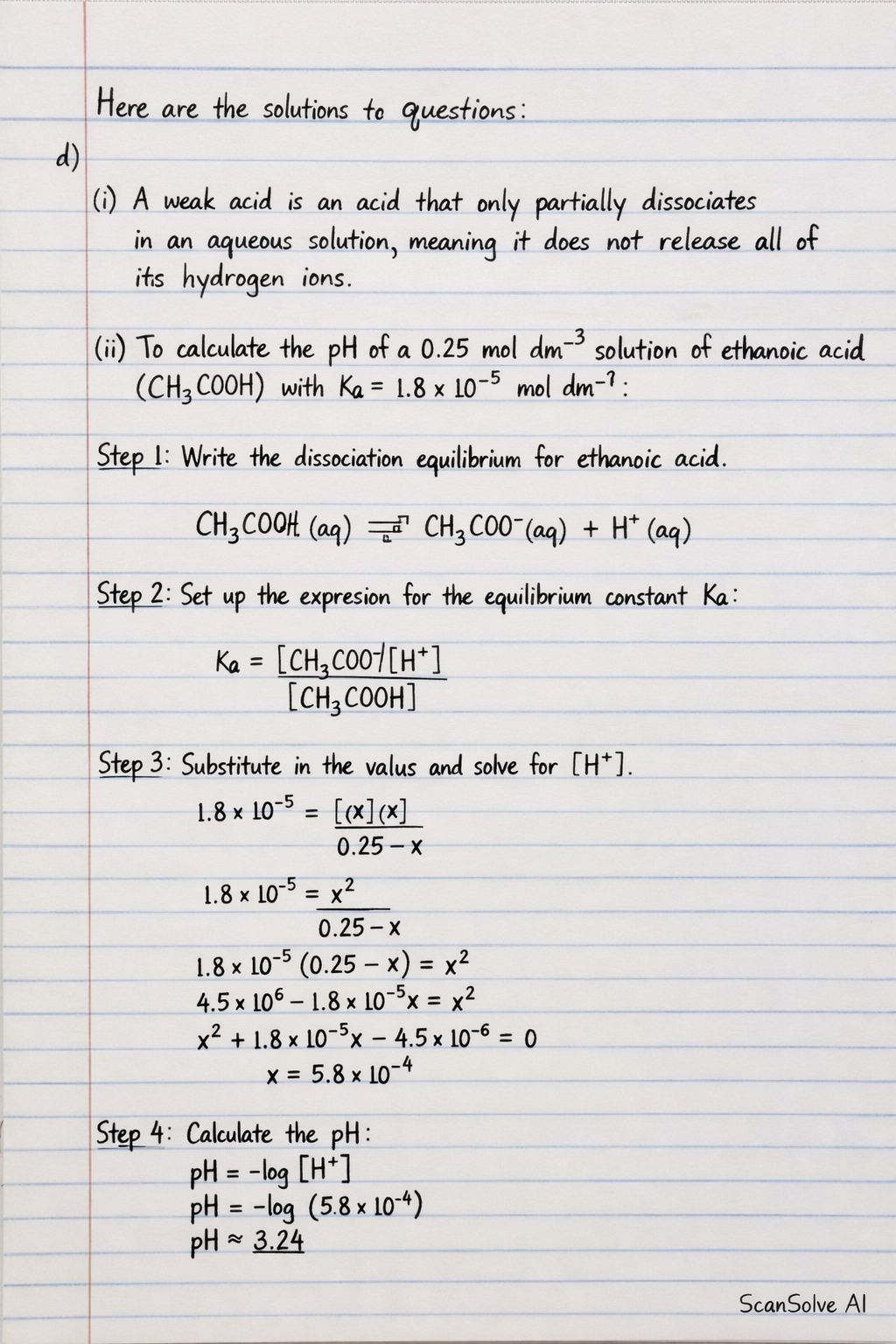
Here are the solutions to the questions:
d)
i) A weak acid is an acid that only partially dissociates (ionizes) in an aqueous solution, meaning it does not release all of its hydrogen ions.
ii) To calculate the pH of a 0.25 mol dm$^{-3}$ solution of ethanoic acid (CH$_3$COOH) with $K_a = 1.8 \times 10^{-5}$ mol dm$^{-3}$:
Step 1: Write the dissociation equilibrium for ethanoic acid.
$$\text{CH}_3\text{COOH(aq)} \rightleftharpoons \text{CH}_3\text{COO}^-\text{(aq)} + \text{H}^+\text{(aq)}$$
Step 2: Set up an ICE (Initial, Change, Equilibrium) table for concentrations.
Let $x$ be the concentration of H$^+$ ions at equilibrium.
| Species | Initial (mol dm$^{-3}$) | Change (mol dm$^{-3}$) | Equilibrium (mol dm$^{-3}$) |
| :------------- | :---------------------- | :--------------------- | :-------------------------- |
| CH$_3$COOH | 0.25 | $-x$ | $0.25 - x$ |
| CH$_3$COO$^-$ | 0 | $+x$ | $x$ |
| H$^+$ | 0 | $+x$ | $x$ |
Step 3: Write the expression for the acid dissociation constant, $K_a$.
$$K_a = \frac{[\text{CH}_3\text{COO}^-][\text{H}^+]}{[\text{CH}_3\text{COOH}]}$$
Step 4: Substitute the equilibrium concentrations into the $K_a$ expression.
$$1.8 \times 10^{-5} = \frac{(x)(x)}{0.25 - x}$$
Step 5: Since $K_a$ is small, assume $x \ll 0.25$, so $0.25 - x \approx 0.25$.
$$1.8 \times 10^{-5} = \frac{x^2}{0.25}$$
Step 6: Solve for $x$.
$$x^2 = 1.8 \times 10^{-5} \times 0.25$$
$$x^2 = 4.5 \times 10^{-6}$$
$$x = \sqrt{4.5 \times 10^{-6}}$$
$$x = 0.002121 \text{ mol dm}^{-3}$$
This value of $x$ represents $[\text{H}^+]$.
Step 7: Calculate the pH.
$$\text{pH} = -\log[\text{H}^+]$$
$$\text{pH} = -\log(0.002121)$$
$$\text{pH} \approx 2.67$$
The pH of the solution is $\boxed{2.67}$.
e)
i) A buffer solution is a solution that resists significant changes in pH when small amounts of an acid or a base are added to it. It typically consists of a weak acid and its conjugate base, or a weak base and its conjugate acid.
ii) When a small amount of HCl (a strong acid) is added to the buffer solution (a mixture of CH$_3$COOH and CH$_3$COONa), the added H$^+$ ions from HCl react with the conjugate base, ethanoate ions (CH$_3$COO$^-$), to form the weak acid, ethanoic acid (CH$_3$COOH). This consumes the added H$^+$ ions, preventing a large drop in pH.
$$\text{CH}_3\text{COO}^-\text{(aq)} + \text{H}^+\text{(aq)} \rightarrow \text{CH}_3\text{COOH(aq)}$$
3 done, 2 left today. You're making progress.
i) A weak acid is an acid that only partially dissociates (ionizes) in an aqueous solution, meaning it does not release all of its hydrogen ions.
|Chemistry
i) A weak acid is an acid that only partially dissociates (ionizes) in an aqueous solution, meaning it does not release all of its hydrogen ions.
ScanSolve AI Answer
Here are the solutions to the questions:
d)i) A weak acid is an acid that only partially dissociates (ionizes) in an aqueous solution, meaning it does not release all of its hydrogen ions.
ii) To calculate the pH of a 0.25 mol dm−3 solution of ethanoic acid (CH3COOH) with Ka=1.8×10⁻⁵ mol dm−3:
Step 1: Write the dissociation equilibrium for ethanoic acid.
CH3COOH(aq)⇌CH3COO−(aq)+H+(aq)
Step 2: Set up an ICE (Initial, Change, Equilibrium) table for concentrations.
Let x be the concentration of H+ ions at equilibrium.
| Species | Initial (mol dm−3) | Change (mol dm−3) | Equilibrium (mol dm−3) |
| :------------- | :---------------------- | :--------------------- | :-------------------------- |
| CH3COOH | 0.25 | −x | 0.25−x |
| CH3COO− | 0 | +x | x |
| H+ | 0 | +x | x |
Step 3: Write the expression for the acid dissociation constant, Ka.
Ka=[CH3COOH][CH3COO−][H+]
Step 4: Substitute the equilibrium concentrations into the Ka expression.
1.8×10−5=0.25−x(x)(x)
Step 5: Since Ka is small, assume x≪0.25, so 0.25−x≈0.25.
1.8×10−5=0.25x2
Step 6: Solve for x.
x2=1.8×10−5×0.25x2=4.5×10⁻⁶x=4.5×10⁻⁶x=0.002121moldm−3
This value of x represents [H+].
Step 7: Calculate the pH.
pH=−log[H+]pH=−log(0.002121)pH≈2.67
The pH of the solution is 2.67.
e)i) A buffer solution is a solution that resists significant changes in pH when small amounts of an acid or a base are added to it. It typically consists of a weak acid and its conjugate base, or a weak base and its conjugate acid.
ii) When a small amount of HCl (a strong acid) is added to the buffer solution (a mixture of CH3COOH and CH3COONa), the added H+ ions from HCl react with the conjugate base, ethanoate ions (CH3COO−), to form the weak acid, ethanoic acid (CH3COOH). This consumes the added H+ ions, preventing a large drop in pH.
CH3COO−(aq)+H+(aq)→CH3COOH(aq)
3 done, 2 left today. You're making progress.
Need help with your own homework?
Get instant step-by-step solutions to any question. Free to start.