
How to balance equations
ScanSolve AI Answer
Answer
Balancing chemical equations ensures that the law of conservation of mass is upheld, meaning the number of atoms of each element is the same on both the reactant and product sides of the equation.
Step-by-step solution
11 stepsWrite the unbalanced chemical equation.
Count the number of atoms of each element on both sides.
Use coefficients (numbers placed in front of chemical formulas) to balance the atoms.
Start with elements that appear in only one reactant and one product.
Balance polyatomic ions as single units if they appear unchanged on both sides.
Balance oxygen and hydrogen last, if applicable.
Verify that the number of atoms of each element is equal on both sides.
For example, to balance the equation for the formation of water from hydrogen and oxygen:
Unbalanced:Reactants
2 H, 2 O. Products: 2 H, 1 O.
To balance oxygen, place a coefficient of 2 in front of
.
Now, reactants
2 H, 2 O. Products: 4 H, 2 O.
To balance hydrogen, place a coefficient of 2 in front of
.
Verification
Reactants: 4 H, 2 O. Products: 4 H, 2 O. The equation is balanced.
The balanced equation is:
Still stuck on this one?
Ask a follow-up, and the answer starts from this question.
More Chemistry Questions
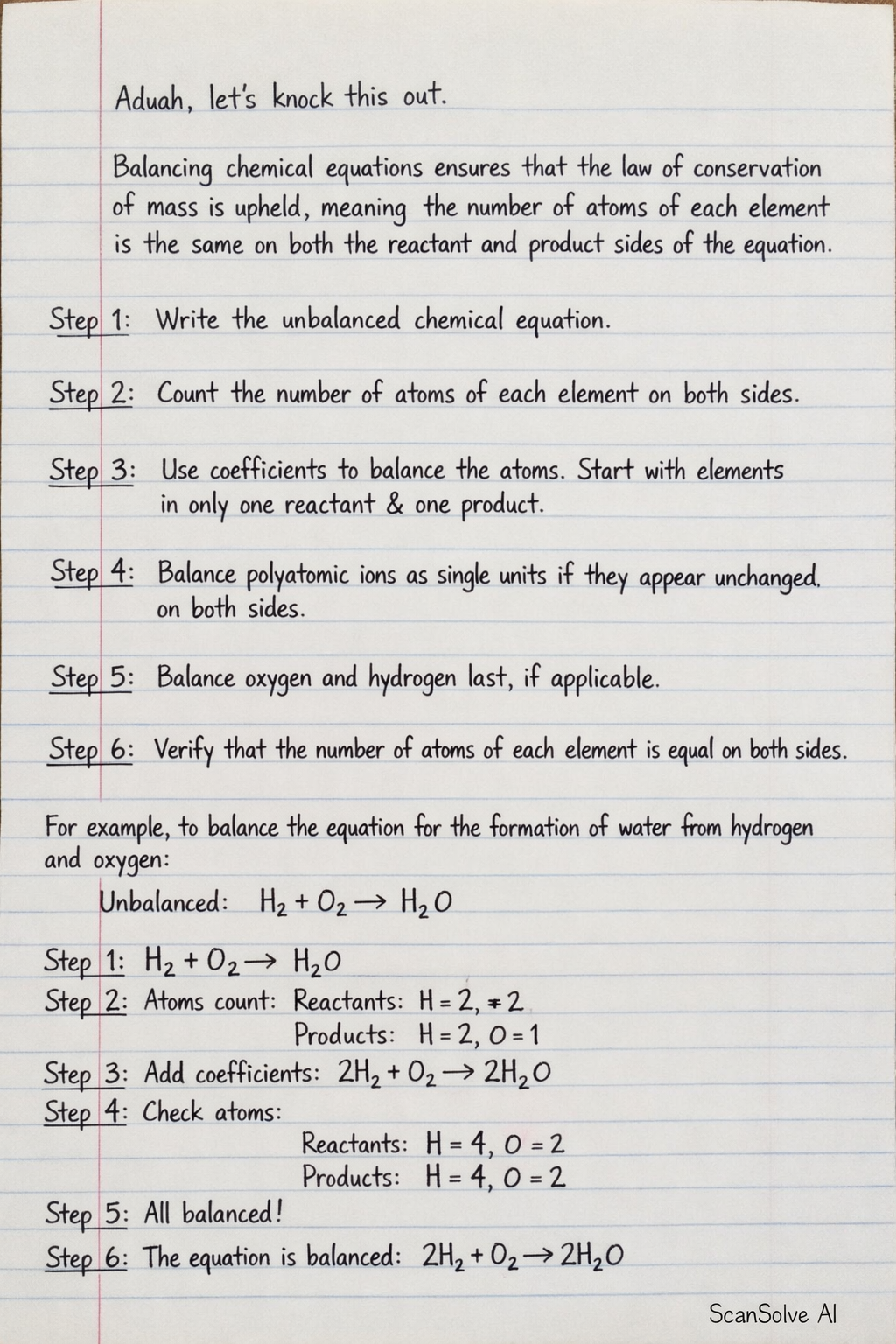
Handwritten Step-by-Step Solution
Get this as a handwritten image on WhatsApp — like a tutor wrote it for you.
Try on WhatsApp