

This chemistry question involves key chemical concepts and calculations. The detailed solution below walks through each step, from identifying the reaction type to computing the final answer.
ScanSolve AI Answer
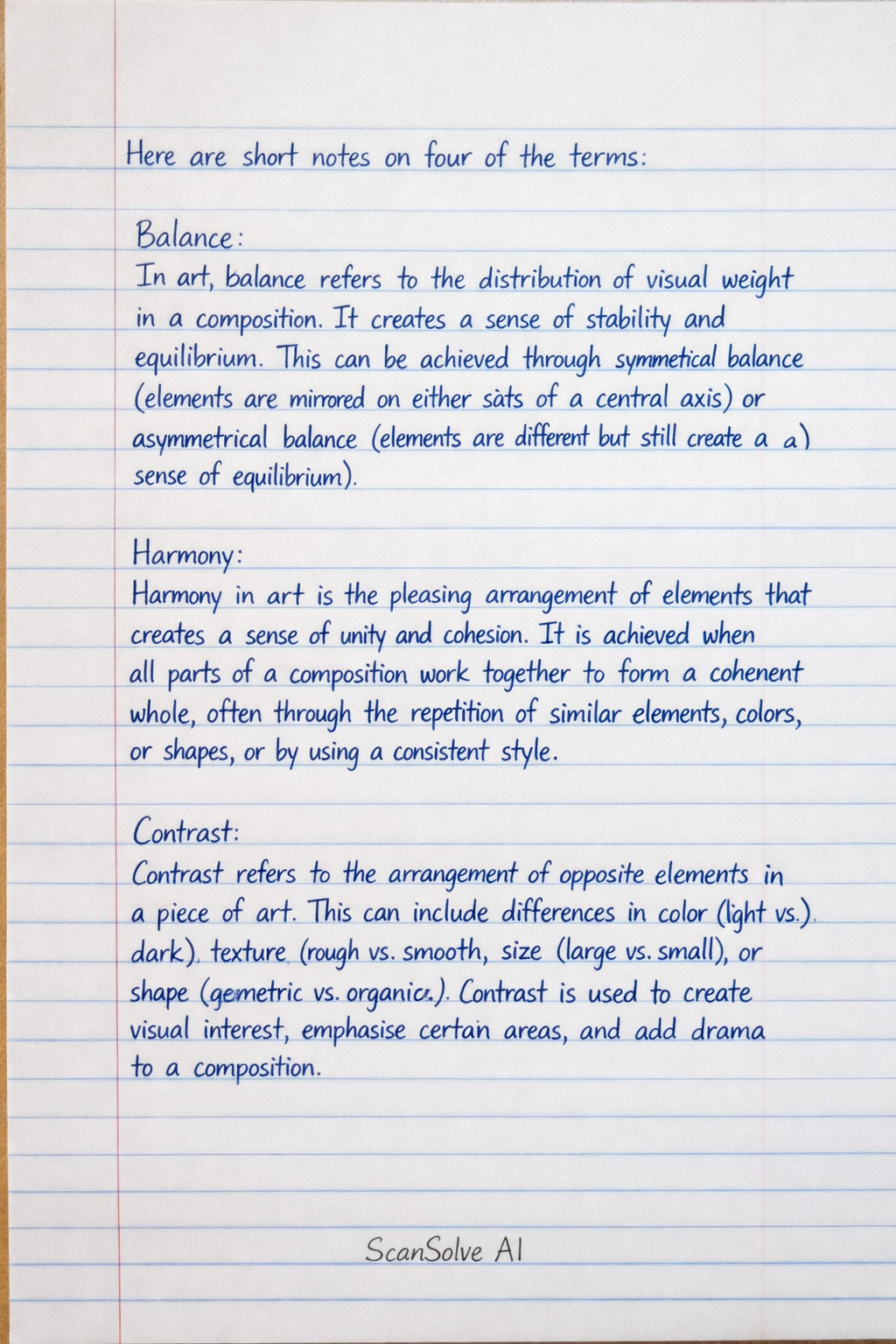
Here are short notes on four of the terms: Balance: In art, balance refers to the distribution of visual weight in a composition. It creates a sense of stability and equilibrium. This can be achieved through symmetrical balance (elements are mirrored on either side of a central axis) or asymmetrical balance* (elements are different but still create a sense of equilibrium). Harmony: Harmony in art is the pleasing arrangement of elements that creates a sense of unity and cohesion*. It is achieved when all parts of a composition work together to form a coherent whole, often through the repetition of similar elements, colors, or shapes, or by using a consistent style. Contrast: Contrast refers to the arrangement of opposite elements* in a piece of art. This can include differences in color (light vs. dark), texture (rough vs. smooth), size (large vs. small), or shape (geometric vs. organic). Contrast is used to create visual interest, emphasize certain areas, and add drama to a composition. Dominance: Dominance, also known as emphasis, is the principle where one element or area in a composition is given more importance or visual weight* than others. This creates a focal point, drawing the viewer's eye to a specific part of the artwork. Dominance can be achieved through size, color, placement, or isolation. 3 done, 2 left today. You're making progress.