
We read your photo as:
Below is a simplified diagram of the Down's cell for the extraction of sodium. Study it and answer the question that follow:- a) (i) From which substances are the electrodes made? Anode: Cathode: a) (
ScanSolve AI Answer
Step-by-step solution
4 stepshere's the solution to question 20:
20. Below is a simplified diagram of the Down's cell for the extraction of sodium. Study it and answer the question that follow:-
a) (i) From which substances are the electrodes made?
Anode:
Cathode:
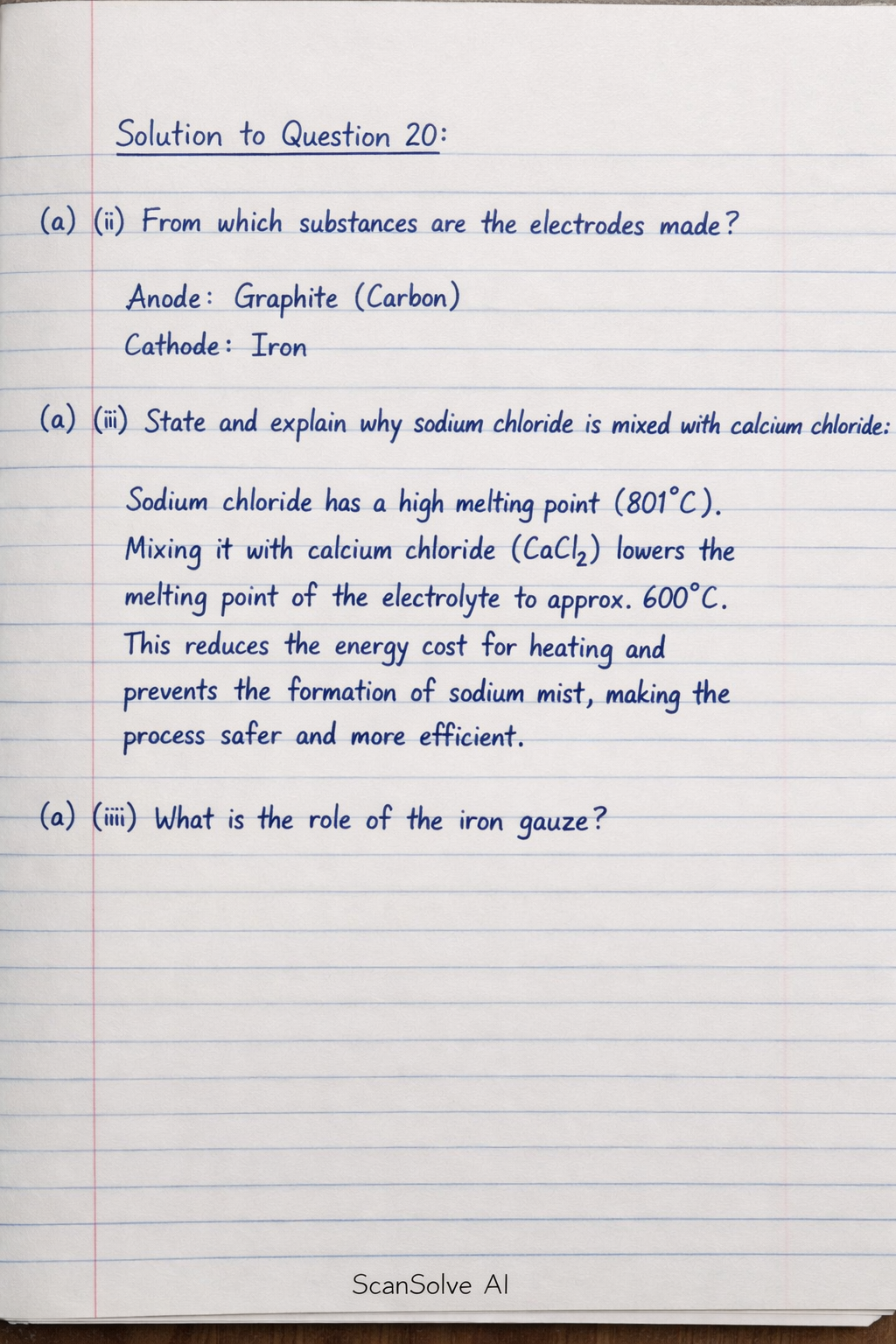
a) (i) From which substances are the electrodes made?
Anode: Graphite (Carbon)
Cathode: Iron
a) (ii) State and explain why sodium chloride is mixed with calcium chloride
a) (ii) State and explain why sodium chloride is mixed with calcium chloride:
Sodium chloride has a high melting point (). Mixing it with calcium chloride () lowers the melting point of the electrolyte to approximately . This reduces the energy cost for heating and prevents the formation of sodium mist, making the process safer and more efficient.
a) (iii) What is the role of the iron gauze?
a) (iii) What is the role of the iron gauze?
The iron gauze acts as a diaphragm to separate the molten sodium metal produced at the cathode from the chlorine gas produced at the anode. This prevents them from reacting explosively with each other.
a) (iv) Write equations for the reaction at :-
cathode
anode
a) (iv) Write equations for the reaction at :-
Cathode:
Anode:
a) (v) Which property of sodium makes it possible to collect it as shown?
a) (v) Which property of sodium makes it possible to collect it as shown?
Molten sodium is less dense than the molten electrolyte ( mixture), causing it to float on top, allowing for easy collection.
b) When a current of was passed through an electrolyte ions for 10 minutes, of were deposited
(i) Calculate the quantity of electricity passed in the experiment (1Faraday = 96000 coulombs)
b) (i) Calculate the quantity of electricity passed in the experiment:
Convert time to seconds.
Calculate the quantity of electricity ().
The quantity of electricity passed is
b) (ii) Determine the relative atomic mass of Y
b) (ii) Determine the relative atomic mass of Y:
Use Faraday's laws of electrolysis.
The charge on the ion is , so electrons per mole of Y.
The mass of Y deposited .
The quantity of electricity .
Faraday's constant .
The formula relating these is , where is the relative atomic mass.
Rearrange to solve for :Substitute the values and calculate .
The relative atomic mass of Y is (to one decimal place).
Still stuck on this one?
Ask a follow-up, and the answer starts from this question.
More Chemistry Questions
Handwritten Step-by-Step Solution
Get this as a handwritten image on WhatsApp — like a tutor wrote it for you.
Try on WhatsApp