

This chemistry question involves key chemical concepts and calculations. The detailed solution below walks through each step, from identifying the reaction type to computing the final answer.
ScanSolve AI Answer
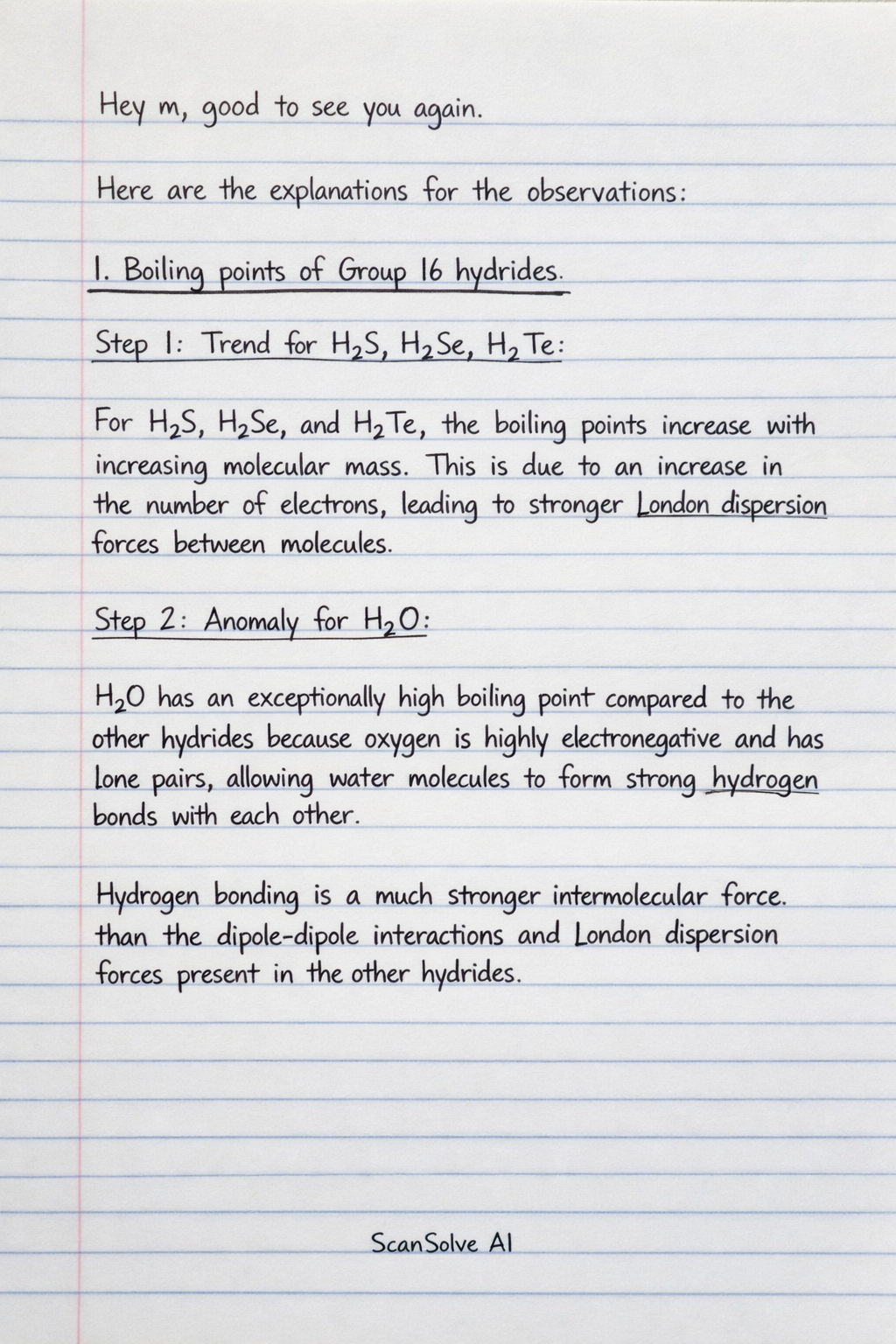
Hey m, good to see you again. Here are the explanations for the observations: 1. Boiling points of Group 16 hydrides Step 1: Explain the general trend for H_2S, H_2Se, H_2Te. For H_2S, H_2Se, and H_2Te, the boiling points increase with increasing molecular mass. This is due to an increase in the number of electrons, leading to stronger London dispersion forces between molecules. Step 2: Explain the anomaly for H_2O. H_2O has an exceptionally high boiling point compared to the other hydrides because oxygen is highly electronegative and has lone pairs, allowing water molecules to form strong hydrogen bonds with each other. Hydrogen bonding is a much stronger intermolecular force than the dipole-dipole interactions and London dispersion forces present in the other hydrides. 2. Miscibility of CCl_4 and CH_3OH with water Step 1: Explain CCl_4 immiscibility. Tetrachloromethane (CCl_4) is a nonpolar molecule because its tetrahedral geometry causes the bond dipoles to cancel out. It only exhibits weak London dispersion forces. Water is a polar molecule with strong hydrogen bonds. Since CCl_4 cannot form hydrogen bonds with water, it cannot effectively disrupt water's strong hydrogen bonding network, making them immiscible. Step 2: Explain CH_3OH miscibility. Methanol (CH_3OH) is a polar molecule containing an -OH group. This group allows methanol to form hydrogen bonds with water molecules. Because both methanol and water can form hydrogen bonds, they are miscible in all proportions. 3. Solubility of methanoic acid and octanoic acid in water Step 1: Explain methanoic acid solubility. Methanoic acid (HCOOH) is a small carboxylic acid. Its polar -COOH group can form strong hydrogen bonds with water molecules. The small nonpolar part (a single hydrogen atom) does not significantly impede this interaction, making it soluble in water. Step 2: Explain octanoic acid solubility. Octanoic acid (C_7H_15COOH) also has a polar -COOH group capable of forming hydrogen bonds. However, it possesses a long, nonpolar hydrocarbon chain (C_7H_15). This large hydrophobic chain disrupts the hydrogen bonding network of water, and the energy gained from hydrogen bonding with the -COOH group is insufficient to overcome this disruption, making octanoic acid much less soluble. Drop the next question! 📸