How can prepared a named aldehyde and ketone use oxidation of alcohol

Chemistry

ScanSolve AI Answer

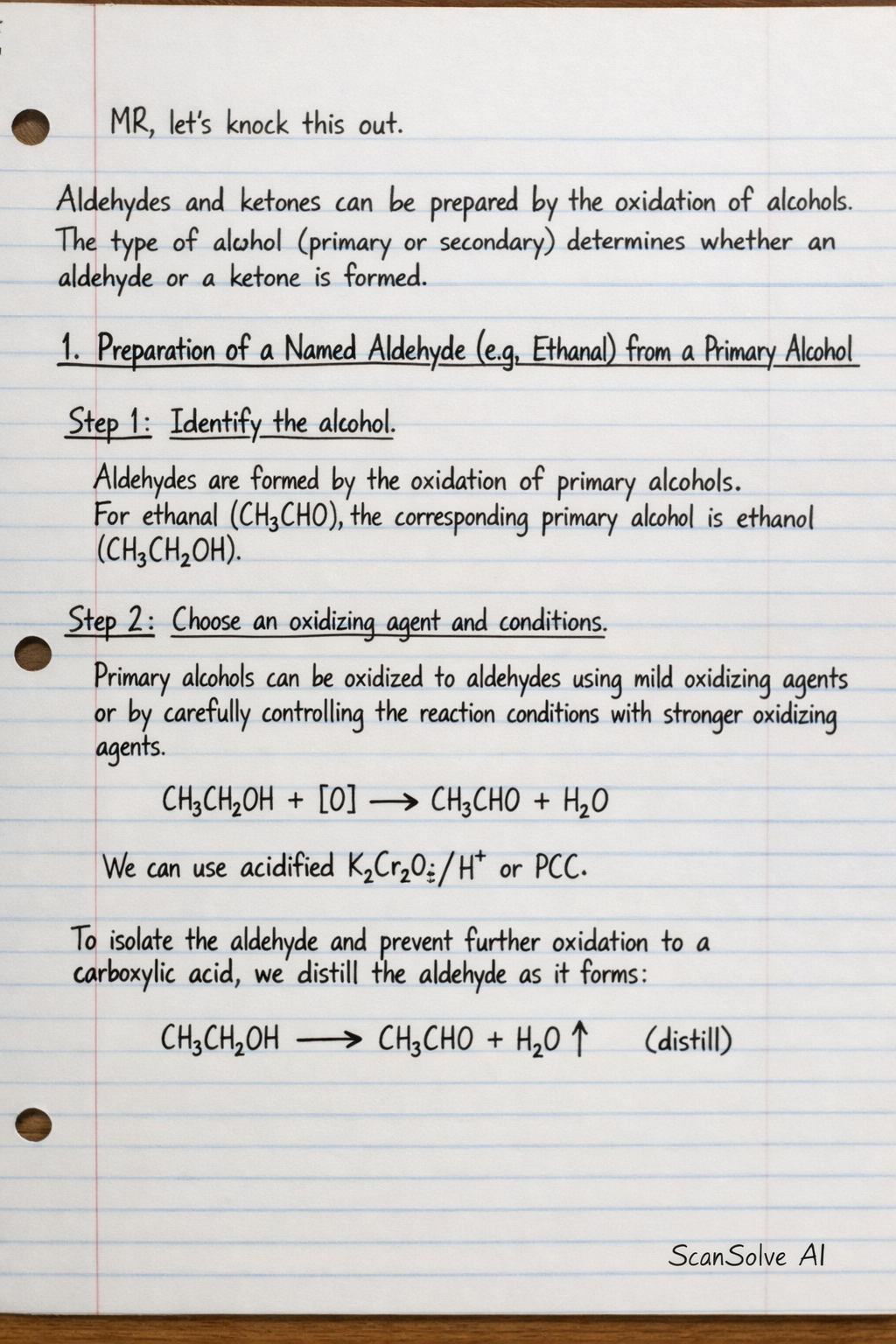
Aldehydes and ketones can be prepared by the oxidation of alcohols. The type of alcohol (primary or secondary) determines whether an aldehyde or a ketone is formed.

1. Preparation of a Named Aldehyde (e.g., Ethanal) from a Primary Alcohol

Step 1: Identify the alcohol. Aldehydes are formed by the oxidation of primary alcohols. For ethanal (CH3CHO\text{CH}_3\text{CHO}), the corresponding primary alcohol is ethanol (CH3CH2OH\text{CH}_3CH_2\text{OH}).

Step 2: Choose an oxidizing agent and conditions. Primary alcohols can be oxidized to aldehydes using mild oxidizing agents or by carefully controlling the reaction conditions with stronger oxidizing agents. A common method uses acidified potassium dichromate(VI) (K2Cr2O7/H+\text{K}_2Cr_2O_7/H^+) or pyridinium chlorochromate (PCC). To obtain the aldehyde and prevent further oxidation to a carboxylic acid, the aldehyde is distilled off as it forms, as it has a lower boiling point than the alcohol and the carboxylic acid.

Step 3: Write the chemical equation. The oxidation of ethanol to ethanal using acidified potassium dichromate(VI) is: CH3CH2OH(l)+[O]AcidifiedK2Cr2O7,heat,distillCH3CHO(l)+H2O(l)CH_3CH_2OH (l) + [O] \xrightarrow{Acidified K_2Cr_2O_7, heat, distill} CH_3CHO (l) + H_2O (l) The named aldehyde prepared is Ethanal.

2. Preparation of a Named Ketone (e.g., Propanone) from a Secondary Alcohol

Step 1: Identify the alcohol. Ketones are formed by the oxidation of secondary alcohols. For propanone (CH3COCH3\text{CH}_3COCH_3), the corresponding secondary alcohol is propan-2-ol (CH3CH(OH)CH3\text{CH}_3CH(OH)CH_3).

Step 2: Choose an oxidizing agent and conditions. Secondary alcohols are oxidized to ketones using strong oxidizing agents like acidified potassium dichromate(VI) (K2Cr2O7/H+\text{K}_2Cr_2O_7/H^+) or acidified potassium permanganate (KMnO4/H+\text{KMnO}_4/H^+). Ketones are generally resistant to further oxidation under these conditions, so vigorous heating is often used.

Step 3: Write the chemical equation. The oxidation of propan-2-ol to propanone using acidified potassium dichromate(VI) is: CH3CH(OH)CH3(l)+[O]AcidifiedK2Cr2O7,heatCH3COCH3(l)+H2O(l)CH_3CH(OH)CH_3 (l) + [O] \xrightarrow{Acidified K_2Cr_2O_7, heat} CH_3COCH_3 (l) + H_2O (l) The named ketone prepared is Propanone.

Send me the next one 📸

Was this helpful?

Need help with your own homework?

Get instant step-by-step solutions to any question. Free to start.

Ask Your Question
Handwritten step-by-step solution preview

Handwritten Step-by-Step Solution

Get this as a handwritten image on WhatsApp — like a tutor wrote it for you.

Try on WhatsApp

Still have questions?

Quick Answer

Aldehydes and ketones can be prepared by the oxidation of alcohols. The type of alcohol (primary or secondary) determines whether an aldehyde or a ketone is formed.

How can prepared a named aldehyde and ketone use oxidation of alcohol
Chemistry

This chemistry question involves key chemical concepts and calculations. The detailed solution below walks through each step, from identifying the reaction type to computing the final answer.

ScanSolve AI Answer
Aldehydes and ketones can be prepared by the oxidation of alcohols. The type of alcohol (primary or secondary) determines whether an aldehyde or a ketone is formed. 1. Preparation of a Named Aldehyde (e.g., Ethanal) from a Primary Alcohol Step 1: Identify the alcohol. Aldehydes are formed by the oxidation of primary alcohols. For ethanal (CH_3CHO), the corresponding primary alcohol is ethanol (CH_3CH_2OH). Step 2: Choose an oxidizing agent and conditions. Primary alcohols can be oxidized to aldehydes using mild oxidizing agents or by carefully controlling the reaction conditions with stronger oxidizing agents. A common method uses acidified potassium dichromate(VI) (K_2Cr_2O_7/H^+) or pyridinium chlorochromate (PCC). To obtain the aldehyde and prevent further oxidation to a carboxylic acid, the aldehyde is distilled off as it forms, as it has a lower boiling point than the alcohol and the carboxylic acid. Step 3: Write the chemical equation. The oxidation of ethanol to ethanal using acidified potassium dichromate(VI) is: CH_3CH_2OH (l) + [O] Acidified K_2Cr_2O_7, heat, distill CH_3CHO (l) + H_2O (l) The named aldehyde prepared is Ethanal. 2. Preparation of a Named Ketone (e.g., Propanone) from a Secondary Alcohol Step 1: Identify the alcohol. Ketones are formed by the oxidation of secondary alcohols. For propanone (CH_3COCH_3), the corresponding secondary alcohol is propan-2-ol (CH_3CH(OH)CH_3). Step 2: Choose an oxidizing agent and conditions. Secondary alcohols are oxidized to ketones using strong oxidizing agents like acidified potassium dichromate(VI) (K_2Cr_2O_7/H^+) or acidified potassium permanganate (KMnO_4/H^+). Ketones are generally resistant to further oxidation under these conditions, so vigorous heating is often used. Step 3: Write the chemical equation. The oxidation of propan-2-ol to propanone using acidified potassium dichromate(VI) is: CH_3CH(OH)CH_3 (l) + [O] Acidified K_2Cr_2O_7, heat CH_3COCH_3 (l) + H_2O (l) The named ketone prepared is Propanone. Send me the next one 📸