
We read your photo as:
Explain chemical equilibrium and analyze the effect of adding O2 and decreasing pressure on a reaction involving CO, O2, and CO2.
ScanSolve AI Answer
Here are the answers to your questions:
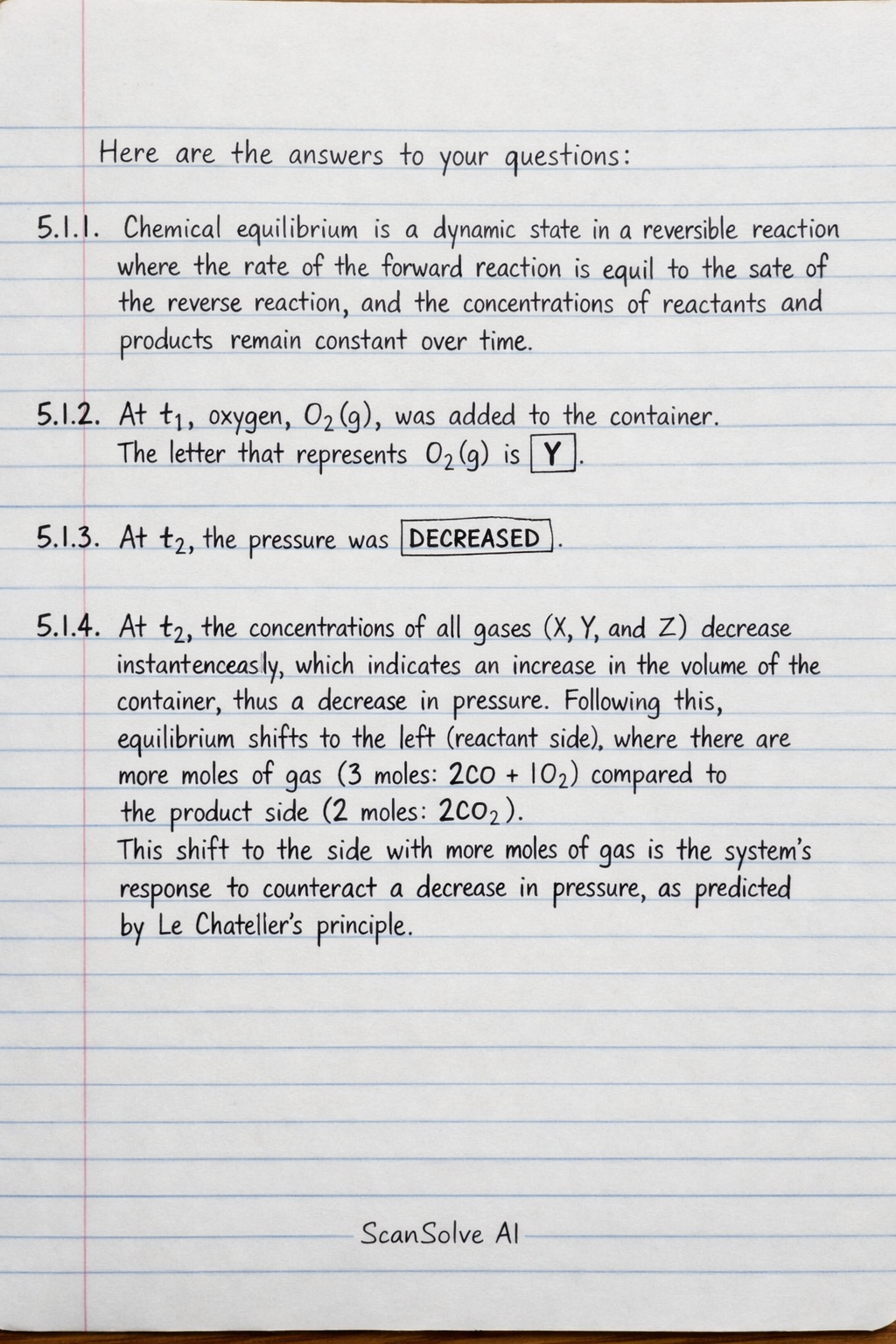
5.1.1. Chemical equilibrium is a dynamic state in a reversible reaction where the rate of the forward reaction is equal to the rate of the reverse reaction, and the concentrations of reactants and products remain constant over time.
5.1.2. At , oxygen, , was added to the container. The letter that represents is .
5.1.3. At , the pressure was .
5.1.4. At , the concentrations of all gases (X, Y, and Z) decrease instantaneously, which indicates an increase in the volume of the container, thus a decrease in pressure. Following this, the equilibrium shifts to the left (reactant side), where there are more moles of gas (3 moles: ) compared to the product side (2 moles: ). This shift to the side with more moles of gas is the system's response to counteract a decrease in pressure, as predicted by Le Chatelier's principle.
5.1.5. The gas represented by the letter Z is .
5.1.6. Z represents the product because its concentration is initially low and increases as the reaction proceeds towards equilibrium. When (Y) is added at , the equilibrium shifts to the right, causing the concentration of Z to increase further. Conversely, when the pressure is decreased at , the equilibrium shifts to the left, leading to a decrease in the concentration of Z. These changes are consistent with Z being the product of the reaction.
5.1.7. The change in temperature made at is .
5.1.8. The forward reaction is exothermic, indicated by . At , the temperature is decreased. According to Le Chatelier's principle, the system will counteract this stress by favoring the reaction that produces heat. Therefore, the equilibrium shifts to the right (forward reaction) to release more heat and increase the temperature. This shift results in a decrease in the concentrations of reactants (X and Y) and an increase in the concentration of the product (Z), which is observed in the graph after .
Still stuck on this one?
Ask a follow-up, and the answer starts from this question.
More Chemistry Questions
Handwritten Step-by-Step Solution
Get this as a handwritten image on WhatsApp — like a tutor wrote it for you.
Try on WhatsApp