
We read your photo as:
Compare the volume of hydrogen gas produced in experiment 1 and experiment 2 at 120s and explain the difference in reaction rates between experiment 2 and experiment 1, and experiment 3 and experiment
ScanSolve AI Answer
Here are the solutions to your questions:
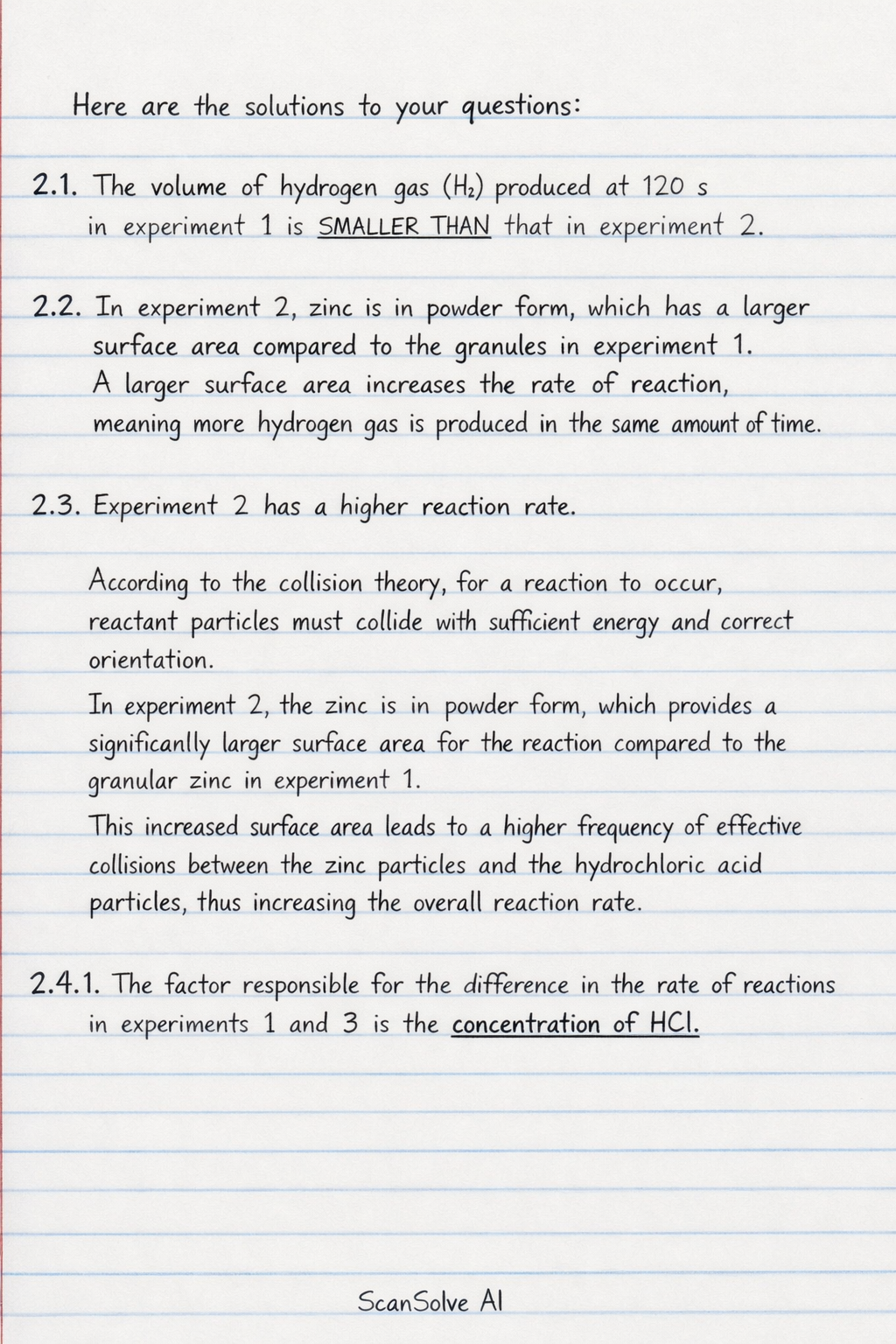
2.1. The volume of hydrogen gas (H₂) produced at 120 s in experiment 1 is SMALLER THAN that in experiment 2.
2.2. In experiment 2, zinc is in powder form, which has a larger surface area compared to the granules in experiment 1. A larger surface area increases the rate of reaction, meaning more hydrogen gas is produced in the same amount of time.
2.3. Experiment 2 has a higher reaction rate.
According to the collision theory, for a reaction to occur, reactant particles must collide with sufficient energy and correct orientation. In experiment 2, the zinc is in powder form, which provides a significantly larger surface area for the reaction compared to the granular zinc in experiment 1. This increased surface area leads to a higher frequency of effective collisions between the zinc particles and the hydrochloric acid particles, thus increasing the overall reaction rate.
2.4.1. The factor responsible for the difference in the rate of reactions in experiments 1 and 3 is the concentration of HCl.
2.4.2. According to the collision theory, a higher concentration of HCl (as in experiment 3 compared to experiment 1) means there are more reactant particles (H⁺ ions) per unit volume. This increases the frequency of collisions between the zinc particles and the H⁺ ions. A higher frequency of collisions, in turn, leads to a higher frequency of effective collisions (those with sufficient energy and correct orientation), resulting in a faster reaction rate.
Still stuck on this one?
Ask a follow-up, and the answer starts from this question.
More Chemistry Questions
Handwritten Step-by-Step Solution
Get this as a handwritten image on WhatsApp — like a tutor wrote it for you.
Try on WhatsApp