
We read your photo as:
Complete the following reactions: CH3−C(=CH2)CH3 + H2SO4(aq) (ii) CH3−C(=C(CH3)2)−CH3 + KMnO4/H2O (iii) CH3-C≡CH + 2HBr --(FeCl3)
ScanSolve AI Answer
Answer
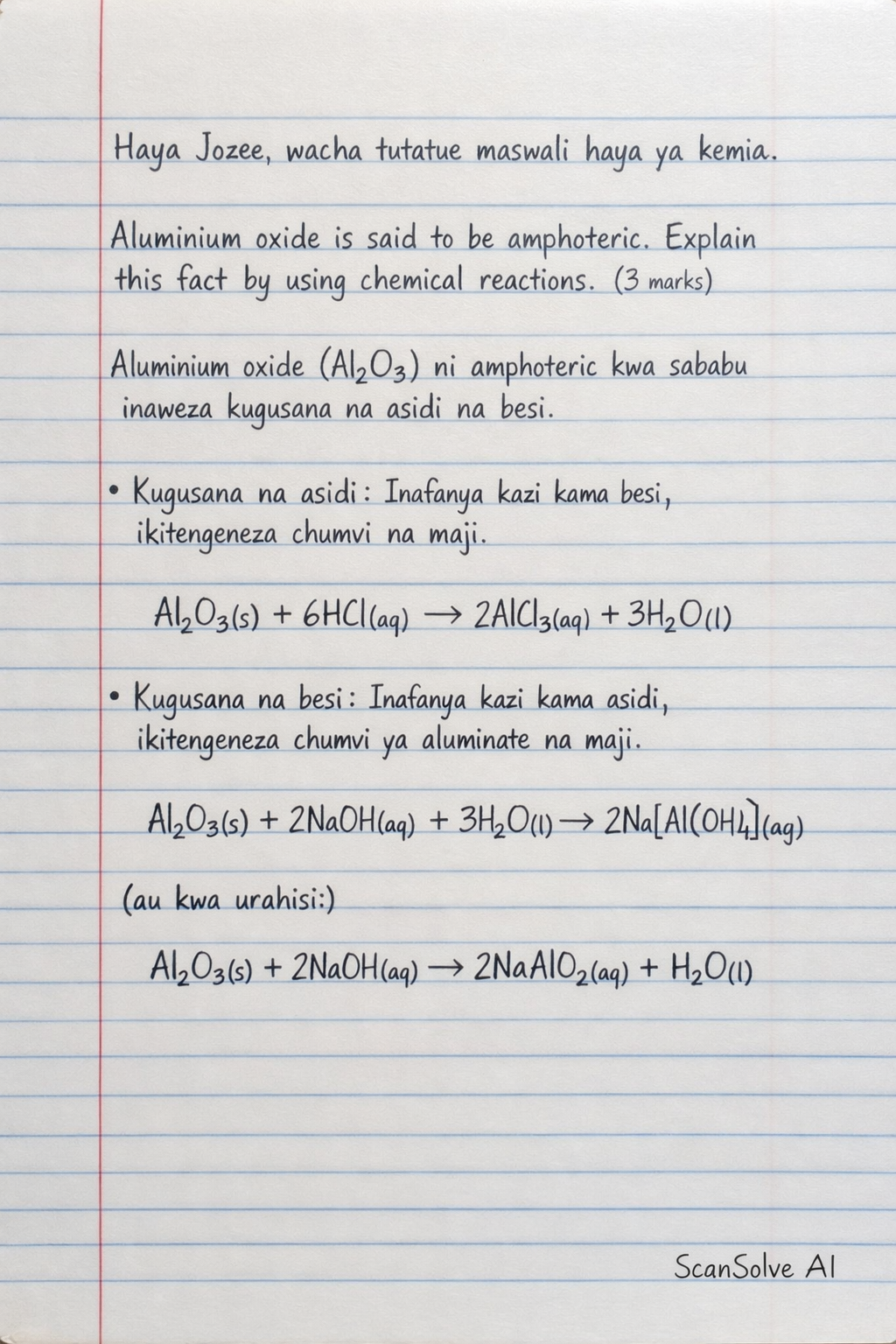
Haya Jozee, wacha tutatue maswali haya ya kemia.
Aluminium oxide is said to be amphoteric. Explain this fact by using chemical reactions. (3 marks)
Aluminium oxide () ni amphoteric kwa sababu inaweza kugusana na asidi na besi.
- Kugusana na asidi: Inafanya kazi kama besi, ikitengeneza chumvi na maji.
- Kugusana na besi: Inafanya kazi kama asidi, ikitengeneza chumvi ya aluminate na maji. (au kwa urahisi: )
Iron (III) carbonate never exists. Explain this statement.
Iron (III) carbonate () haipo kwa sababu ioni ya Iron (III) () ina uwezo mkubwa wa kuhydrolyze katika maji. Ioni ya ni asidi kali ya Lewis na itagusana na maji kutoa ioni za hidrojeni (), na hivyo kufanya suluhisho kuwa asidi. Ioni za karbonati () ni besi kali na zitagusana na ioni za kutoa asidi kaboniki (), ambayo hutengana haraka kuwa kaboni dioksidi na maji. Hivyo, badala ya kutengeneza kabonati ya chuma (III), hidroksidi ya chuma (III) () hutengenezwa na gesi ya kaboni dioksidi hutolewa.
Explain the following with the aid of chemical reaction if applicable:
-
i. MgCl₂.6H₂O when heated can never give out anhydrous MgCl₂. Wakati magnesium chloride hexahydrate () inapokanzwa, haitoi anhydrous magnesium chloride () kwa sababu ioni ya ina uwezo mkubwa wa kuhydrolyze. Katika joto la juu, maji ya fuwele hugusana na ioni ya kutoa magnesium oksidi () na hidrojeni kloridi () badala yake.
-
ii. CuCl₂ solution is acidic to litmus paper. Suluhisho la copper (II) chloride () ni asidi kwa karatasi ya litmus kwa sababu ioni ya copper (II) () hupitia hydrolysis katika maji. Ioni ya hufanya kazi kama asidi ya Lewis, ikivuta elektroni kutoka kwa molekuli za maji na kusababisha kutolewa kwa ioni za hidrojeni (), na hivyo kufanya suluhisho kuwa asidi.
-
iii. Fe₃O₄ is called mixed oxide. inaitwa mixed oxide kwa sababu inaweza kuonekana kama mchanganyiko wa oksidi mbili za chuma: Iron (II) oxide () na Iron (III) oxide (). Muundo wake halisi ni , ambapo chuma kipo katika hali zote mbili za oksidesheni, +2 na +3.
SECTION B (30 MARKS)
(a) Using one example, briefly explain the following:
-
i. Homologous series
- Homologous series ni mfululizo wa misombo ya kikaboni ambayo ina functional group sawa na sifa za kemikali zinazofanana, na kila mwanachama hutofautiana na mwanachama anayefuata kwa kitengo cha .
- Mfano: Alkanes (methane , ethane , propane ).
-
ii. Functional group
- Functional group ni atomi au kikundi cha atomi ndani ya molekuli ambayo huipa molekuli hiyo sifa zake maalum za kemikali.
- Mfano: Kikundi cha hydroxyl () katika alkoholi (k.m., ethanol ).
-
iii. Isomerism
- Isomerism ni jambo ambapo misombo miwili au zaidi ina fomula ya molekuli sawa lakini miundo tofauti ya atomi, na hivyo kusababisha sifa tofauti za kimwili na kemikali.
- Mfano: Butane () na isobutane (2-methylpropane, ) zote zina fomula ya molekuli .
-
iv. Elimination reactions
- Elimination reactions ni athari za kikaboni ambapo atomi mbili au vikundi vya atomi huondolewa kutoka kwa molekuli, mara nyingi huunda dhamana mpya ya pi (k.m., dhamana mbili au tatu).
- Mfano: Dehydration ya ethanol kutoa ethene.
(b) By using chemical reactions, show how Phenol() reacts with:
-
i. Heated zinc dusts. Phenol hupunguzwa kuwa benzene.
-
ii. Sodium hydroxide solution. Phenol hugusana na besi kali kutengeneza chumvi ya sodium phenoxide.
-
iii. Dilute nitric (V) acid at room temperature. Phenol hupitia nitration, ikitengeneza mchanganyiko wa 2-nitrophenol na 4-nitrophenol.
(Au kwa fomula za miundo):
(c) Complete the following reactions:
-
i. Hii ni hydration ya alkene (2-methylpropene) kwa kutumia asidi. Inafuata sheria ya Markovnikov.
(2-methylpropan-2-ol)
-
ii. Hii ni oxidation ya alkene (2,3-dimethylbut-2-ene) na cold, dilute potassium permanganate (Baeyer's test), ikitengeneza diol.
(2,3-dimethylbutane-2,3-diol)
-
iii. Hii ni nyongeza ya hydrogen bromide kwa alkyne (propyne). Kwa kuwa kuna molekuli mbili za HBr, nyongeza itatokea mara mbili, ikifuata sheria ya Markovnikov kila wakati, na kutengeneza dihalide ya geminal. Ingawa si kichocheo cha kawaida kwa athari hii, athari kuu ni nyongeza ya HBr.
(2,2-dibromopropane)
Try one yourself
A new problem that tests the same skill.
Still stuck on this one?
Ask a follow-up, and the answer starts from this question.
More Chemistry Questions
Handwritten Step-by-Step Solution
Get this as a handwritten image on WhatsApp — like a tutor wrote it for you.
Try on WhatsApp