
We read your photo as:
Complete the table giving the formulae of the oxides of the elements and select oxides that are amphoteric, neutral and acidic.
ScanSolve AI Answer
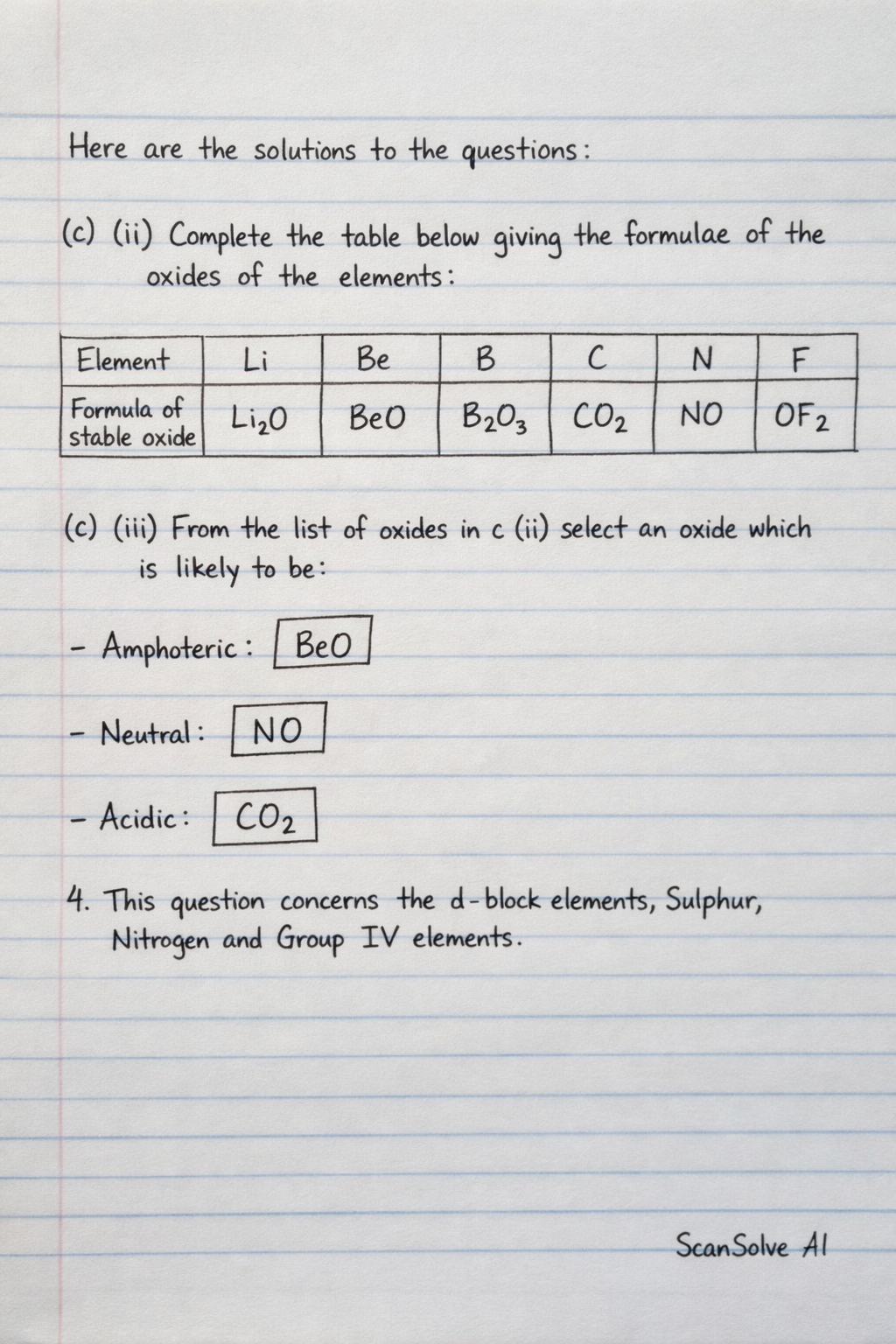
Here are the solutions to the questions:
(c) (ii) Complete the table below giving the formulae of the oxides of the elements
| Element | Li | Be | B | C | N | F |
|---|---|---|---|---|---|---|
| Formula of stable oxide |
(c) (iii) From the list of oxides in c (ii) select an oxide which is likely to be:
- Amphoteric:
- Neutral:
- Acidic:
4. This question concerns the d-block elements, Sulphur, Nitrogen and Group IV elements.
(a) (i) Distinguish between a d-block element and a transition metal.
A d-block element is an element whose last electron enters a d-orbital. A transition metal is a d-block element that forms at least one ion with a partially filled d-subshell. All transition metals are d-block elements, but not all d-block elements (e.g., Scandium and Zinc) are considered transition metals by this definition.
(a) (ii) Write down the symbols for the elements of the first transition series in increasing order of atomic number.
(a) (iii) State the property of the transition element which enables them to act as catalyst in many industrial processes.
Transition elements act as catalysts due to their ability to exhibit variable oxidation states and to form intermediate compounds with reactants, providing alternative reaction pathways with lower activation energies.
(b) Consider the following complex compound [NaFe(CN)]
(b) (i) Give the name of the complex the compound above.
The complex compound is .
(b) (ii) State
-
A) the coordination number of iron in the complex compound The coordination number is the number of ligands directly bonded to the central metal ion. In , there are 6 cyanide ligands. Coordination number =
-
B) the oxidation state of iron in the complex compound Let the oxidation state of Fe be . The charge of is +1. The charge of is -1.
Oxidation state of iron =
(b) (iii) Draw the structure of the complex ion in b (i) and give its shape.
The complex ion is . With a coordination number of 6, its shape is octahedral.
\begin{tikzpicture}[scale=0.8]
\node (Fe) at (0,0) {Fe};
\node (CN1) at (0,2) {CN};
\node (CN2) at (0,-2) {CN};
\node (CN3) at (2,0) {CN};
\node (CN4) at (-2,0) {CN};
\node (CN5) at (1.41,1.41) {}; % Placeholder for front/back
\node (CN6) at (-1.41,-1.41) {}; % Placeholder for front/back

\draw[thick] (Fe) -- (CN1);
\draw[thick] (Fe) -- (CN2);
\draw[thick] (Fe) -- (CN3);
\draw[thick] (Fe) -- (CN4);

% Dashed for back, wedge for front
\draw[dashed, thick] (Fe) -- (-1.41,1.41) node[above left] {CN};
\draw[thick, line width=2pt, cap=round] (Fe) -- (1.41,-1.41) node[below right] {CN};

\node at (0, -3) {Shape: \textbf{Octahedral}};
\node at (2.5, 2.5) {$4-$}; % Charge of the complex ion
\end{tikzpicture}
(c) Give the formula of a fertilizer containing nitrogen and sulphur atoms and state the oxidation state of nitrogen and sulphur in the compound.
| Formula of fertilizer | Oxidation state of Nitrogen | Oxidation state of Sulphur |
|---|---|---|
Still stuck on this one?
Ask a follow-up, and the answer starts from this question.
More Chemistry Questions
Handwritten Step-by-Step Solution
Get this as a handwritten image on WhatsApp — like a tutor wrote it for you.
Try on WhatsApp