
We read your photo as:
Describe the components of a mass spectrometer and explain proton-noise decoupling in C-13 NMR.
ScanSolve AI Answer
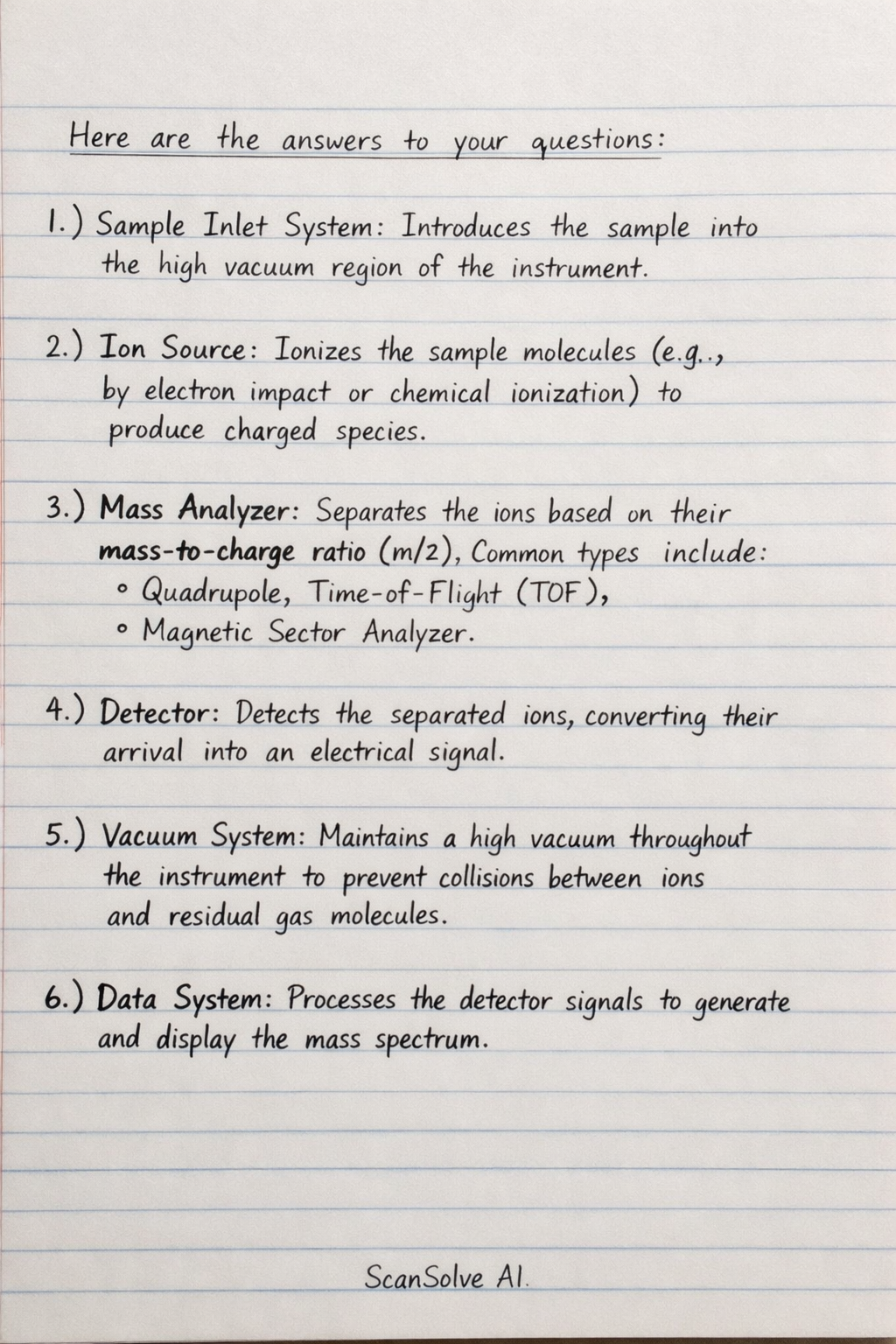
Here are the answers to your questions:
-
A mass spectrometer consists of the following main components, typically arranged in sequence:
- Sample Inlet System: Introduces the sample into the high vacuum region of the instrument.
- Ion Source: Ionizes the sample molecules (e.g., by electron impact or chemical ionization) to produce charged species.
- Mass Analyzer: Separates the ions based on their mass-to-charge ratio (). Common types include quadrupole, time-of-flight (TOF), or magnetic sector analyzers.
- Detector: Detects the separated ions, converting their arrival into an electrical signal.
- Vacuum System: Maintains a high vacuum throughout the instrument to prevent collisions between ions and residual gas molecules.
- Data System: Processes the detector signals to generate and display the mass spectrum.
-
Proton-noise decoupling is a technique primarily used in C NMR spectroscopy to simplify the spectrum. It involves irradiating the sample with a broad band of radiofrequency (RF) energy at the proton resonance frequency during the acquisition of the C spectrum. This rapid irradiation causes the protons to flip their spins quickly, effectively averaging out their coupling interactions with the C nuclei. As a result, each carbon signal appears as a single, sharp peak (a singlet), rather than a multiplet, making the spectrum easier to interpret and enhancing signal intensity due to the nuclear Overhauser effect (NOE).
Still stuck on this one?
Ask a follow-up, and the answer starts from this question.
More Chemistry Questions
Handwritten Step-by-Step Solution
Get this as a handwritten image on WhatsApp — like a tutor wrote it for you.
Try on WhatsApp