
We read your photo as:
Compound A: CH3CH2CH₂OH (Propan-1-ol)
ScanSolve AI Answer
Answers
5 partsHere are the answers to the questions based on the provided table:
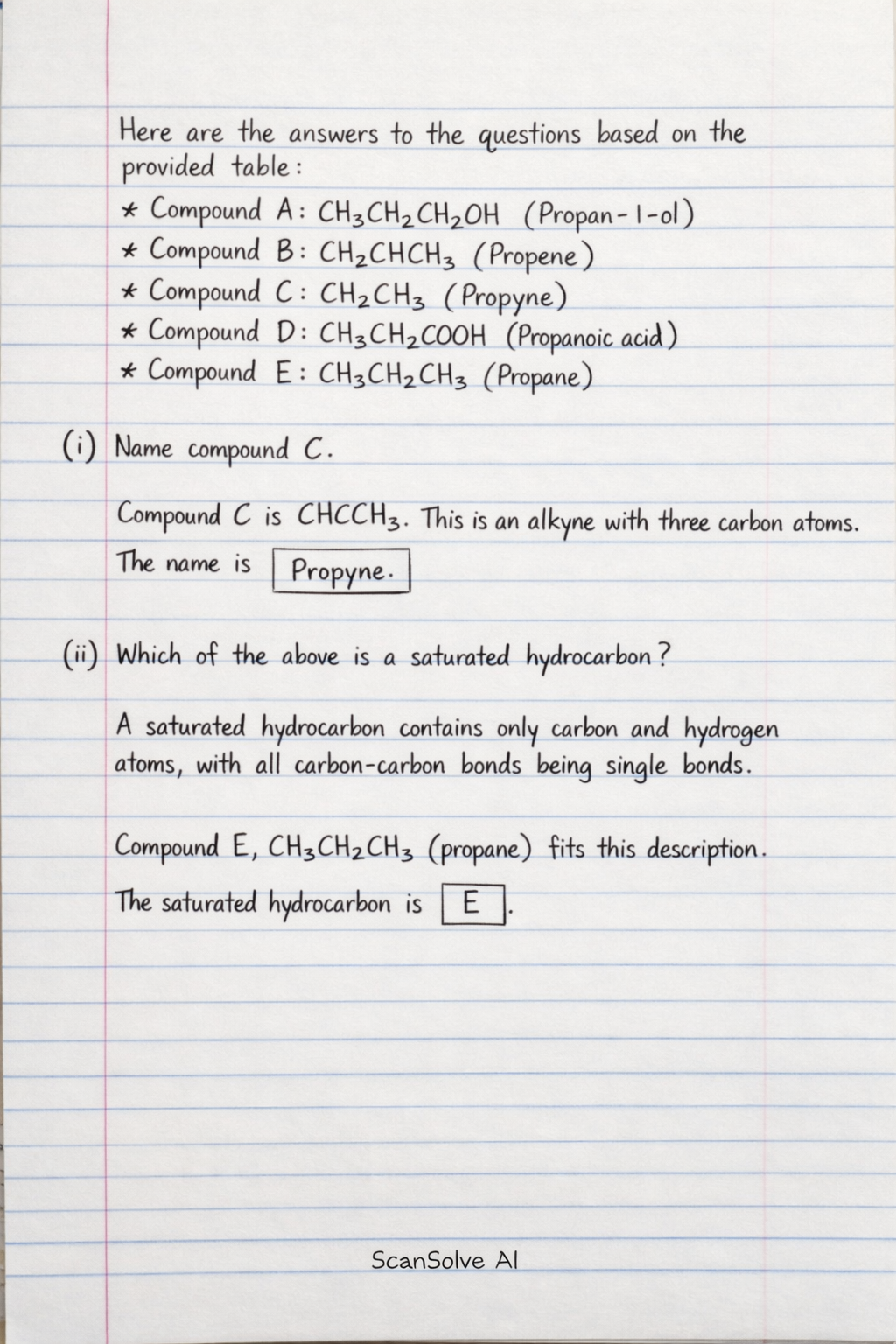
- Compound A: (Propan-1-ol)
- Compound B: (Propene)
- Compound C: (Propyne)
- Compound D: (Propanoic acid)
- Compound E: (Propane)
(i) Name compound C.
Compound C is . This is an alkyne with three carbon atoms.
The name is .
(ii) Which of the above is a saturated hydrocarbon?
A saturated hydrocarbon contains only carbon and hydrogen atoms, with all carbon-carbon bonds being single bonds.
Compound E, (propane), fits this description.
The saturated hydrocarbon is .
(iii) Give one chemical test for compound B.
Compound B is (propene), which is an alkene and thus unsaturated.
A chemical test for unsaturation is:
- Add . The orange-brown color of the bromine water will .
(iv) Name the compound formed when A and D react in the presence of an acid.
Compound A is propan-1-ol (an alcohol) and Compound D is propanoic acid (a carboxylic acid). When an alcohol and a carboxylic acid react in the presence of an acid catalyst, an ester is formed. This reaction is called esterification.
The alcohol part is propyl and the acid part is propanoate.
The compound formed is .
(v) Compound A has a higher boiling point than compound E. Explain.
Compound A (, propan-1-ol) is an alcohol, while Compound E (, propane) is an alkane.
- Compound A can form . The hydroxyl (-OH) group in propan-1-ol allows for strong intermolecular hydrogen bonding.
- Compound E, being an alkane, only has .
- More energy is required to overcome the stronger hydrogen bonds in propan-1-ol compared to the weaker London dispersion forces in propane, resulting in a higher boiling point for Compound A.
Try one yourself
A new problem that tests the same skill.
Still stuck on this one?
Ask a follow-up, and the answer starts from this question.
More Chemistry Questions
Handwritten Step-by-Step Solution
Get this as a handwritten image on WhatsApp — like a tutor wrote it for you.
Try on WhatsApp