
We read your photo as:
Calculate the concentration (mol dm⁻³) of your sodium oxalate solution (Na₂C₂O₄) given the mass of sodium oxalate used and the volume of the solution prepared.
ScanSolve AI Answer
Step-by-step solution
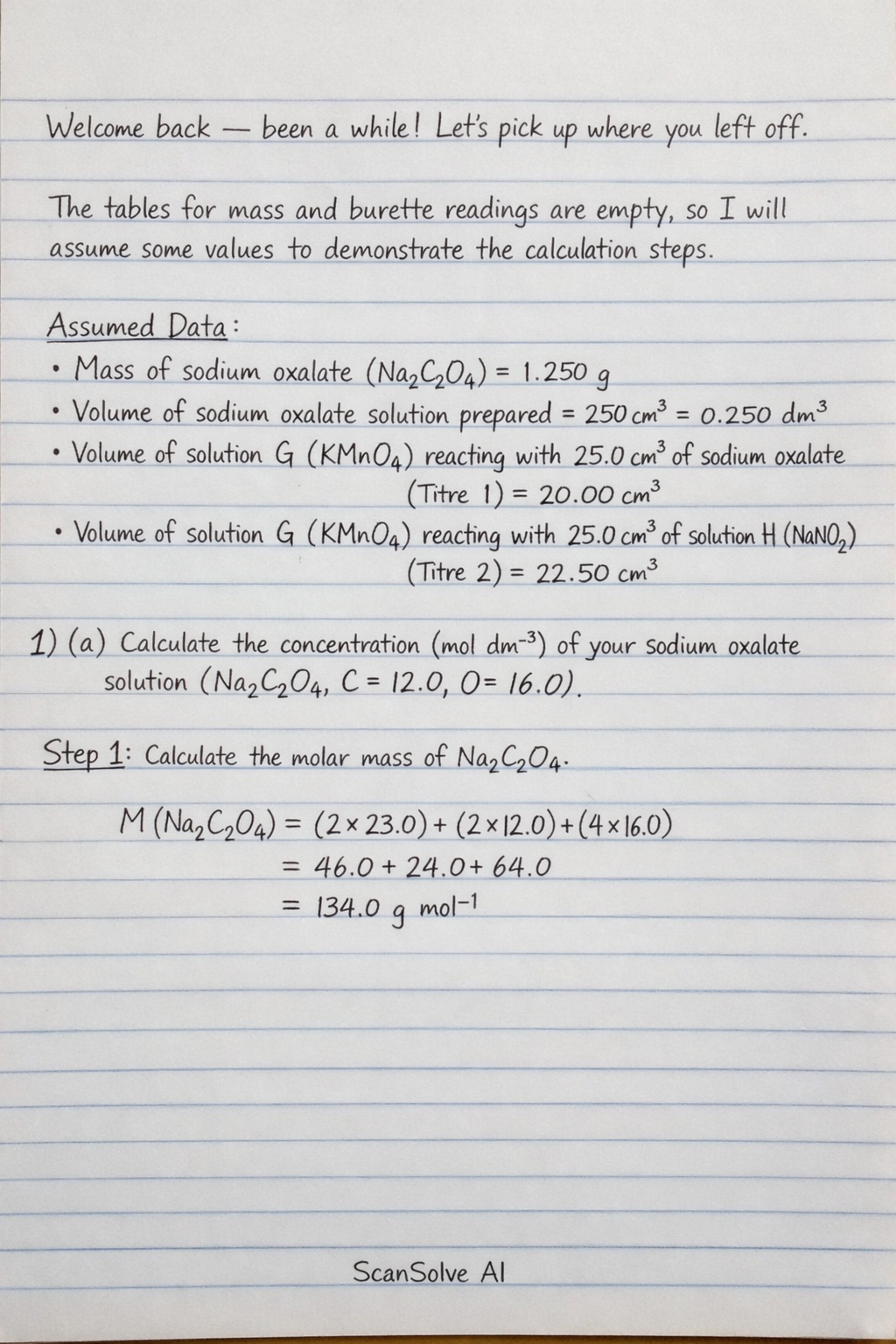
11 stepsThe tables for mass and burette readings are empty, so I will assume some values to demonstrate the calculation steps.
Assumed Data:
- Mass of sodium oxalate () = 1.250 g
- Volume of sodium oxalate solution prepared = 250 cm³ = 0.250 dm³
- Volume of solution G () reacting with 25.0 cm³ of sodium oxalate (Titre 1) = 20.00 cm³
- Volume of solution G () reacting with 25.0 cm³ of solution H () (Titre 2) = 22.50 cm³
1 (a) Calculate the concentration (mol dm⁻³) of your sodium oxalate solution (, C = 12.0, O = 16.0).
Calculate the molar mass of .
Calculate the moles of sodium oxalate.
Calculate the concentration of sodium oxalate solution.
1 (b) The concentration (mol dm⁻³) of the potassium permanganate in solution G.
The balanced equation for the reaction between and is:
The mole ratio of to is 2:5.Calculate the moles of in 25.0 cm³ of solution.
Calculate the moles of that reacted.
Calculate the concentration of in solution G.
2 Find the concentration (mol dm⁻³) of the sodium nitrite in solution H.
The balanced equation for the reaction between and is given:
The mole ratio of to is 2:5.Calculate the moles of that reacted with solution H.
Calculate the moles of that reacted.
Calculate the concentration of in solution H.
3 Find the mass of sodium nitrite actually present in 1 dm³ of solution H (O = 16.0).
Calculate the molar mass of .
Calculate the mass of in 1 dm³ of solution H.
4 Calculate the percentage purity of the sodium nitrite used.
To calculate the percentage purity, the initial mass of the impure sodium nitrite used to prepare solution H is required. This information is not provided in the problem.
If, for example, 3.00 g of impure sodium nitrite was dissolved to make 1 dm³ of solution H, then the calculation would be:
(This is an example calculation assuming an initial impure mass of 3.00 g.)
Still stuck on this one?
Ask a follow-up, and the answer starts from this question.
More Chemistry Questions
Handwritten Step-by-Step Solution
Get this as a handwritten image on WhatsApp — like a tutor wrote it for you.
Try on WhatsApp