We read your photo as:

Calculate the concentration of HCl (Solution A) in mol dm⁻³ given the information and reaction for a titration problem.

Chemistry

ScanSolve AI Answer

This answer stops before the end.

It was cut off when it was first written. Ask ScanSolve this question again for the full working.

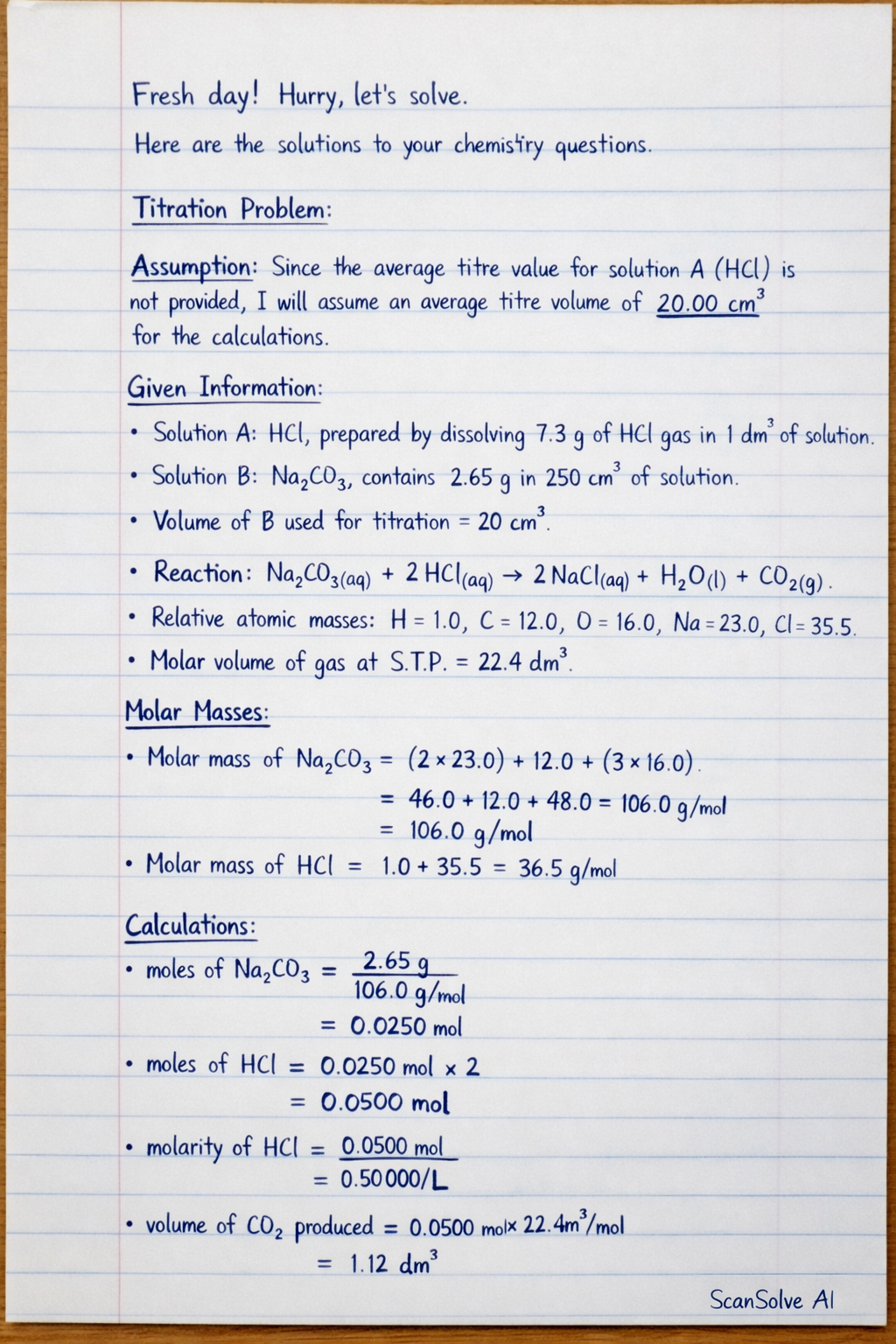
Here are the solutions to your chemistry questions.

Titration Problem:

Assumption: Since the average titre value for solution A (HCl) is not provided, I will assume an average titre volume of 20.00 cm3\mathbf{20.00 \text{ cm}^3} for the calculations.

Given Information:

  • Solution A: HCl, prepared by dissolving 7.3 g of HCl gas in 1 dm3^3 of solution.
  • Solution B: Na2_2CO3_3, contains 2.65 g in 250 cm3^3 of solution.
  • Volume of B used for titration = 20 cm3^3.
  • Reaction: Na2CO3(aq)+2HCl(aq)→2NaCl(aq)+H2O(l)+CO2(g)\text{Na}_2\text{CO}_3(aq) + 2\text{HCl}(aq) \rightarrow 2\text{NaCl}(aq) + \text{H}_2\text{O}(l) + \text{CO}_2(g)
  • Relative atomic masses: H=1.0, C=12.0, O=16.0, Na=23.0, Cl=35.5.
  • Molar volume of gas at S.T.P. = 22.4 dm3^3.

Molar Masses:

  • Molar mass of Na2CO3=(2×23.0)+12.0+(3×16.0)=46.0+12.0+48.0=106.0 g/mol\text{Na}_2\text{CO}_3 = (2 \times 23.0) + 12.0 + (3 \times 16.0) = 46.0 + 12.0 + 48.0 = 106.0 \text{ g/mol}.
  • Molar mass of HCl=1.0+35.5=36.5 g/mol\text{HCl} = 1.0 + 35.5 = 36.5 \text{ g/mol}.

Calculations:

1. (i) Concentration of B in mol dm−3^{-3}

Step 1: Calculate the number of moles of Na2CO3\text{Na}_2\text{CO}_3 in 250 cm3^3.

Moles of Na2CO3=MassMolar mass=2.65 g106.0 g/mol=0.025 mol\text{Moles of Na}_2\text{CO}_3 = \frac{\text{Mass}}{\text{Molar mass}} = \frac{2.65 \text{ g}}{106.0 \text{ g/mol}} = 0.025 \text{ mol}

Step 2: Calculate the concentration of Na2CO3\text{Na}_2\text{CO}_3 in mol dm−3^{-3}.

Concentration of B=MolesVolume in dm3=0.025 mol250 cm3×1 dm31000 cm3=0.025 mol0.250 dm3=0.100 mol dm−3\text{Concentration of B} = \frac{\text{Moles}}{\text{Volume in dm}^3} = \frac{0.025 \text{ mol}}{250 \text{ cm}^3 \times \frac{1 \text{ dm}^3}{1000 \text{ cm}^3}} = \frac{0.025 \text{ mol}}{0.250 \text{ dm}^3} = 0.100 \text{ mol dm}^{-3}

The concentration of B is 0.100 mol dm−3\boxed{0.100 \text{ mol dm}^{-3}}.

1. (ii) Concentration of A in mol dm−3^{-3}

Step 1: Calculate the number of moles of Na2CO3\text{Na}_2\text{CO}_3 in the 20 cm3^3 portion used for titration.

Moles of Na2CO3 in 20 cm3=Concentration×Volume in dm3\text{Moles of Na}_2\text{CO}_3 \text{ in 20 cm}^3 = \text{Concentration} \times \text{Volume in dm}^3 =0.100 mol dm−3×(20 cm3×1 dm31000 cm3)=0.100 mol dm−3×0.020 dm3=0.002 mol= 0.100 \text{ mol dm}^{-3} \times (20 \text{ cm}^3 \times \frac{1 \text{ dm}^3}{1000 \text{ cm}^3}) = 0.100 \text{ mol dm}^{-3} \times 0.020 \text{ dm}^3 = 0.002 \text{ mol}

Step 2: Use the mole ratio from the balanced equation: 1 mol of Na2CO31 \text{ mol of Na}_2\text{CO}_3 reacts with 2 mol of HCl2 \text{ mol of HCl}.

Moles of HCl=2×Moles of Na2CO3=2×0.002 mol=0.004 mol\text{Moles of HCl} = 2 \times \text{Moles of Na}_2\text{CO}_3 = 2 \times 0.002 \text{ mol} = 0.004 \text{ mol}

Step 3: Calculate the concentration of A (HCl) using the assumed average titre volume of 20.00 cm3^3.

Concentration of A=Moles of HClVolume of A in dm3=0.004 mol20.00 cm3×1 dm31000 cm3=0.004 mol0.020 dm3=0.200 mol dm−3\text{Concentration of A} = \frac{\text{Moles of HCl}}{\text{Volume of A in dm}^3} = \frac{0.004 \text{ mol}}{20.00 \text{ cm}^3 \times \frac{1 \text{ dm}^3}{1000 \text{ cm}^3}} = \frac{0.004 \text{ mol}}{0.020 \text{ dm}^3} = 0.200 \text{ mol dm}^{-3}

The concentration of A is 0.200 mol dm−3\boxed{0.200 \text{ mol dm}^{-3}}.

1. (iii) Concentration of A in g dm−3^{-3}

Step 1: Convert the molar concentration of A (HCl) to mass concentration using its molar mass.

Concentration of A in g dm−3=Concentration in mol dm−3×Molar mass of HCl\text{Concentration of A in g dm}^{-3} = \text{Concentration in mol dm}^{-3} \times \text{Molar mass of HCl} =0.200 mol dm−3×36.5 g/mol=7.30 g dm−3= 0.200 \text{ mol dm}^{-3} \times 36.5 \text{ g/mol} = 7.30 \text{ g dm}^{-3}

The concentration of A is 7.30 g dm−3\boxed{7.30 \text{ g dm}^{-3}}.

1. (iv) Volume of hydrogen chloride gas dissolved in 1 dm3^3 of solution A at S.T.P.

Step 1: The problem states that solution A is prepared by dissolving 7.3 g of hydrogen chloride gas in 1 dm3^3 of solution. We need to find the volume this mass of gas would occupy at S.T.P.

Moles of HCl gas=MassMolar mass=7.3 g36.5 g/mol=0.20 mol\text{Moles of HCl gas} = \frac{\text{Mass}}{\text{Molar mass}} = \frac{7.3 \text{ g}}{36.5 \text{ g/mol}} = 0.20 \text{ mol}

Step 2: Use the molar volume of gas at S.T.P. (22.4 dm3^3/mol) to find the volume.

Volume of HCl gas=Moles×Molar volume at S.T.P.\text{Volume of HCl gas} = \text{Moles} \times \text{Molar volume at S.T.P.}
Was this helpful?

Still stuck on this one?

Ask a follow-up, and the answer starts from this question.

Got a different question?Ask your own question
Handwritten step-by-step solution preview

Handwritten Step-by-Step Solution

Get this as a handwritten image on WhatsApp — like a tutor wrote it for you.

Try on WhatsApp