
We read your photo as:
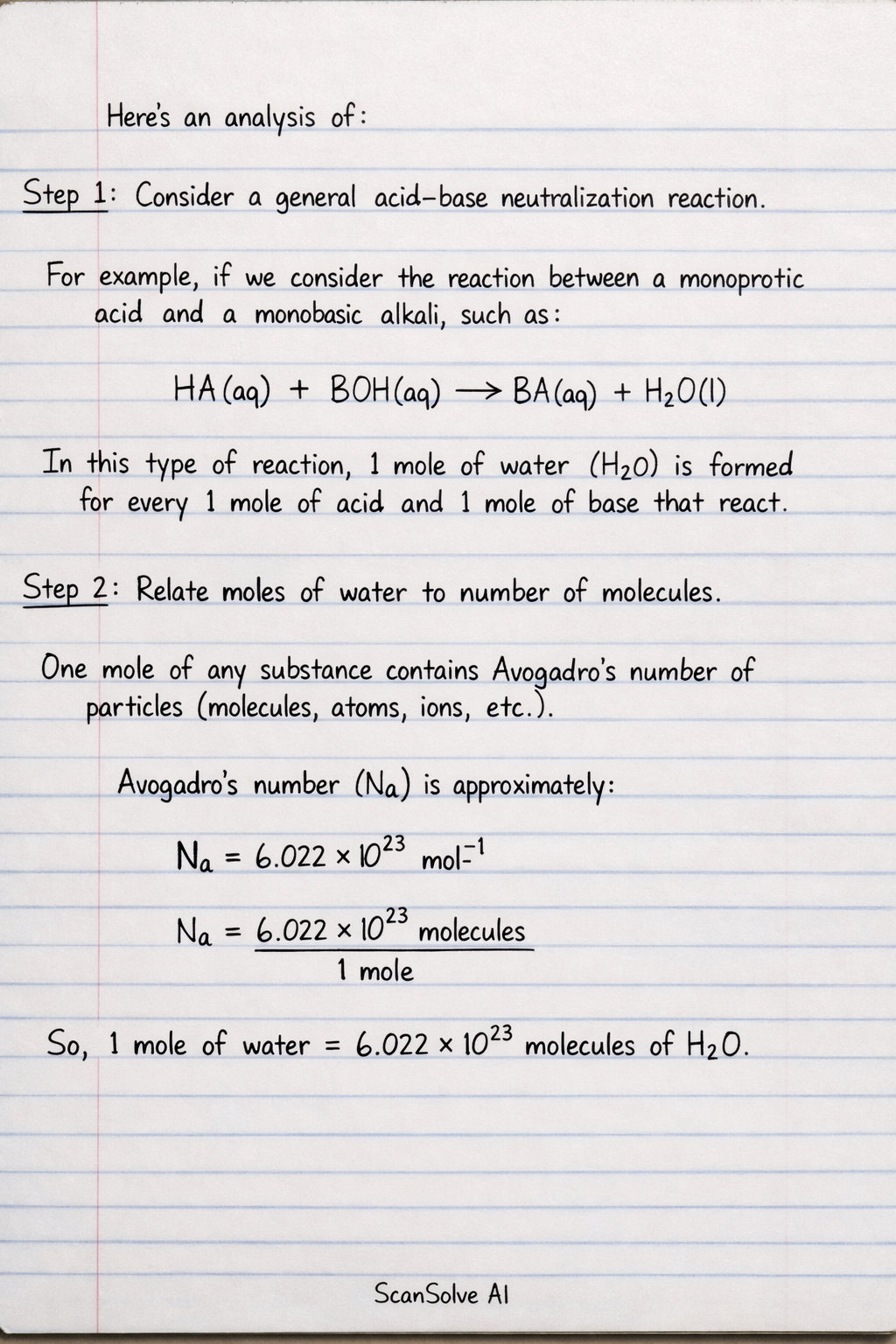
Consider a general acid-base neutralization reaction.
ScanSolve AI Answer
Answer
Step-by-step solution
3 stepsTo determine the number of water molecules formed in a reaction, we need the balanced chemical equation and the specific quantities (e.g., moles or mass) of the reactants involved. Since these details are not provided, I will assume a typical acid-base neutralization reaction where one mole of water is formed per mole of reaction.
Consider a general acid-base neutralization reaction.
For example, if we consider the reaction between a monoprotic acid and a monobasic alkali, such as:
In this type of reaction, 1 mole of water () is formed for every 1 mole of acid and 1 mole of base that react.
Relate moles of water to the number of molecules.
One mole of any substance contains Avogadro's number of particles (molecules, atoms, ions, etc.). Avogadro's number () is approximately .
Calculate the number of water molecules.
If 1 mole of water is formed in the reaction, then the number of water molecules formed is equal to Avogadro's number.
Therefore, if the reaction produces one mole of water, the number of water molecules formed is:
Try one yourself
A new problem that tests the same skill.
Still stuck on this one?
Ask a follow-up, and the answer starts from this question.
More Chemistry Questions
Handwritten Step-by-Step Solution
Get this as a handwritten image on WhatsApp — like a tutor wrote it for you.
Try on WhatsApp