
We read your photo as:
Consider investigation III. Identify the independent variable, explain the effect of reactant concentration on reaction rate using collision theory, and calculate the percentage purity of aluminum.
ScanSolve AI Answer
Answer
Step-by-step solution
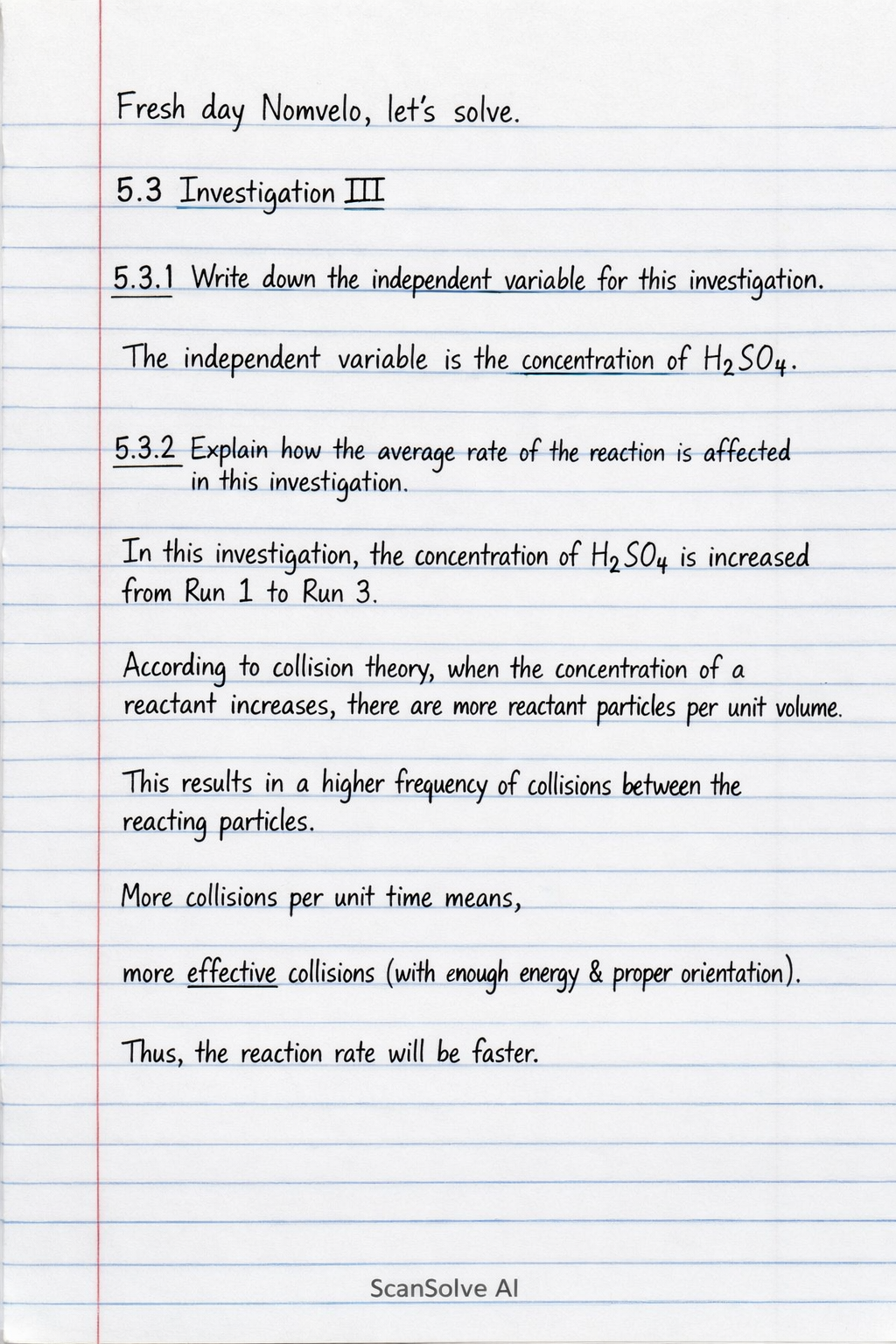
5 steps5.3 Investigation III
-
5.3.1 Write down the independent variable for this investigation. The independent variable is the factor that is intentionally changed by the experimenter to observe its effect. In this investigation, the concentration of is varied across the runs. The independent variable is the concentration of .
-
5.3.2 Use the collision theory to explain how the average rate of the reaction is affected in this investigation. In this investigation, the concentration of is increased from Run 1 to Run 3. According to collision theory, increasing the concentration of a reactant means there are more reactant particles per unit volume. This leads to a higher frequency of collisions between the reacting particles. Since more collisions occur per unit time, the frequency of effective collisions (collisions with sufficient energy and correct orientation) also increases, resulting in a faster reaction rate.
-
5.3.3 Calculate the percentage purity of the aluminium.
Calculate the total volume of gas produced in RUN 3.
The reaction time is given as 2.6 minutes. Convert this to seconds.
The average rate of production in RUN 3 is .
Calculate the moles of gas produced.
The molar gas volume at is given as .
Calculate the moles of pure Al reacted.
From the balanced chemical equation:
The mole ratio of Al to is .Calculate the mass of pure Al reacted.
The molar mass of Al is approximately .
Calculate the percentage purity of the aluminium.
The initial mass of the impure aluminium powder is .
Rounding to one decimal place:
Try one yourself
A new problem that tests the same skill.
Still stuck on this one?
Ask a follow-up, and the answer starts from this question.
More Chemistry Questions
Handwritten Step-by-Step Solution
Get this as a handwritten image on WhatsApp — like a tutor wrote it for you.
Try on WhatsApp