We read your photo as:

Consider the reduction potentials below: Pb2+(aq) + 2e^- <=> Pb(s) E° = -0.13 V and Mg2+(aq) + 2e^- <=> Mg(s) E° = -0.76 V. a) Write the overall Redox reaction that takes place when the above half cel

Chemistry

ScanSolve AI Answer

Answers

2 parts
a

Mg(s)+Pb2+(aq)→Mg2+(aq)+Pb(s)\text{Mg}(s) + \text{Pb}^{2+}(aq) \to \text{Mg}^{2+}(aq) + \text{Pb}(s)

b

0.63 V0.63 \text{ V}

Step-by-step solution

5 steps

here's the solution to question 5:

5. Consider the reduction potentials below:

  • Pb2+(aq)+2e−⇌Pb(s)\text{Pb}^{2+}(aq) + 2\text{e}^- \rightleftharpoons \text{Pb}(s) E∘=−0.13 V\text{E}^\circ = -0.13 \text{ V}
  • Mg2+(aq)+2e−⇌Mg(s)\text{Mg}^{2+}(aq) + 2\text{e}^- \rightleftharpoons \text{Mg}(s) E∘=−0.76 V\text{E}^\circ = -0.76 \text{ V}

Part a· 3 steps

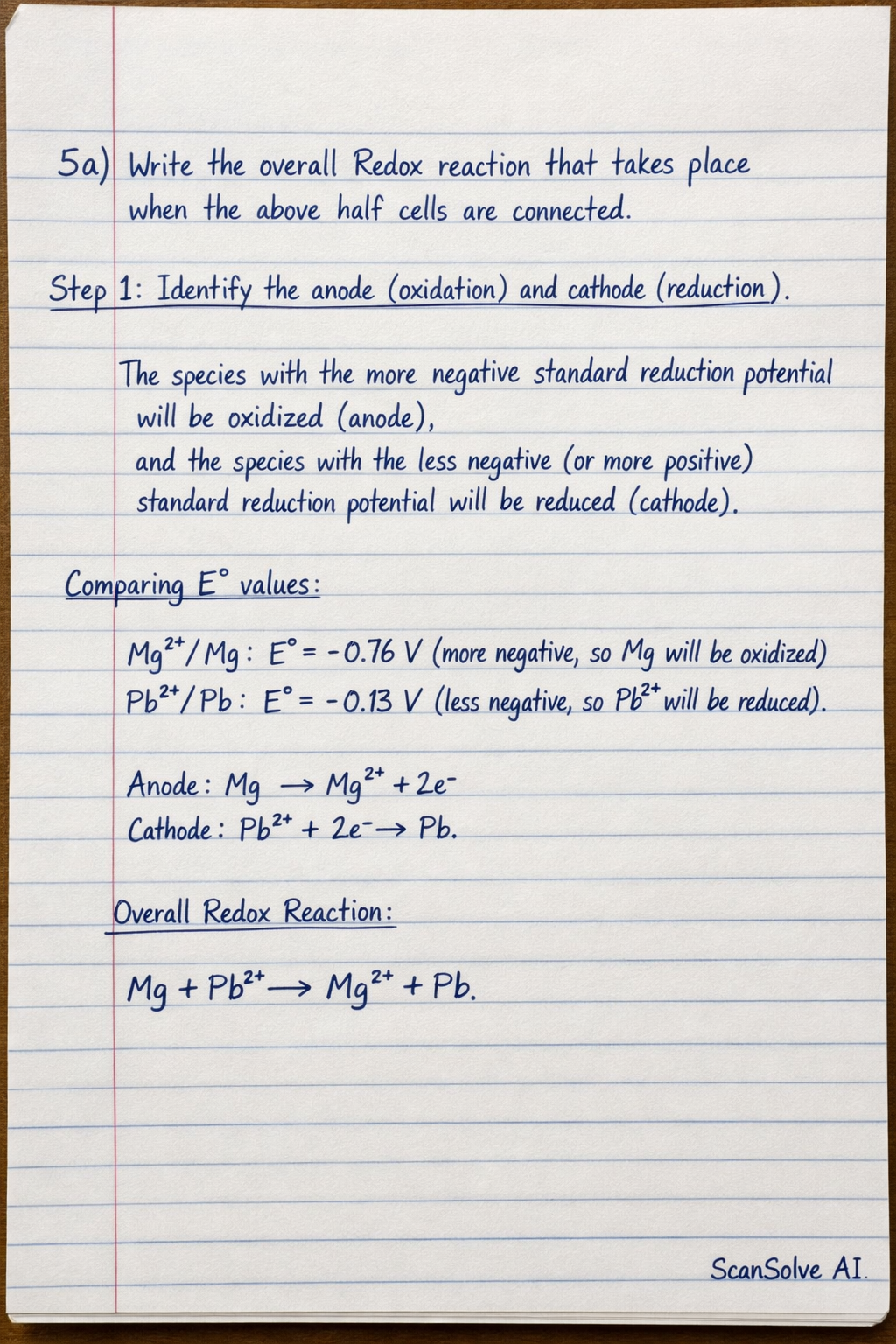
Write the overall Redox reaction that takes place when the above half cells are connected.

  1. Identify the anode (oxidation) and cathode (reduction).

    The species with the more negative standard reduction potential will be oxidized (anode), and the species with the less negative (or more positive) standard reduction potential will be reduced (cathode).
    Comparing E∘\text{E}^\circ values:

    • Mg2+/Mg\text{Mg}^{2+}/\text{Mg}: E∘=−0.76 V\text{E}^\circ = -0.76 \text{ V} (more negative, so Mg\text{Mg} will be oxidized)
    • Pb2+/Pb\text{Pb}^{2+}/\text{Pb}: E∘=−0.13 V\text{E}^\circ = -0.13 \text{ V} (less negative, so Pb2+\text{Pb}^{2+} will be reduced)
  2. Write the half-reactions.

    Oxidation (Anode): Mg(s)→Mg2+(aq)+2e−\text{Mg}(s) \to \text{Mg}^{2+}(aq) + 2\text{e}^-
    Reduction (Cathode): Pb2+(aq)+2e−→Pb(s)\text{Pb}^{2+}(aq) + 2\text{e}^- \to \text{Pb}(s)

  3. Combine the half-reactions to get the overall redox reaction.

    The electrons are already balanced.

    Mg(s)+Pb2+(aq)→Mg2+(aq)+Pb(s)\boxed{\text{Mg}(s) + \text{Pb}^{2+}(aq) \to \text{Mg}^{2+}(aq) + \text{Pb}(s)}

Part b

0.63 V0.63 \text{ V}

Determine the E∘\text{E}^\circ value of the above cell.

  1. Use the standard cell potential formula.

    Ecell∘=Ecathode∘−Eanode∘\text{E}^\circ_{cell} = \text{E}^\circ_{cathode} - \text{E}^\circ_{anode}

    Where:

    • Ecathode∘=E∘(Pb2+/Pb)=−0.13 V\text{E}^\circ_{cathode} = \text{E}^\circ(\text{Pb}^{2+}/\text{Pb}) = -0.13 \text{ V}
    • Eanode∘=E∘(Mg2+/Mg)=−0.76 V\text{E}^\circ_{anode} = \text{E}^\circ(\text{Mg}^{2+}/\text{Mg}) = -0.76 \text{ V}
  2. Substitute the values and calculate.

    Ecell∘=(−0.13 V)−(−0.76 V)\text{E}^\circ_{cell} = (-0.13 \text{ V}) - (-0.76 \text{ V}) Ecell∘=−0.13 V+0.76 V\text{E}^\circ_{cell} = -0.13 \text{ V} + 0.76 \text{ V} Ecell∘=0.63 V\text{E}^\circ_{cell} = 0.63 \text{ V}

    The E∘\text{E}^\circ value of the cell is 0.63 V\boxed{0.63 \text{ V}}

Part c

Calculate which group of the periodic table is element F?

More information is needed to answer this question about element F. There is no data provided for element F in the problem statement.

Was this helpful?

Try one yourself

A new problem that tests the same skill.

Still stuck on this one?

Ask a follow-up, and the answer starts from this question.

Got a different question?Ask your own question
Handwritten step-by-step solution preview

Handwritten Step-by-Step Solution

Get this as a handwritten image on WhatsApp — like a tutor wrote it for you.

Try on WhatsApp