
We read your photo as:
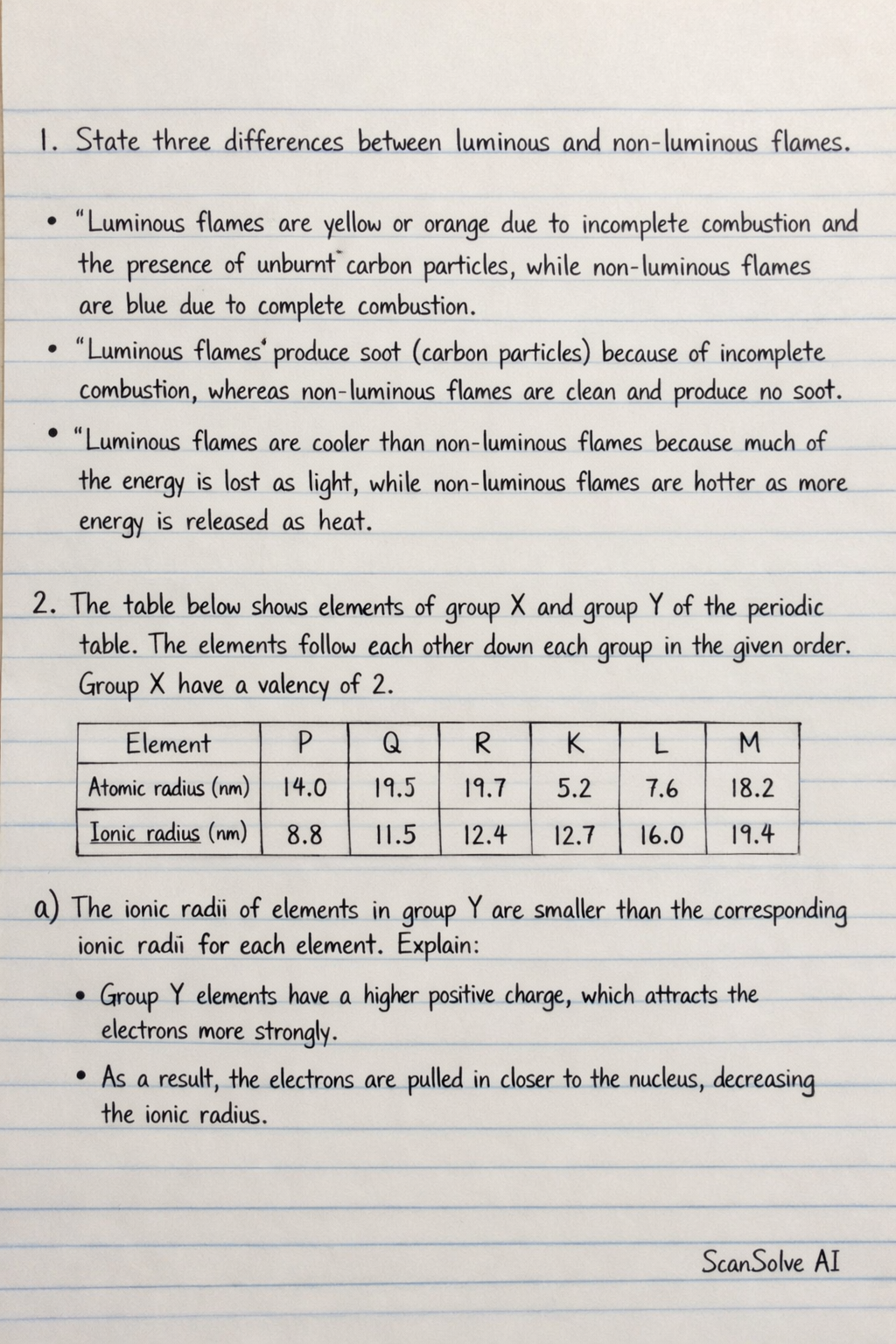
Explain the differences between luminous and non-luminous flames and why ionic radii are larger than atomic radii for Group Y elements.
ScanSolve AI Answer
Step-by-step solution
2 steps- State three differences between luminous and non-luminous flames.
- Luminous flames are yellow or orange due to incomplete combustion and the presence of unburnt carbon particles, while non-luminous flames are blue due to complete combustion.
- Luminous flames produce soot (carbon particles) because of incomplete combustion, whereas non-luminous flames are clean and produce no soot.
- Luminous flames are cooler than non-luminous flames because much of the energy is lost as light, while non-luminous flames are hotter as more energy is released as heat.
- The table below shows elements of group X and group Y of the periodic table. The elements follow each other down each group in the given order. Group X have a valency of 2.
| Element | P | Q | R | K | L | M |
|---|---|---|---|---|---|---|
| Atomic radius (nm) | 14.0 | 19.5 | 19.7 | 5.2 | 7.6 | 18.2 |
| Ionic radius (nm) | 8.8 | 11.5 | 12.4 | 12.7 | 16.00 | 19.4 |
Part a
The ionic radii of elements in group Y are smaller than the corresponding ionic radii for each element. Explain.
The statement in the question is incorrect based on the provided data. For elements in Group Y (K, L, M), the ionic radii are larger than their corresponding atomic radii. This occurs because Group Y elements are non-metals that gain electrons to form negatively charged ions (anions). The addition of electrons increases the electron-electron repulsion within the electron cloud, causing the electron cloud to expand and thus making the ionic radius larger than the atomic radius.
Part b
State the general name given to elements in group X.
The elements in Group X have a valency of 2 and their ionic radii are smaller than their atomic radii, indicating they are metals that lose two electrons to form cations. These elements are known as Alkaline Earth Metals.
Part c· 2 steps
Give the formula of the compound that would be formed between Q and L.
Determine the valency of Q.
Group X elements have a valency of 2. Therefore, Q forms a ion.
Determine the valency of L.
Elements in Group Y are non-metals (as their ionic radii are larger than their atomic radii). Common non-metals that react with Group 2 metals are often in Group 17 (halogens) or Group 16 (chalcogens). If L is a halogen (Group 17), it would have a valency of 1, forming an ion.
Still stuck on this one?
Ask a follow-up, and the answer starts from this question.
More Chemistry Questions
Handwritten Step-by-Step Solution
Get this as a handwritten image on WhatsApp — like a tutor wrote it for you.
Try on WhatsApp