
We read your photo as:
A) The atomic radii of elements in group Y are smaller than the corresponding ionic radii for each element. Explain. b) State the general name given to elements
ScanSolve AI Answer
Step-by-step solution
2 stepsHere are the solutions to the questions:
Part 2
Part a· 2 steps
The atomic radii of elements in group Y are smaller than the corresponding ionic radii for each element. Explain.
Observe the relationship between atomic and ionic radii for Group Y.
For elements K, L, and M in Group Y, the ionic radius is larger than the atomic radius.
Explain why this occurs.
This indicates that elements in Group Y gain electrons to form anions. When an atom gains electrons, the increased electron-electron repulsion and the decreased effective nuclear charge per electron cause the electron cloud to expand, resulting in a larger ionic radius compared to its atomic radius.
Part b
State the general name given to elements
Still stuck on this one?
Ask a follow-up, and the answer starts from this question.
More Chemistry Questions
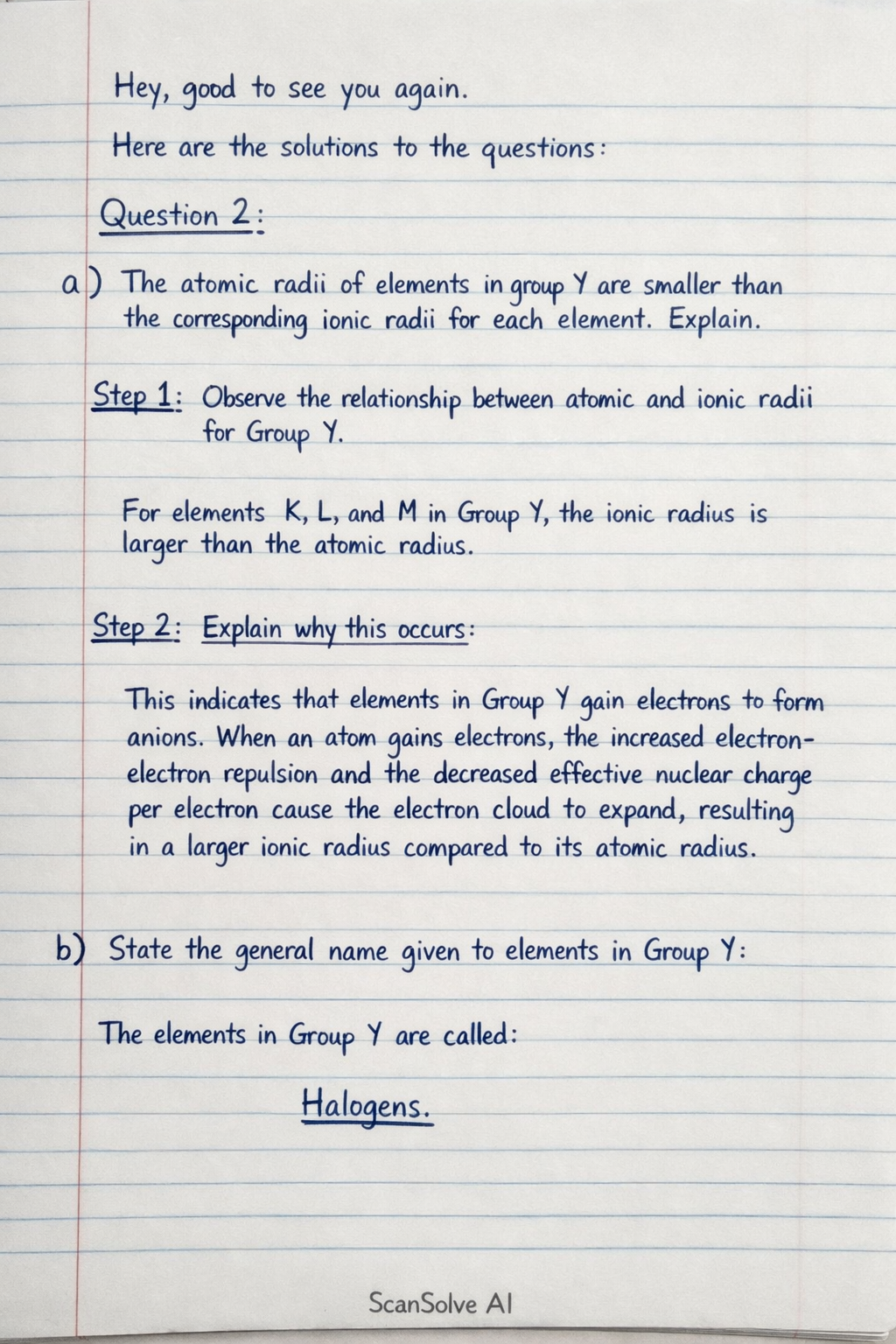
Handwritten Step-by-Step Solution
Get this as a handwritten image on WhatsApp — like a tutor wrote it for you.
Try on WhatsApp