
We read your photo as:
Discuss the unique placement of hydrogen in the periodic table, detailing its similarities and differences with Group 1 elements and Group 17 elements.
ScanSolve AI Answer
here is the solution to Q1 and Q2.
Q1. The properties of hydrogen are unique, leading to its placement in a separate position in the periodic table, though it shares characteristics with both Group 1 and Group 17 elements.
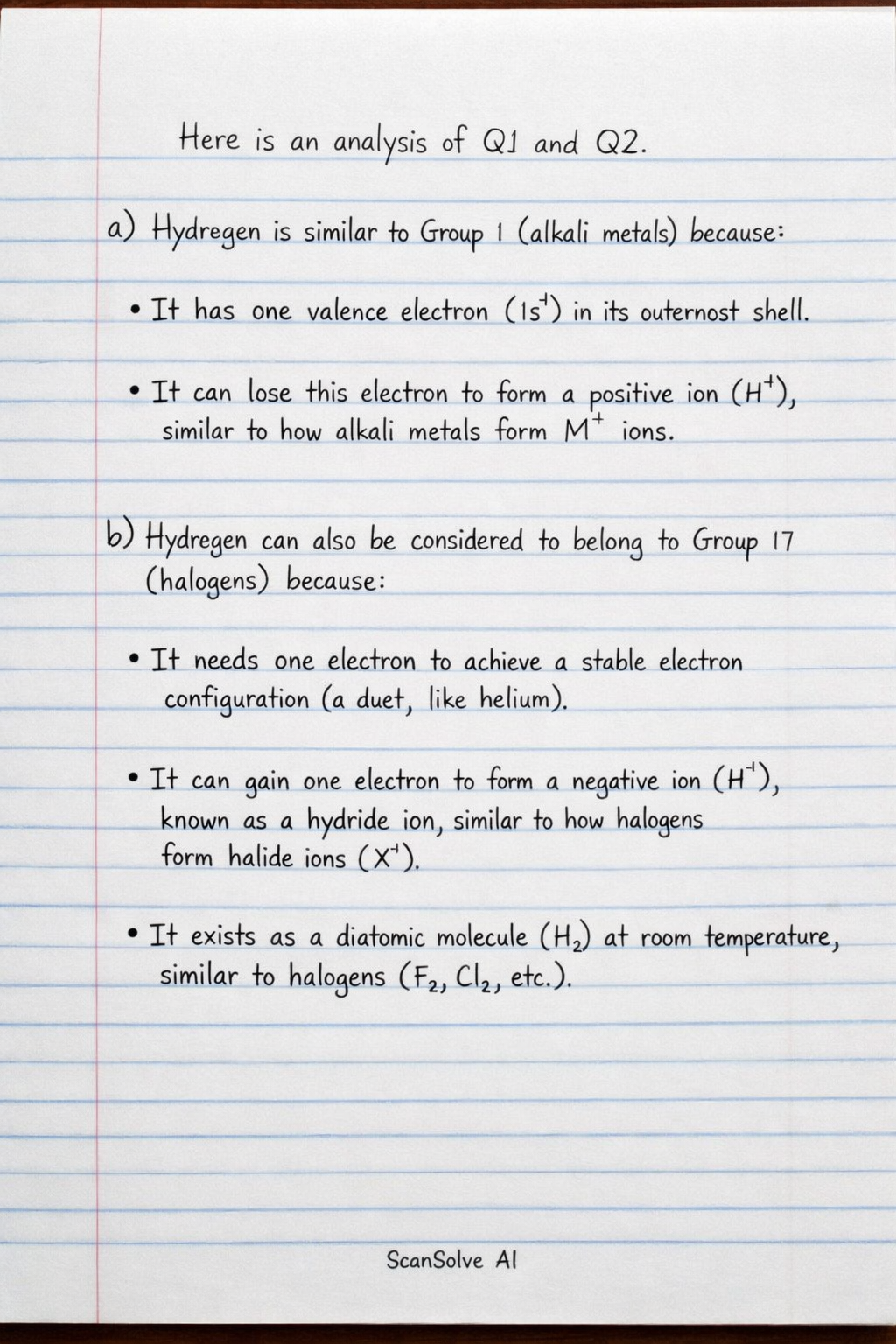
a) Hydrogen is similar to Group 1 (alkali metals) because:
- It has one valence electron () in its outermost shell.
- It can lose this electron to form a positive ion (), similar to how alkali metals form ions.
b) Hydrogen can also be considered to belong to Group 17 (halogens) because:
- It needs one electron to achieve a stable electron configuration (a duet, like helium).
- It can gain one electron to form a negative ion (), known as a hydride ion, similar to how halogens form halide ions ().
- It exists as a diatomic molecule () at room temperature, similar to halogens (, , etc.).
c) Hydrogen does not fully fit into Group 17 because:
- Unlike halogens, hydrogen has a much lower electronegativity and a weaker tendency to gain electrons.
- Hydrogen's ion is a bare proton, which is extremely reactive and does not exist freely in aqueous solutions, unlike the larger, less reactive alkali metal cations.
- Hydrogen forms predominantly covalent bonds, whereas halogens readily form ionic bonds with metals.
Q2.
a) The basis of the electropositive nature of Group 1 elements (alkali metals) is their strong tendency to lose electrons and form positive ions. This is due to:
- Having only one valence electron in their outermost shell.
- Possessing large atomic radii and relatively low ionization energies. These factors make it energetically favorable for them to readily donate their single valence electron to achieve a stable noble gas electron configuration, resulting in a +1 oxidation state.
b) The differentiation between Group 1 and Group 2 elements is as follows:
- Valence Electrons: Group 1 elements have one valence electron, while Group 2 elements have two valence electrons.
- Oxidation State: Group 1 elements typically form ions with a +1 oxidation state, whereas Group 2 elements form ions with a +2 oxidation state.
- Reactivity: Group 1 elements are generally more reactive than Group 2 elements due to their lower first ionization energies.
- Hardness and Density: Group 1 metals are typically softer and less dense than Group 2 metals.
Still stuck on this one?
Ask a follow-up, and the answer starts from this question.
More Chemistry Questions
Handwritten Step-by-Step Solution
Get this as a handwritten image on WhatsApp — like a tutor wrote it for you.
Try on WhatsApp