
We read your photo as:
Distinguish between physical and chemical changes and provide examples of each.
Chemistry
ScanSolve AI Answer
here's the answer to question 4:
A physical change is a type of change in which the form of matter is altered but its chemical identity remains the same. No new substances are formed, and the change is often reversible.
A chemical change (or chemical reaction) is a type of change in which one or more substances are converted into different substances with new chemical properties. New substances are formed, and the change is generally irreversible.
Here's a differentiation with examples:
-
Physical Change:
- Definition: Alters the form or appearance of a substance but does not change its chemical composition.
- Key characteristic: No new substance is formed.
- Example: Melting ice. When ice (solid water) melts, it becomes liquid water. Both are still , just in a different physical state. Other examples include dissolving sugar in water, cutting paper, or boiling water.
-
Chemical Change:
- Definition: Results in the formation of one or more new substances with different chemical properties.
- Key characteristic: New substances are formed.
- Example: Burning wood. When wood burns, it reacts with oxygen to produce ash, carbon dioxide, and water vapor. These are entirely new substances with different properties from the original wood. Other examples include rusting of iron, cooking an egg, or digestion of food.
Was this helpful?
Still stuck on this one?
Ask a follow-up, and the answer starts from this question.
Got a different question?Ask your own question
More Chemistry Questions
QState the difference between "physical change" and "chemical change" and provide examples for each.QState the difference between physical change and chemical changeQWhich of the following processes involves both a chemical and a physical change?QDistinguish between physical and chemical changes. Differentiate between reversible changes and…QIdentify and differentiate between physical and chemical changes, define atomicity, and explain…
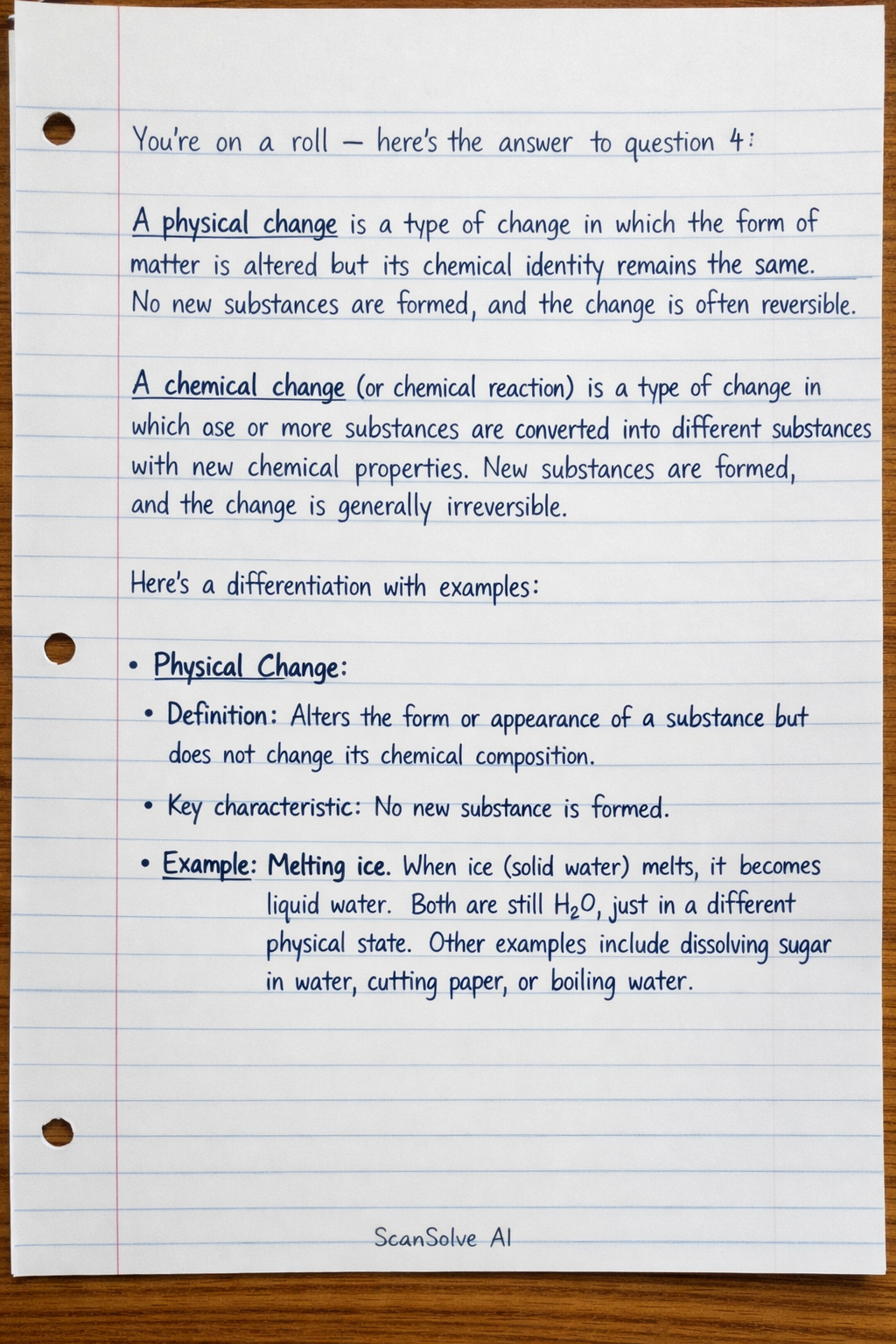
Handwritten Step-by-Step Solution
Get this as a handwritten image on WhatsApp — like a tutor wrote it for you.
Try on WhatsApp