

This chemistry question involves key chemical concepts and calculations. The detailed solution below walks through each step, from identifying the reaction type to computing the final answer.
ScanSolve AI Answer
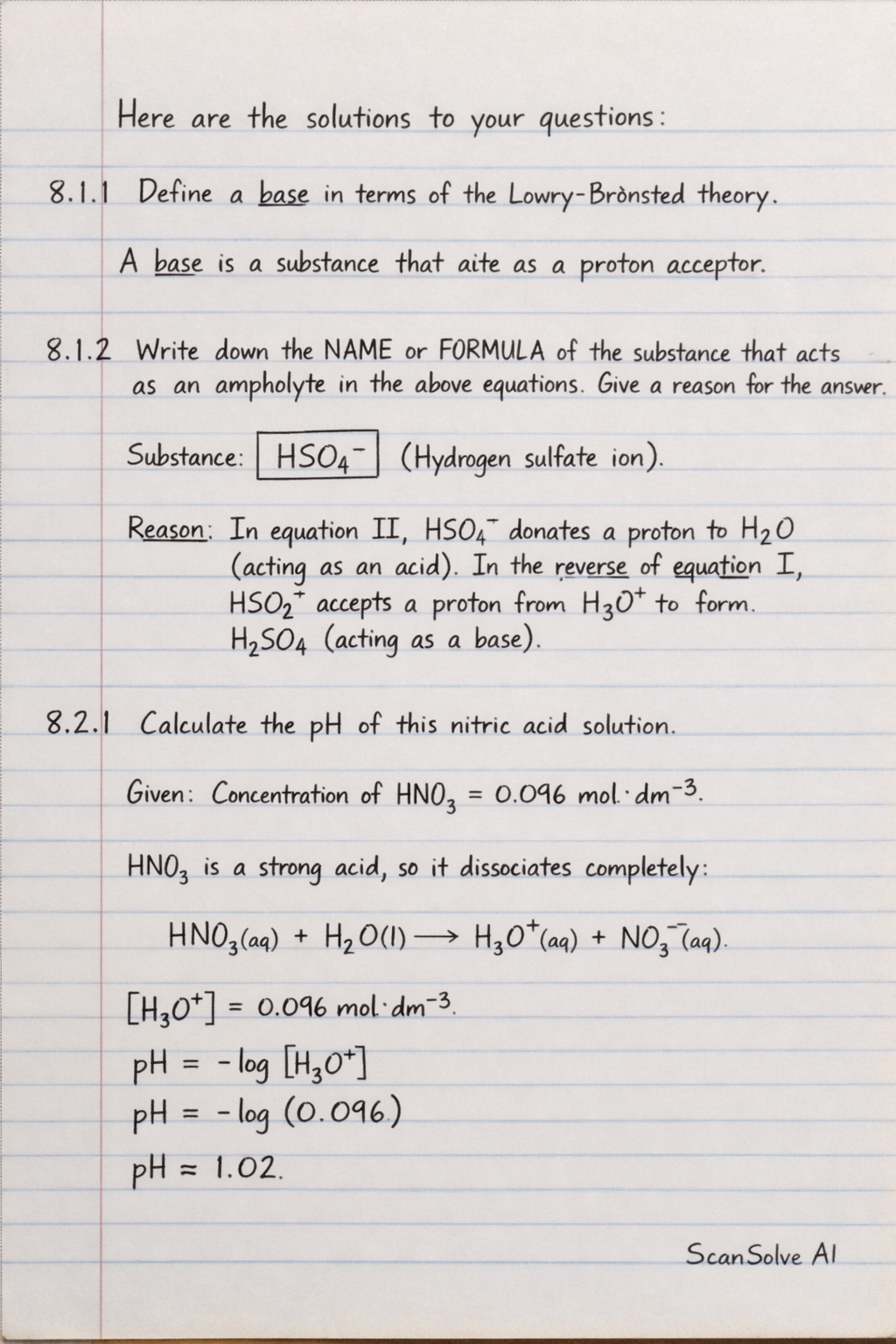
Here are the solutions to your questions: 8.1.1 Define a base in terms of the Lowry-Brønsted theory. A base is a substance that acts as a proton acceptor. 8.1.2 Write down the NAME or FORMULA of the substance that acts as an ampholyte in the above equations. Give a reason for the answer. Substance: HSO_4^- (Hydrogen sulfate ion) Reason: In equation II, HSO_4^- donates a proton to H_2O (acting as an acid). In the reverse of equation I, HSO_4^- accepts a proton from H_3O^+ to form H_2SO_4 (acting as a base). 8.2.1 Calculate the pH of this nitric acid solution. Given: Concentration of HNO_3 = 0.096 mol·dm^-3. HNO_3 is a strong acid, so it dissociates completely: HNO_3(aq) + H_2O(l) → H_3O^+(aq) + NO_3^-(aq) Step 1: Determine the concentration of hydronium ions. Since HNO_3 is a strong acid, [H_3O^+] = [HNO_3]. [H_3O^+] = 0.096 mol·dm^-3 Step 2: Calculate the pH. pH = -[H_3O^+] pH = -(0.096) pH ≈ 1.02 8.2.2 Calculate the concentration of the EXCESS HNO_3 in the new solution. Balanced equation: 2HNO_3(aq) + Na_2CO_3(aq) → 2NaNO_3(aq) + CO_2(g) + H_2O(l) Given: Volume of HNO_3 (V_A) = 50 cm^3 = 0.050 dm^3 Concentration of HNO_3 (C_A) = 0.096 mol·dm^-3 Volume of Na_2CO_3 (V_B) = 25 cm^3 = 0.025 dm^3 Concentration of Na_2CO_3 (C_B) = 0.075 mol·dm^-3 Step 1: Calculate the initial moles of HNO_3. n(HNO_3)_initial = C_A × V_A n(HNO_3)_initial = (0.096 mol·dm^-3) × (0.050 dm^3) n(HNO_3)_initial = 0.0048 mol Step 2: Calculate the initial moles of Na_2CO_3. n(Na_2CO_3)_initial = C_B × V_B n(Na_2CO_3)_initial = (0.075 mol·dm^-3) × (0.025 dm^3) n(Na_2CO_3)_initial = 0.001875 mol Step 3: Determine the moles of HNO_3 that react with Na_2CO_3. From the balanced equation, the mole ratio HNO_3 : Na_2CO_3 is 2:1. n(HNO_3)_reacted = 2 × n(Na_2CO_3)_initial n(HNO_3)_reacted = 2 × 0.001875 mol n(HNO_3)_reacted = 0.00375 mol Since n(HNO_3)_initial (0.0048 mol) > n(HNO_3)_reacted (0.00375 mol), HNO_3 is in excess. Step 4: Calculate the moles of excess HNO_3. n(HNO_3)_excess = n(HNO_3)_initial - n(HNO_3)_reacted n(HNO_3)_excess = 0.0048 mol - 0.00375 mol n(HNO_3)_excess = 0.00105 mol Step 5: Calculate the total volume of the new solution. V_total = V_A + V_B V_total = 0.050 dm^3 + 0.025 dm^3 V_total = 0.075 dm^3 Step 6: Calculate the concentration of the excess HNO_3. C(HNO_3)_excess = n(HNO_3)_excessV_total C(HNO_3)_excess = 0.00105 mol0.075 dm^3 C(HNO_3)_excess = 0.014 mol·dm^-3 3 done, 2 left today. You're making progress.