
We read your photo as:
Draw a Lewis structure for OCl-, Ethane, C2H4. Predict the Geometry of NH4+. State the hybridization of Nitrogen in NH3. Give the number of pi and sigma bonds in NH3, NO2, N2. Draw structural formula of 3-isobutylhexane, 2,3,3-trimethyl-2-hexene.
ScanSolve AI Answer
This answer stops before the end.
It was cut off when it was first written. Ask ScanSolve this question again for the full working.
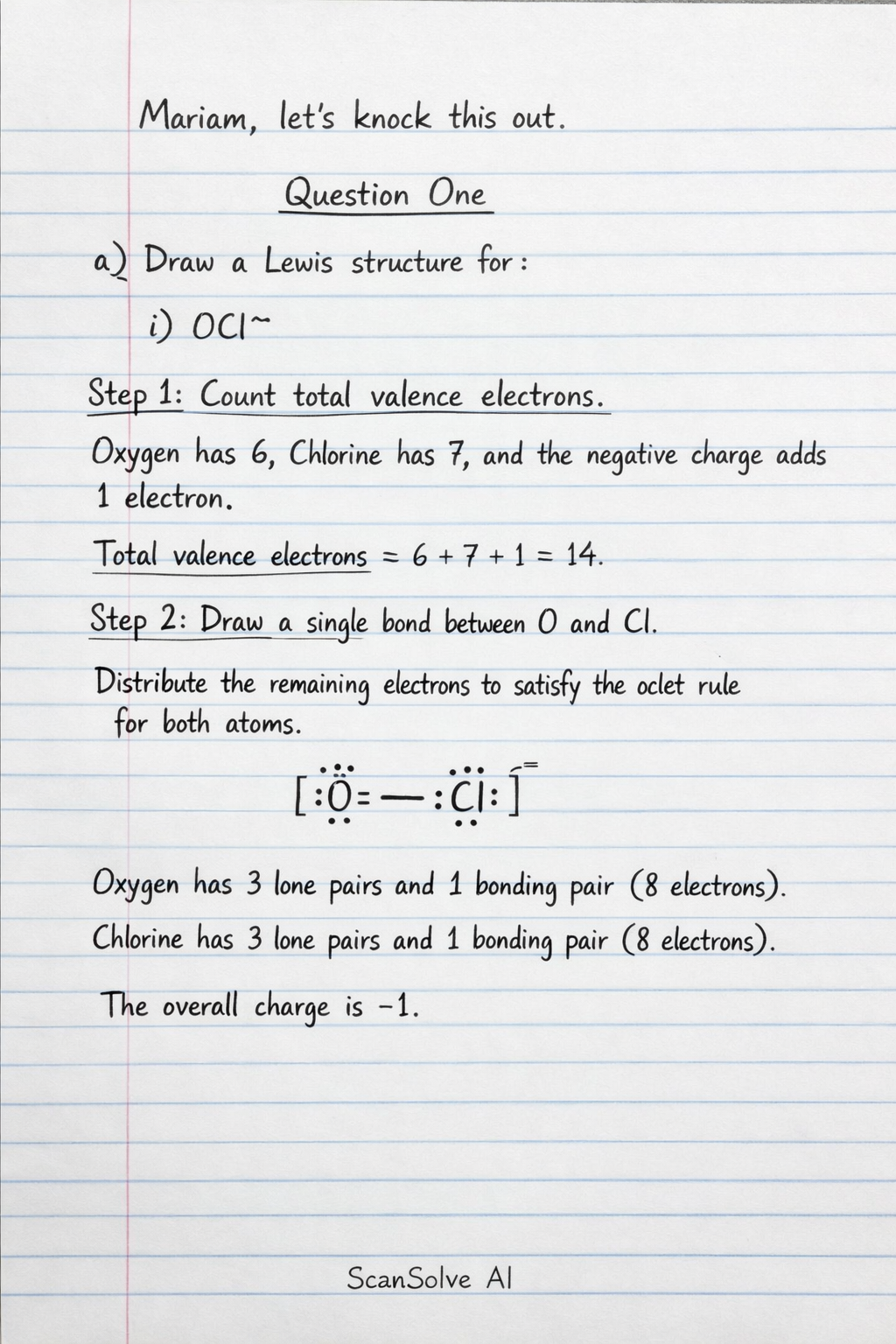
Question One
a) Draw a Lewis structure for:
i) OCl⁻
Step 1: Count total valence electrons. Oxygen has 6, Chlorine has 7, and the negative charge adds 1 electron.
Total valence electrons = .
Step 2: Draw a single bond between O and Cl. Distribute the remaining electrons to satisfy the octet rule for both atoms.
The oxygen atom has 3 lone pairs and 1 bonding pair (8 electrons). The chlorine atom has 3 lone pairs and 1 bonding pair (8 electrons). The overall charge is -1.
ii) Ethane, C₂H₄
Assumption: The formula C₂H₄ refers to ethene, not ethane (which is C₂H₆).
Step 1: Count total valence electrons. Each Carbon has 4, each Hydrogen has 1.
Total valence electrons = .
Step 2: Connect the two carbon atoms and then connect each carbon to two hydrogen atoms.
Step 3: Form a double bond between the carbon atoms to satisfy the octet rule for both carbons, as each carbon needs 8 electrons.
Each carbon atom forms two single bonds with hydrogen atoms and one double bond with the other carbon atom, satisfying the octet rule. Each hydrogen atom has 2 electrons.
b) Predict the Geometry of NH₄⁺
Step 1: Determine the central atom (Nitrogen) and count its valence electrons (5). Each Hydrogen contributes 1 electron. The positive charge means one electron is removed.
Total valence electrons = .
Step 2: Nitrogen forms single bonds with four hydrogen atoms. This uses electrons.
Step 3: Nitrogen has no lone pairs. There are 4 bonding pairs around the central nitrogen atom.
Step 4: According to VSEPR theory, 4 electron domains (all bonding pairs) result in a tetrahedral electron geometry and molecular geometry.
The geometry of NH₄⁺ is tetrahedral.
c) State the hybridization of Nitrogen in NH₃
Step 1: Determine the central atom (Nitrogen) and count its valence electrons (5). Each Hydrogen contributes 1 electron.
Total valence electrons = .
Step 2: Nitrogen forms single bonds with three hydrogen atoms, using 6 electrons. The remaining electrons form one lone pair on the nitrogen atom.
Step 3: Count the number of electron domains around the central nitrogen atom: 3 bonding pairs (to H atoms) + 1 lone pair = 4 electron domains.
Step 4: A central atom with 4 electron domains is sp³ hybridized.
The hybridization of Nitrogen in NH₃ is sp³.
d) Give the number of pi () and sigma () bonds in:
i) NH₃
Step 1: Draw the Lewis structure for NH₃. Nitrogen forms three single bonds with hydrogen atoms and has one lone pair.
Step 2: Each single bond is a sigma () bond. There are no double or triple bonds.
Number of bonds = 3
Number of bonds = 0
ii) NO₂
Assumption: This refers to the neutral nitrogen dioxide molecule, NO₂.
Step 1: Draw the Lewis structure for NO₂. Nitrogen is the central atom, forming one double bond with an oxygen atom, one single bond with another oxygen atom, and has one unpaired electron.
Step 2: A single bond contains one bond. A double bond contains one bond and one bond.
Number of bonds = 2 (one for N-O, one for N=O)
Number of bonds = 1 (from the N=O double bond)
iii) N₂
Step 1: Draw the Lewis structure for N₂. The two nitrogen atoms are connected by a triple bond, and each nitrogen has one lone pair.
Step 2: A triple bond consists of one bond and two bonds.
Number of bonds = 1
Number of bonds = 2
Question Two
a) Draw structural formula of 3-isobutylhexane
Step 1: Identify the parent chain: hexane, which means 6 carbon atoms in a straight chain.
Step 2: Identify the substituent: isobutyl group, which is .
Step 3: Attach the isobutyl group to the 3rd carbon of the hexane chain.
Or, drawn out:
Still stuck on this one?
Ask a follow-up, and the answer starts from this question.
More Chemistry Questions
Handwritten Step-by-Step Solution
Get this as a handwritten image on WhatsApp — like a tutor wrote it for you.
Try on WhatsApp