
We read your photo as:
Draw cross-and-dot diagrams for the ionic compounds KF, Na₂O, and MgO.
ScanSolve AI Answer
This answer stops before the end.
It was cut off when it was first written. Ask ScanSolve this question again for the full working.
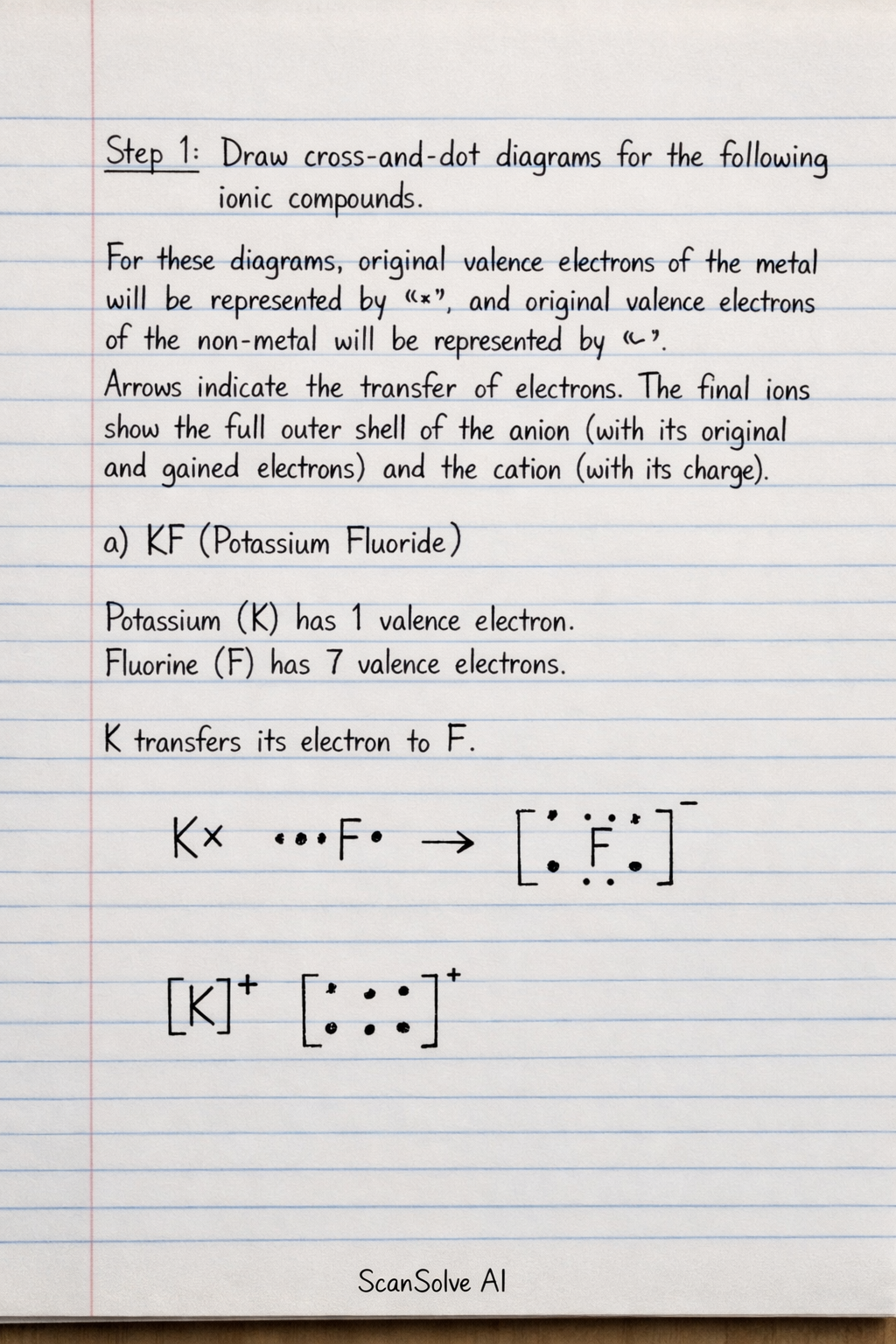
Step 1: Draw cross-and-dot diagrams for the following ionic compounds.
For these diagrams, original valence electrons of the metal will be represented by , and original valence electrons of the non-metal will be represented by . Arrows indicate the transfer of electrons. The final ions show the full outer shell of the anion (with its original and gained electrons) and the cation (with its charge).
a) KF (Potassium Fluoride)
Potassium (K) has 1 valence electron. Fluorine (F) has 7 valence electrons. K transfers its electron to F.
b) Na₂O (Sodium Oxide)
Sodium (Na) has 1 valence electron. Oxygen (O) has 6 valence electrons. Two Na atoms each transfer 1 electron to one O atom.
c) MgO (Magnesium Oxide)
Magnesium (Mg) has 2 valence electrons. Oxygen (O) has 6 valence electrons. Mg transfers its 2 electrons to O.
d) CaCl₂ (Calcium Chloride)
Calcium (Ca) has 2 valence electrons. Chlorine (Cl) has 7 valence electrons. Ca transfers 1 electron to each of two Cl atoms.
e) Li₃N (Lithium Nitride)
Lithium (Li) has 1 valence electron. Nitrogen (N) has 5 valence electrons. Three Li atoms each transfer 1 electron to one N atom.
f) AlCl₃ (Aluminum Chloride)
Aluminum (Al) has 3 valence electrons. Chlorine (Cl) has 7 valence electrons. Al transfers 1 electron to each of three Cl atoms.
Still stuck on this one?
Ask a follow-up, and the answer starts from this question.
More Chemistry Questions
Handwritten Step-by-Step Solution
Get this as a handwritten image on WhatsApp — like a tutor wrote it for you.
Try on WhatsApp