
We read your photo as:
During distillation, the vapour is cooled and changes back into liquid. What is this change of state called?
ScanSolve AI Answer
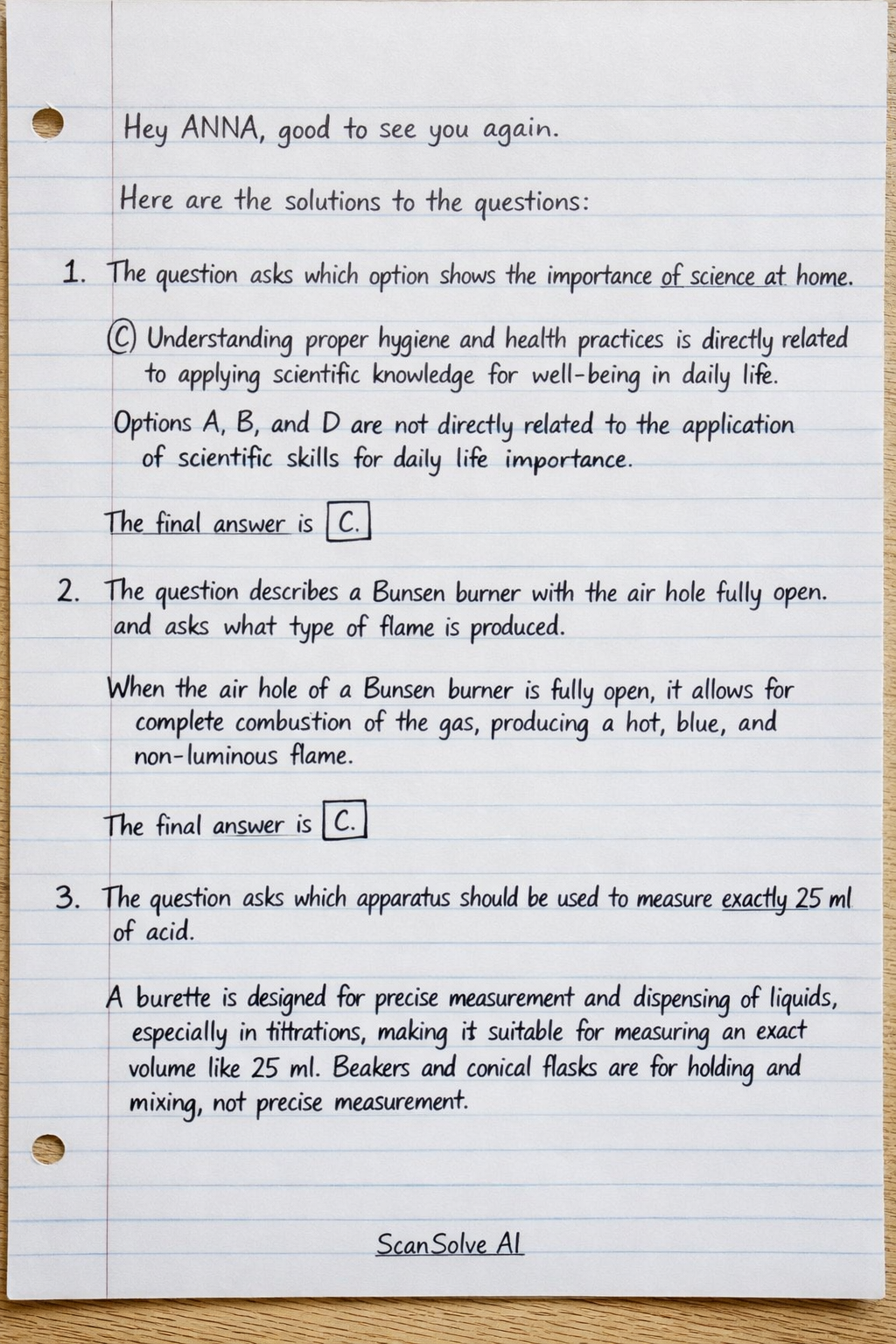
Here are the solutions to the questions:
1. The question asks which option shows the importance of science at home.
- C) Understanding proper hygiene and health practices is directly related to applying scientific knowledge for well-being in daily life.
- Options A, B, and D are not directly related to the application of scientific skills for daily life importance.
The final answer is
2. The question describes a Bunsen burner with the air hole fully open and asks what type of flame is produced.
- When the air hole of a Bunsen burner is fully open, it allows for complete combustion of the gas, producing a hot, blue, and non-luminous flame.
The final answer is
3. The question asks which apparatus should be used to measure exactly 25 ml of acid.
- A burette is designed for precise measurement and dispensing of liquids, especially in titrations, making it suitable for measuring an exact volume like 25 ml. Beakers and conical flasks are for holding and mixing, not precise measurement.
The final answer is
4. The question asks for the most appropriate method to separate iron filings and sand.
- Iron is a magnetic material, while sand is not. Therefore, using a magnet is the most effective and appropriate method to separate them.
The final answer is
5. The question asks what hazard a skull and crossbones symbol on a chemical container indicates.
- The skull and crossbones symbol is an internationally recognized warning sign for poisonous or toxic substances, indicating that the material can cause death or serious injury if ingested, inhaled, or absorbed through the skin.
The final answer is
6. The question describes a situation where a classmate spilled a chemical and got a burn, and asks for the most likely cause.
- Carelessness while handling chemicals is the most common cause of accidents like spills and burns in a laboratory setting. The other options describe good practices or a general safety measure, not a cause of an accident.
The final answer is
7. The question asks why laboratory safety rules should be followed.
- B) To avoid accidents and maintain a healthy environment is the primary reason for following safety rules in a laboratory. Safety rules are put in place to protect individuals from harm and ensure a safe working space.
The final answer is
8. The question describes distillation where vapor is cooled and changes back into liquid, and asks for the name of this change of state.
- The process where a gas (vapor) loses heat and changes back into a liquid is called condensation.
The final answer is
9. The question asks which observation shows that a substance is acidic when tested with litmus paper.
- Acids turn blue litmus paper red. If red litmus paper remains red, it could be an acid or neutral. If red litmus paper turns blue, it's a base. If both remain unchanged, it's neutral.
The final answer is
10. The question asks which option shows the use of a base in daily life.
- C) Soap used for cleaning clothes is an example of a base. Soaps are typically alkaline (basic) and are effective in removing grease and dirt. Vinegar, lemon juice, and orange juice are all acidic.
The final answer is
11. The question asks which waste is not excreted by the skin.
- The skin excretes water (as sweat), excess salts (in sweat), and some urea (in sweat). Carbon dioxide is primarily excreted by the lungs during respiration, not the skin.
The final answer is
Still stuck on this one?
Ask a follow-up, and the answer starts from this question.
More Chemistry Questions
Handwritten Step-by-Step Solution
Get this as a handwritten image on WhatsApp — like a tutor wrote it for you.
Try on WhatsApp